Best Telescopes Under £200 in the UK
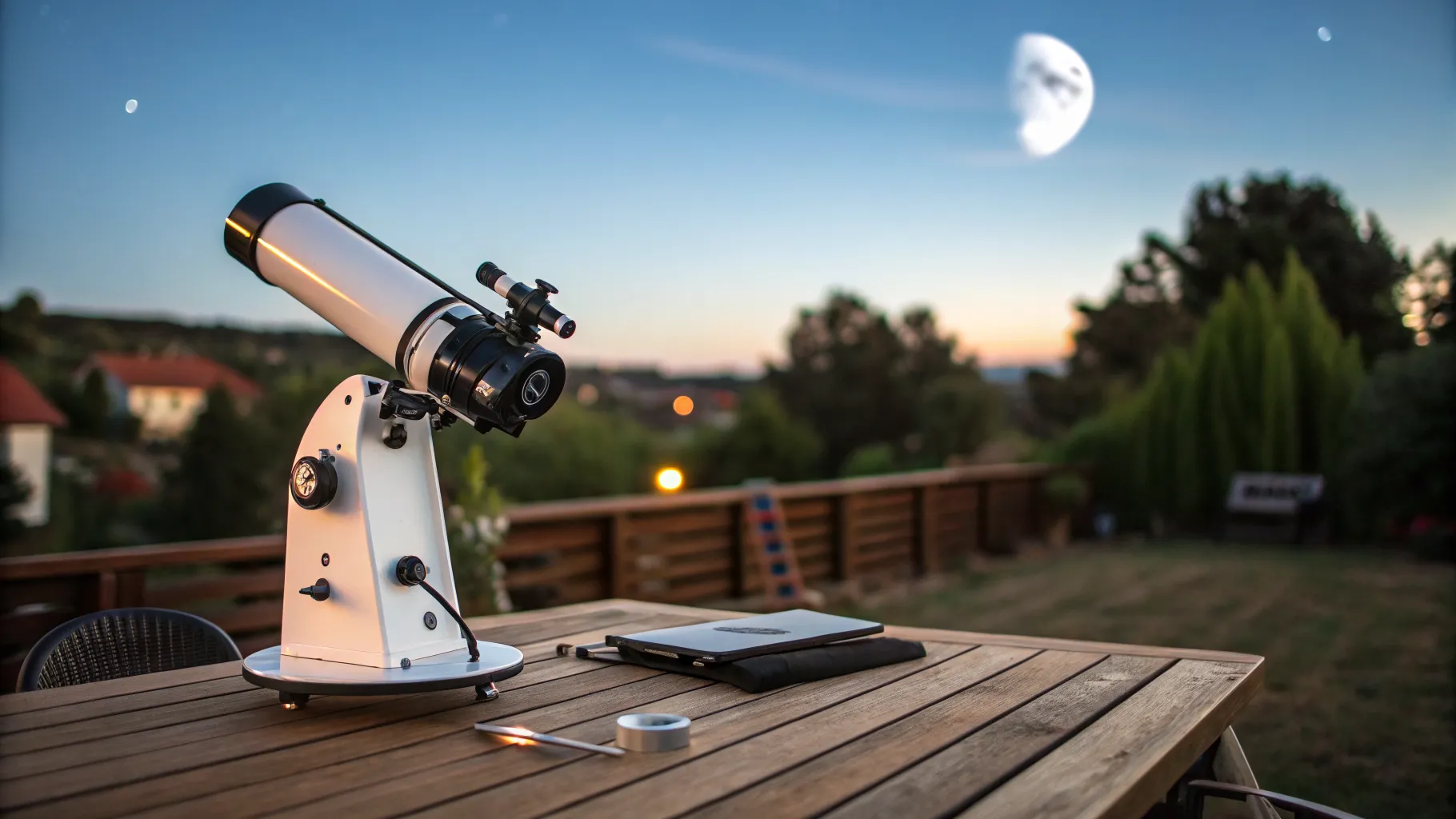
If you have £200 to spend on a telescope in the UK right now, buy the Sky-Watcher Heritage 130P FlexTube. It sits right at the top of the budget at First Light Optics, and nothing else under £200 gathers as much light or shows as much sky. If you want to spend less, the smaller Heritage 100P does most of the same job in the £125 to £145 bracket.
Everything here was checked against named UK retailers in June 2026: First Light Optics (FLO) and Rother Valley Optics (RVO). No models that quietly crept over budget, and no Amazon-special refractors promising 575x magnification on a tripod made of hope.
The short version
- Best overall under £200: Sky-Watcher Heritage 130P FlexTube tabletop Dobsonian
- Best cheap telescope: Sky-Watcher Heritage 100P tabletop Dobsonian
- Best on a full-height tripod: Sky-Watcher Skyhawk 114
- For learning an equatorial mount: Sky-Watcher Explorer 130 EQ2
- App-guided wildcard: Celestron StarSense Explorer LT 70AZ, if you find it under £200
How we chose
Three rules drove this list. First, every pick had to be verifiably under £200 at a real UK telescope retailer at the time of writing, not “under £200 if you catch a flash sale”. Second, aperture beats everything else at this price: the diameter of the main mirror or lens decides how much light you collect, which decides what you see. A 130mm mirror gathers roughly 30 per cent more light than a 114mm one, the difference between Saturn’s rings looking crisp and looking smudged. Third, the mount has to be simple; far more beginners are defeated by an equatorial mount they never learned to set up than by their telescope, so alt-azimuth and Dobsonian mounts dominate here.
We also penalised what rival lists gloss over: discontinued brands still being recommended (Orion ceased US operations in 2024), 60mm department-store refractors that enthusiasts uniformly pan, and lists padded with telescopes costing £230 or more in the UK. For the general theory first, our guide on how to buy a telescope in the UK covers aperture, focal ratios and mounts from scratch.
The picks
Sky-Watcher Heritage 130P FlexTube
Who it’s for: anyone who wants the most telescope £200 buys in Britain.
The Heritage 130P is a tabletop Dobsonian: a 130mm parabolic mirror with a 650mm focal length (f/5) in a collapsible FlexTube, on a simple wooden alt-azimuth base. You plonk it down, swing it to your target, and look. It ships with 25mm and 10mm eyepieces giving 26x and 65x, plus a red dot finder, and weighs about 6.2kg; the collapsing tube means it stores on a shelf. Sky-Watcher’s official Heritage 130P page lists the highest practical magnification at an honest 260x.
What does 130mm of aperture show from a UK garden? Saturn’s rings clearly, Jupiter’s four bright moons and its main cloud bands, the phases of Venus, Mars’s polar cap when the planet is close, endless detail on the Moon, the Orion Nebula in winter, and the brighter star clusters year round.
Drawbacks: the open FlexTube design lets stray light in, so a homemade light shroud helps in town, and as a tabletop scope it needs something sturdy to stand on (more below). At the time of writing FLO listed it at around £190 to £200 with short restock waits. Check current price.
Sky-Watcher Heritage 100P
Who it’s for: tight budgets, kids, and anyone who values grab-and-go over maximum aperture.
The 100P is the 130P’s little sibling: a 100mm parabolic mirror, 400mm focal length at f/4, with 25mm and 10mm eyepieces plus a 2x Barlow in the box. It weighs about 2.8kg, light enough for a child to carry out to the garden, and a 3/8 inch thread underneath lets it bolt onto a sturdy photo tripod. At the £125 to £145 bracket it is the cheapest telescope here we would actually recommend, and FLO had it in stock when we checked.
You give up some light grasp against the 130P, but the Moon, Jupiter, Saturn and the bright showpiece objects are all comfortably within reach. The fast f/4 mirror is less forgiving of cheap eyepieces, so an eyepiece upgrade later makes a real difference. For a child’s first scope it is a far better buy than anything in a toy shop. Check current price.
Sky-Watcher Skyhawk 114
Who it’s for: beginners who specifically want a full-height tripod rather than a tabletop base.
The Skyhawk 114 is a 4.5 inch (114mm) Newtonian reflector, listed at RVO in the £160 to £180 bracket. The appeal is ergonomic: it stands at full height on its own aluminium tripod, no table required. Two honest trade-offs. First, RVO’s version comes on an EQ1 equatorial mount, the fiddly kind we warned about above, so budget an evening for the manual. Second, a lightweight tripod is never as steady as a Dobsonian base, and you get less aperture than the Heritage 130P for similar money. A sensible buy only if the tabletop format will not work for you; otherwise the 130P shows more. Check current price.
Sky-Watcher Explorer 130 EQ2
Who it’s for: the beginner who definitely wants to learn an equatorial mount.
Same useful 130mm aperture class, but on an EQ2 equatorial mount, available at RVO in the £170 to £190 bracket. Once polar aligned, an equatorial mount tracks the sky with one slow-motion control, genuinely useful at high magnification. The catch: polar alignment and counterweights confuse many first-timers, and plenty of EQ-mounted scopes end up in cupboards. Buy this only if learning the equatorial way of working is part of the appeal; if you just want to look at things tonight, get the Dobsonian. Check current price.
Celestron StarSense Explorer LT 70AZ
Who it’s for: people who care more about finding objects than about aperture.
This 70mm refractor’s party trick is the StarSense dock: clip your phone in, and the app shows arrows that guide the telescope onto your target, with a bullseye that turns green when you arrive. For someone who finds star-hopping intimidating, it works. The honest caveat is that you are paying for software, not glass: 70mm of aperture shows far less than a 130mm mirror, and UK pricing floats around the upper end of this budget; FLO listed it in the £180 to £200 bracket when we checked, with other retailers higher. Its bigger sibling, the LT 80AZ (80mm, 900mm focal length, f/11), hovers right at the £200 mark in the UK and only dips under on offer. Check current price.
The floor option: Sky-Watcher’s Capricorn 70 on an EQ1 mount sells at RVO for under £100. A real telescope from a real brand, it will show the Moon and bright planets, but the small aperture and basic equatorial mount make it a compromise. Stretch to the Heritage 100P if you can.
What about the telescopes other lists recommend?
Several models in rival “under £200” round-ups fail the actual-UK-price test. The Celestron StarSense Explorer LT 114AZ runs roughly £240 to £270 here; a fine scope, not a sub-£200 one. The Sky-Watcher Heritage 150P FlexTube sells for around £250 at FLO and is the natural “stretch” upgrade if you can wait and save: same format as the 130P, usefully more aperture. And if your budget is heading towards £400 and beyond, app-controlled smart telescopes are a different conversation; our Seestar S30, S50 and Dwarf 3 comparison covers those.
Also ignore any telescope marketed on magnification. A box shouting “575x!” is a red flag, not a feature. Useful magnification is limited by aperture (a rough ceiling is twice the aperture in millimetres), and Sky-Watcher’s own figure for the 130P, 260x, reflects that. Play with the numbers in our telescope magnification calculator.
Living with a tabletop Dobsonian
The most common question about the Heritage scopes: what do you stand them on? Anything stable at a comfortable seated height. A garden table, a sturdy stool, a wheelie bin with the lid down in a pinch. Picnic tables are ideal because you can sit at them. Avoid anything that wobbles; every wobble is magnified 65 times at the eyepiece.
On light pollution: a town sky costs you faint galaxies and nebulae, but the Moon, planets and double stars punch straight through streetlight glow, and those are exactly the targets a first telescope lives on. Check how bad your local sky is with our Bortle scale light pollution calculator: planets from the garden, dark-sky trips for the faint stuff.
One non-negotiable safety point: never point any telescope, or its finder, anywhere near the Sun without a certified solar filter fitted at the front. An unfiltered glimpse can blind you permanently.
Our verdict
Buy the Sky-Watcher Heritage 130P FlexTube if your budget reaches it; it is the most capable telescope under £200 sold in the UK and the one we would hand a first-time stargazer. Buy the Heritage 100P if it does not. Everything else here serves a specific preference: a full-height tripod, an equatorial education, or app-guided pointing. For a broader look beyond this price bracket, see our best telescopes for beginners in the UK.
Frequently asked questions
Is a telescope under £200 actually worth it, or should I save up? Worth it, provided you buy aperture on a simple mount from a proper brand. A Heritage 130P or 100P can keep an observer busy for years. The trap is spending the same money on a flimsy 60mm refractor with inflated magnification claims; that is the purchase people regret.
What can I actually see with a 100mm or 130mm telescope? The Moon in cratered detail, Saturn’s rings, Jupiter’s cloud bands and four bright moons, the phases of Venus, the Orion Nebula, and bright star clusters. Galaxies appear as faint grey smudges under a dark sky; the colourful views in photographs come from long camera exposures, not the eyepiece.
Refractor or reflector for a beginner? At this budget, a reflector. Mirrors are cheaper per millimetre than lenses, so a sub-£200 reflector like the Heritage 130P offers far more aperture than any refractor at the same price. Refractors only pull ahead in this bracket if you specifically want the StarSense app guidance.
Alt-azimuth or equatorial mount: which is easier? Alt-azimuth, and it is not close. Up-down, left-right, point and look; that is why the Dobsonians top this list. Equatorial mounts track the sky well once polar aligned, but the setup defeats many beginners.
Can I do astrophotography with a telescope under £200? Manage your expectations: phone snaps of the Moon held to the eyepiece, and that is about it. Deep-sky imaging needs tracking mounts well beyond this budget; if photography is the real goal, a smart telescope at a higher price is the more honest route.
Is buying a used telescope a good idea? It can stretch your budget if you inspect before paying. Check the main mirror or lens for fungus, scratches and heavy dust, make sure the focuser moves smoothly, and confirm the eyepieces and finder are included, since replacing accessories erodes the saving. Sky-Watcher Dobsonians hold up well used; there is little to go wrong.
Clear skies forecast? Get a nudge.
Our weekly email flags the next good UK observing window and one easy target to find.
Join the listMore from Starvest
Keep reading
Best Telescopes for Beginners in the UK (Tested by Price Bracket)
The best beginner telescopes in the UK by budget, from sub-£150 tabletop scopes to app-guided and smart telescopes, with real 2026 prices.

What Can You See with Binoculars at Night? A Realistic Astronomy List
A realistic list of what you can see with binoculars in astronomy, from the Moon and Jupiter's moons to Andromeda, with tips for spotting each from the UK.
How to Set Up and Use Your First Telescope (Step by Step)
How to use a telescope as a beginner: assemble the mount, align the finder, focus, and find your first targets. A clear step-by-step UK guide.