How to See Jupiter's Moons, and Tell Which Is Which
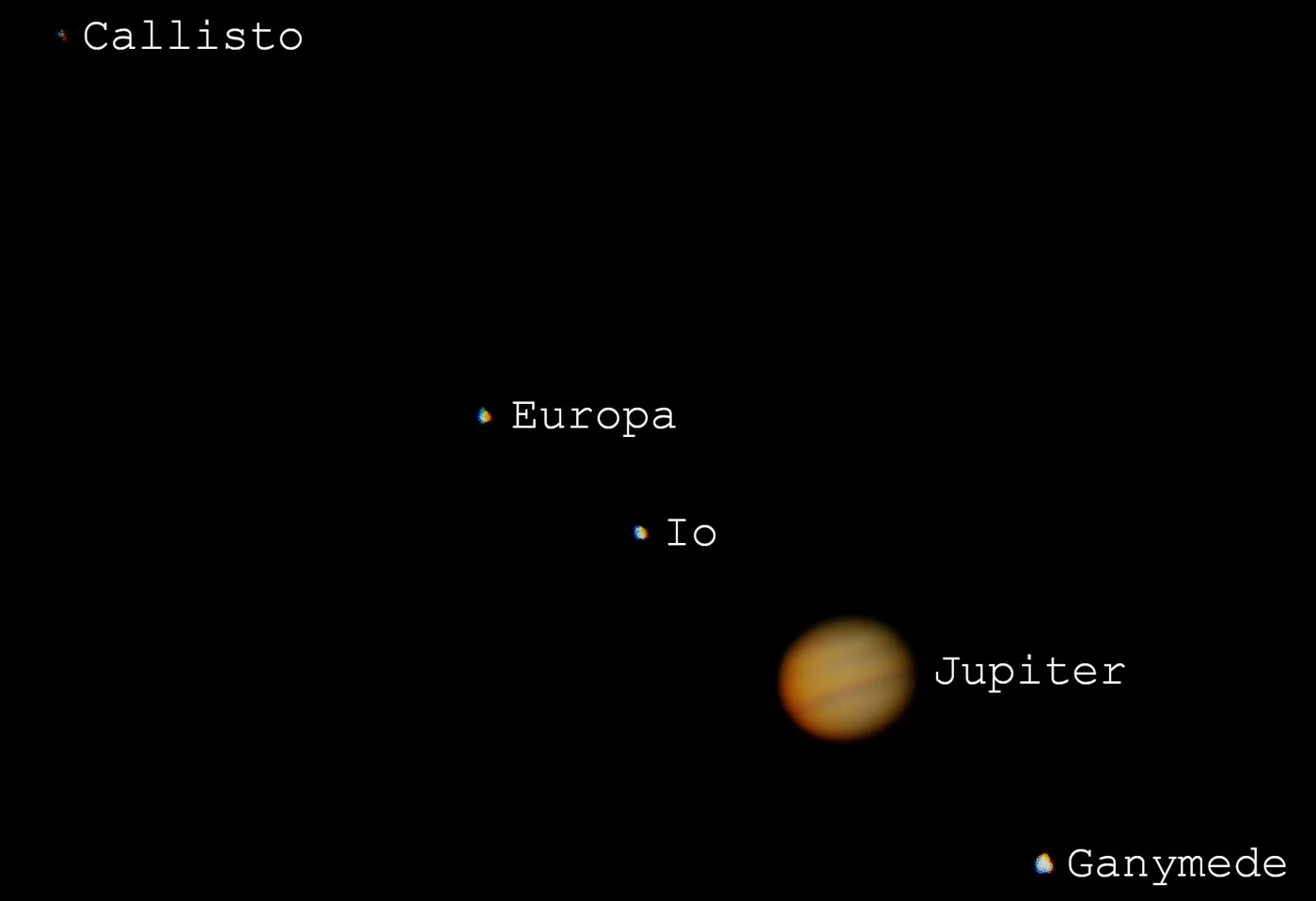
If you want to know how to see Jupiter’s moons, the honest answer is that it is one of the easiest things in astronomy. Hold a pair of 10x50 binoculars steady on Jupiter and you will see up to four faint points of light strung out in a line beside it. Those are Io, Europa, Ganymede and Callisto, the moons Galileo found in January 1610, and they change position every night. What takes a little more work is telling which is which, and this season there is an extra reason to try: from now until spring 2027 the moons eclipse one another, something that only happens every six years.
When to look from the UK
Jupiter is a morning object in October 2026. It sits in Leo and rises in the early hours, so the first views come before dawn, low in the east. It rises a little earlier each week, and by December it is clearing the rooftops in mid-evening.
The best of the apparition is opposition on 11 February 2027, when Jupiter is opposite the Sun, at its brightest, and up all night. From southern England it climbs to roughly 50 degrees in the south around midnight, high enough to get above most of the murk. Our planets guide has the dates for Jupiter, Mars and Saturn together.
You do not have to wait for opposition. The moons are just as easy to see in the morning sky now; the planet is simply lower and the air less steady.
What you need
- Binoculars. Any 7x50 or 10x50 pair will show the moons, but only if the binoculars are still. Brace them on a wall or a car roof, or put them on a tripod; our tripod guide for binoculars covers adapters. Handheld, the shake smears the moons into Jupiter’s glare.
- A small telescope. Any telescope, even a 60mm refractor, shows the moons as clear points at low power. At 100x or more in a 100mm or larger scope, Ganymede shows a tiny disc rather than a point, and you can watch the moons’ shadows cross Jupiter’s cloud tops.
- Your eyes alone. Ganymede is about magnitude 4.6, bright enough to see in a dark sky if Jupiter were not there. Jupiter’s glare hides it for nearly everyone. A few people with sharp eyes claim Ganymede or Callisto when they are at their widest; treat it as a party trick, not a plan.
How to tell Io, Europa, Ganymede and Callisto apart
The moons always lie close to a straight line, because we see their orbits almost edge on. Their order along that line changes nightly, and the order in the sky is not their order from Jupiter: a moon passing in front of or behind the planet appears close to it even if its orbit is the widest.
| Moon | Brightness (at opposition) | Orbit takes | Furthest it gets from Jupiter (at opposition) |
|---|---|---|---|
| Io | 5.0 | 1.8 days | About 2.3 arcminutes |
| Europa | 5.3 | 3.6 days | About 3.7 arcminutes |
| Ganymede | 4.6 | 7.2 days | About 6 arcminutes |
| Callisto | 5.7 | 16.7 days | About 10 arcminutes |
For scale, Jupiter’s disc is about 45 arcseconds wide at opposition, so 10 arcminutes is around 13 Jupiter widths. Three rules of thumb then do most of the work:
- A moon far from Jupiter, more than about eight planet widths out, is Callisto. Nothing else gets that far.
- The brightest moon is usually Ganymede. It is the largest moon in the solar system and, at magnitude 4.6, clearly brighter than the rest.
- A moon that has moved noticeably within an hour, close to the planet, is Io. It laps Jupiter in under two days, so its movement shows up in a single session. Sketch the line at 9pm and again at 11pm and you will see it.
Europa is the hardest. It is the faintest of the inner three and never strays far from the planet, so when only three moons are visible, the missing one is often Europa or Io hidden in front of or behind Jupiter, or in its shadow.
For certainty, use a chart. Free planetarium software such as Stellarium shows the moons’ positions for any date and time; set your location, zoom in on Jupiter, and compare it with what you see. Remember that many telescopes flip or mirror the view, so match the pattern rather than left and right. Our guide on how to read a star chart explains the flips.
Disappearing moons: transits, shadows and eclipses
Watch for long enough and a moon will vanish. There are four ways it happens, and most can be caught in a small telescope:
- Transit: a moon crosses in front of Jupiter. Against the bright clouds it is often hard to see.
- Shadow transit: the moon’s shadow falls on Jupiter as a sharp black dot. This is easier than the moon itself, and an 80 to 100mm telescope at 100x or more shows it well on a steady night. Io’s shadow is the commonest.
- Occultation: the moon passes behind Jupiter’s disc.
- Eclipse: the moon enters Jupiter’s shadow and fades out over a minute or two, some distance from the planet’s edge.
Times for all of these are listed in planetarium apps and in the monthly sky notes of most astronomy magazines.
The rare part: the moons eclipsing each other in 2026-27
Twice in each 12-year orbit, Jupiter reaches equinox and its moons’ orbits line up edge on to the Sun and to us. For a few months either side, the moons occult and eclipse one another, which they cannot do the rest of the time. Jupiter’s next equinox is on 16 December 2026. The British Astronomical Association’s mutual events notes for 2026-27 list events from May 2026 to August 2027, with the eclipses clustered between October 2026 and January 2027.
The ones to try for are the eclipses, when one moon passes into another’s shadow and dims. The BAA says they show better in small telescopes than the occultations, which need a big aperture to split two moons a fraction of an arcsecond apart. One example it gives is an eclipse of Ganymede with a combined drop of 0.7 magnitudes: easily noticed if you compare it with the moon beside it before and during. Events last minutes, so you need a predicted time and to be at the eyepiece early. The BAA collects timings and brightness measurements from amateurs, so a careful observation is genuinely useful.
The next chance after this season is around Jupiter’s following equinox, roughly six years later.
Common problems
I only see two or three moons. Normal. On any given night one or two may be in front of, behind, or in the shadow of Jupiter, or too close to its glare. Look again tomorrow.
There are five or six “moons”. One is probably a background star. Stars stay put relative to the field while Jupiter moves over a night or two; check Stellarium to see which points are moons.
The moons look like fuzzy blobs. Either the binoculars are moving, the telescope is out of focus, or the air is unsteady. Focus on a bright star first, then return to Jupiter. If the view boils, our guide to astronomical seeing explains why low planets suffer, and telescope cool down time covers the other common cause.
Frequently asked questions
Can you see Jupiter’s moons with binoculars? Yes. Steadily held 7x50 or 10x50 binoculars show up to four moons as points of light in a line beside Jupiter. Brace them or use a tripod, because hand shake hides the moons in the planet’s glare.
Which of Jupiter’s moons is the brightest? Ganymede, at about magnitude 4.6. Callisto is the faintest of the four at about 5.7, and is usually the one furthest from the planet.
Why can I only see three of Jupiter’s moons? One is passing in front of Jupiter, behind it, or through its shadow. The moons orbit in 1.8 to 16.7 days, so the line-up changes every night.
When is the best time to see Jupiter’s moons in the UK? Opposition on 11 February 2027 is the peak, with Jupiter up all night and high in the south. The moons are visible now in the pre-dawn sky, and from December in the evening.
Can you see Jupiter’s moons with the naked eye? Almost never. Ganymede is bright enough in principle, but Jupiter’s glare drowns it. Binoculars are the realistic minimum.
What are Jupiter’s mutual events? Around Jupiter’s equinox, the four big moons can eclipse and pass in front of one another. The current season peaks around the equinox on 16 December 2026, with most eclipses between October 2026 and January 2027.
Sources
- British Astronomical Association, Mutual events of the Galilean satellites 2026-27, June 2026
- Stellarium, free planetarium software for moon positions
Clear skies forecast? Get a nudge.
Our weekly email flags the next good UK observing window and one easy target to find.
Join the listMore from Starvest
Keep reading
Best Telescopes for Beginners in the UK (Tested by Price Bracket)
The best beginner telescopes in the UK by budget, from sub-£150 tabletop scopes to app-guided and smart telescopes, with real 2026 prices.
What Can You See with Binoculars at Night? A Realistic Astronomy List
A realistic list of what you can see with binoculars in astronomy, from the Moon and Jupiter's moons to Andromeda, with tips for spotting each from the UK.
How to Set Up and Use Your First Telescope (Step by Step)
How to use a telescope as a beginner: assemble the mount, align the finder, focus, and find your first targets. A clear step-by-step UK guide.