Celestron StarSense Explorer DX 130AZ Review: Honest UK Verdict
Most coverage of this scope leads with the gimmick: point your phone at the sky, follow the arrows, done. This Celestron StarSense Explorer DX 130AZ review takes the app seriously but does not stop there, because a telescope you buy to actually use every clear night lives or dies on its optics, its mount and the small frustrations nobody mentions in the sales copy. Here is what the DX 130AZ shows you on a real UK night, where it wobbles, and who should buy something else.
If you are still weighing up the field, start with our best telescopes for beginners in the UK roundup and the refractor vs reflector explainer, then come back for the detail.
What the DX 130AZ is
The StarSense Explorer DX 130AZ is a 130mm (5.1 inch) f/5 Newtonian reflector with a 650mm focal length, sitting on a manual alt-azimuth mount with dual-axis slow-motion controls and a full-height steel tripod. It ships with two 1.25 inch eyepieces, a 25mm and a 10mm, giving 26x and 65x, plus a red dot finder. All of that is confirmed on the Celestron product page.
The headline feature is the StarSense dock: a spring-loaded phone cradle with a small mirror that reflects the sky into your phone’s camera. The free StarSense Explorer app then plate-solves the star field, works out exactly where the tube is pointing, and overlays arrows that guide you to nudge the scope onto your target until a bullseye turns green. It is not GoTo, there are no motors, but it removes the single biggest barrier for beginners: not knowing where anything is.
What you actually see through it
A 130mm mirror gathers real light, and it shows. On the Moon the DX 130AZ is excellent: crater walls, the ragged terminator and the grey seas snap into focus, and the view stays bright as you increase magnification.
On the planets it earns its keep. Jupiter shows two clear cloud belts and its four Galilean moons in a line; Saturn’s rings separate cleanly from the disc; Venus runs through its phases. There is a caveat worth being honest about: to push planetary detail properly you want around 150x or more, and the supplied 10mm eyepiece only reaches 65x. A cheaper high-power eyepiece or a decent 2x Barlow is the first upgrade most owners make. See our telescope accessories every beginner actually needs for what is worth buying and what is not.
From a darker site the aperture opens up brighter deep-sky targets too: the Orion Nebula shows structure, the Andromeda Galaxy is an obvious oval, and several clusters are within reach. From a light-polluted town garden the faint stuff washes out, as it does with any scope this size.
Living with the StarSense app
The app is the real draw, and for the most part it delivers. Once you have done the one-time alignment on a bright star, it reliably walks you to targets you would never find by chance, and it genuinely does outperform far pricier push-to systems for the money.
It is not flawless. In heavy light pollution or under a bright Moon the plate-solving has less to work with and can take longer to lock on, and older phones with weaker sensors or GPS occasionally need a recalibration. Keep your phone screen brightness low to protect your night vision, because the app is on constantly.
The quirks nobody mentions
Two things surprise first-time buyers. First, this is a Newtonian, so the mirrors need collimating. Celestron includes the instructions and it is genuinely straightforward, but it is not fully set-and-forget, and a scope that has been knocked in transit will show soft views until you align it. Our how to collimate a Newtonian reflector guide walks through it.
Second, the mount transmits vibration. Touch the focuser or the slow-motion controls and the image shivers for a second or two before settling, which is more noticeable at higher power. It is normal for a scope at this price, but plan to focus, let go, and wait rather than fiddling constantly. And because it is a manual alt-azimuth mount, objects drift out of view as the Earth turns, so you will keep nudging during long looks at a single target.
DX 130AZ vs the cheaper LT and the Heritage 130P
If budget is tight, the StarSense Explorer LT models use the same app in a lighter, simpler package with smaller optics, so you keep the clever finding but lose light grasp. Against the Sky-Watcher Heritage 130P, the trade is clear: the Heritage gives you the same 130mm f/5 optics in a collapsible tabletop form for less money, but no app to find things for you. Choose the DX 130AZ if the phone-guided finding is what will keep you observing; choose the Heritage if you are happy to learn the sky yourself and want to spend the difference on eyepieces.
Who should buy it
The DX 130AZ suits a beginner who wants capable 130mm optics and hates the idea of hunting blindly for targets. It is a proper first telescope that will keep you busy for years, especially once you add a higher-power eyepiece. Skip it if you already know your way around the sky and would rather put the app’s cost into aperture, or if you specifically want a grab-and-go scope, where the collapsible Heritage or a good pair of binoculars for stargazing makes more sense.
Frequently asked questions
Is the Celestron StarSense Explorer DX 130AZ good for beginners? Yes. The DX 130AZ is one of the easier first telescopes to get results from, because the StarSense app guides you straight to targets while the 130mm mirror gathers enough light for genuinely rewarding views of the Moon and planets. The main learning curves are collimation and managing vibration.
What can you see with the StarSense Explorer DX 130AZ? The Moon in crisp detail, Jupiter’s cloud belts and moons, Saturn’s rings, the phases of Venus, and brighter deep-sky objects such as the Orion Nebula and Andromeda Galaxy from a darker site. For sharper planetary detail you will want a higher-power eyepiece than the 10mm supplied.
Does the StarSense app replace a GoTo mount? Not exactly. There are no motors, so it does not move the telescope for you or track objects automatically. Instead it tells you precisely which way to nudge the scope by hand until the target is centred, which delivers most of the convenience of GoTo at a much lower price.
Do you have to collimate the DX 130AZ? Yes, occasionally. As a Newtonian reflector its mirrors can drift out of alignment, especially after transport, and collimating them restores sharp views. Celestron supplies instructions and the process is beginner-friendly with a simple tool.
Does the StarSense app work in light-polluted skies? It works, but it performs best under darker skies. Heavy light pollution or a bright Moon gives the app fewer stars to analyse, so it can take longer to lock on. Older phones with weaker cameras or GPS may need the occasional recalibration.
What is the first upgrade to buy for the DX 130AZ? A higher-power eyepiece or a quality 2x Barlow lens, so you can push past the 65x ceiling of the supplied 10mm and pull more detail out of the planets. A collimation cap and a red torch to protect your night vision are worthwhile next.
Clear skies forecast? Get a nudge.
Our weekly email flags the next good UK observing window and one easy target to find.
Join the listMore from Starvest
Keep reading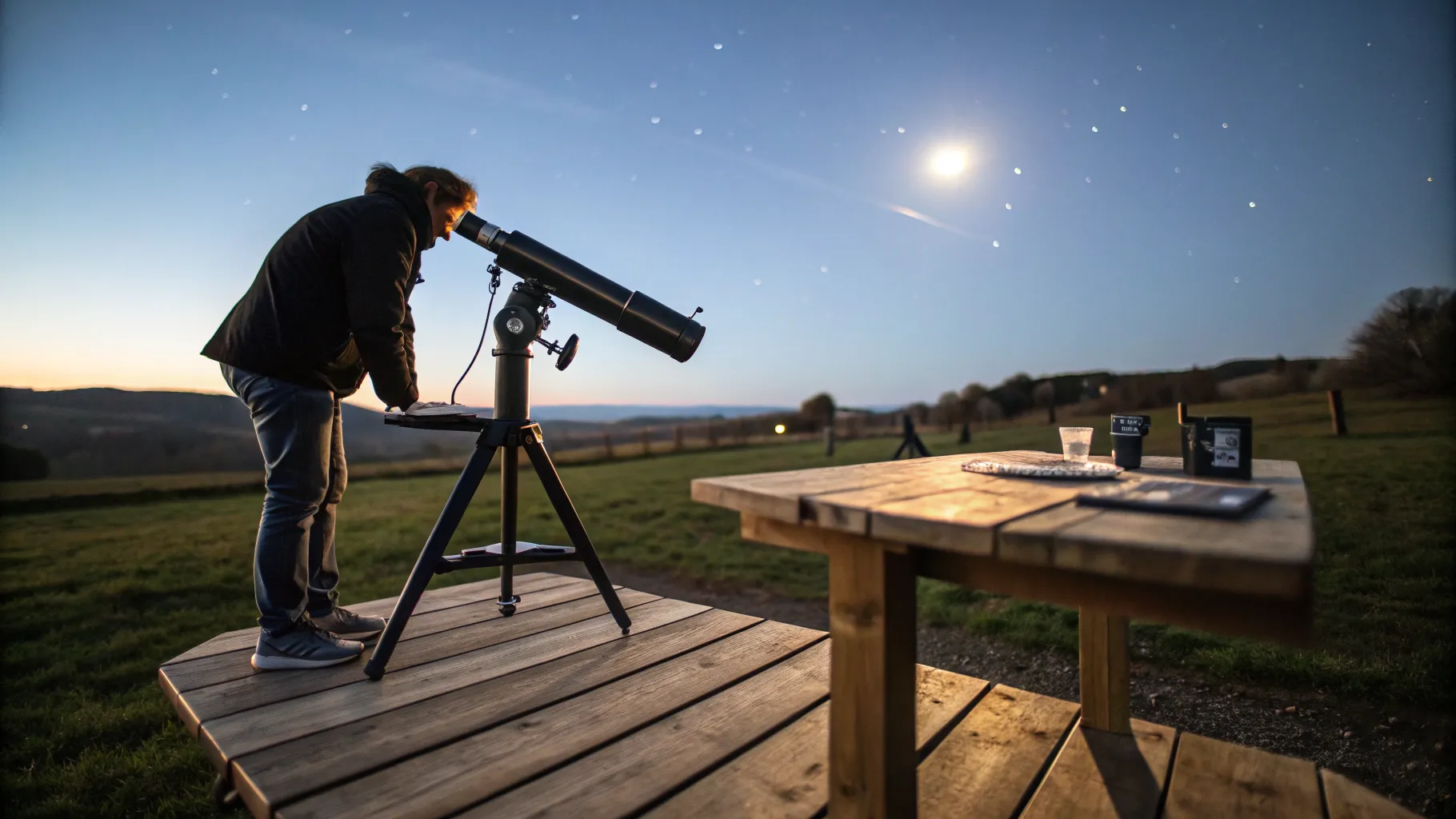
Best Telescopes for Beginners in the UK (Tested by Price Bracket)
The best beginner telescopes in the UK by budget, from sub-£150 tabletop scopes to app-guided and smart telescopes, with real 2026 prices.

What Can You See with Binoculars at Night? A Realistic Astronomy List
A realistic list of what you can see with binoculars in astronomy, from the Moon and Jupiter's moons to Andromeda, with tips for spotting each from the UK.

How to Set Up and Use Your First Telescope (Step by Step)
How to use a telescope as a beginner: assemble the mount, align the finder, focus, and find your first targets. A clear step-by-step UK guide.