Observing the Moon With a Telescope: Skip the Full Moon
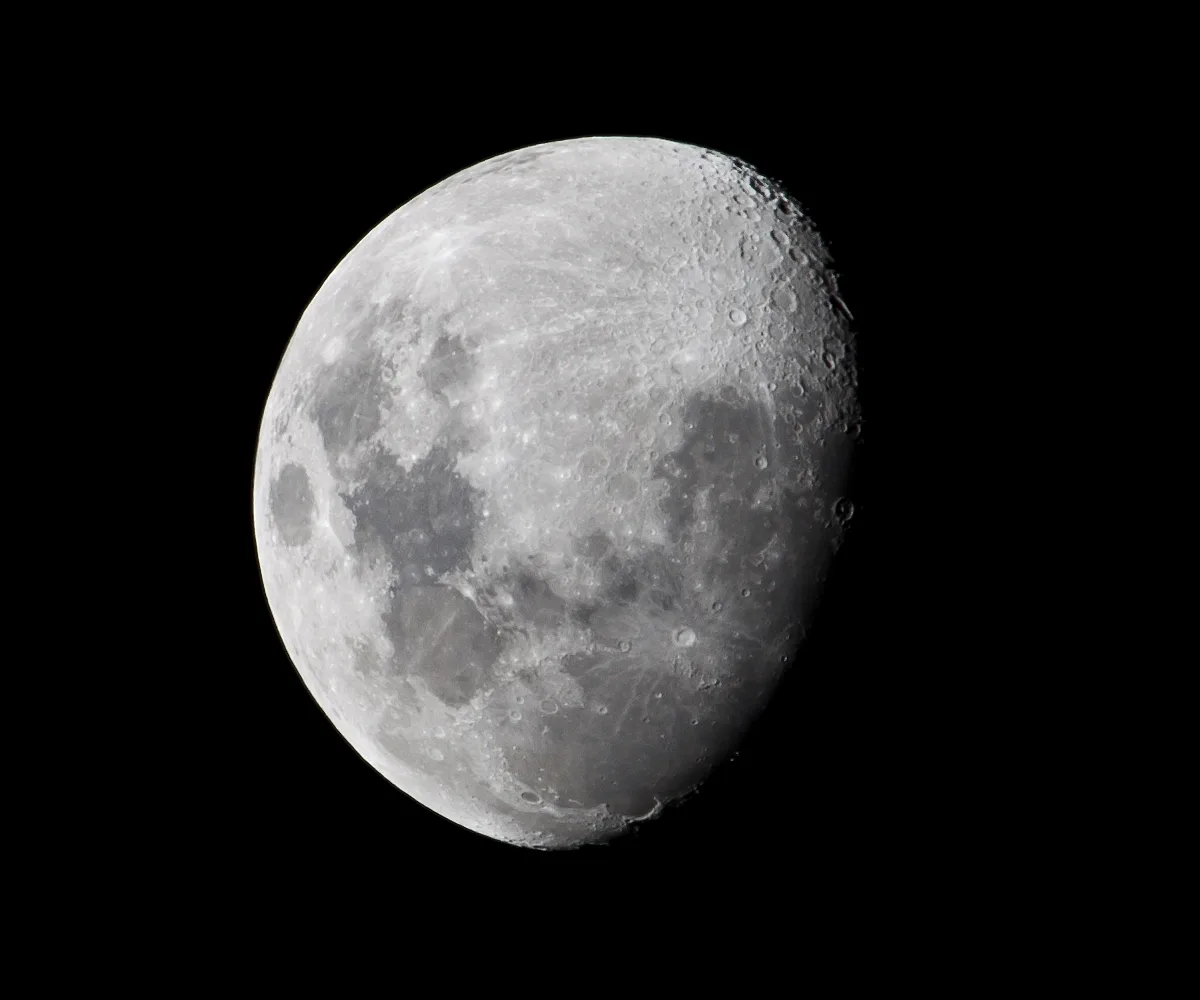
Almost everyone gets observing the Moon with a telescope wrong the first time, and they all make the same mistake: they wait for the full Moon. It is the biggest, brightest, most obviously photogenic phase, and through an eyepiece it is close to the worst view the Moon offers all month. The Sun is shining straight down onto the surface, so nothing casts a shadow, and a flat white disc glares back at you with almost no relief.
Go out five days earlier and the same telescope shows crater walls throwing shadows across their own floors, mountain peaks catching the light while the ground below is still in darkness, and a jagged, three-dimensional landscape that genuinely looks like somewhere. The equipment did not change. The lighting did.
The terminator is the whole game
The terminator is the line between the lit and unlit halves of the Moon. It is sunrise or sunset on the lunar surface, and it is where every worthwhile detail lives.
Along that line the Sun is skimming the ground at a shallow angle, so a crater rim a couple of kilometres high lays a shadow tens of kilometres long across the floor below. Move a few hundred kilometres away from the terminator into full daylight and that same crater flattens into a pale smudge. The effect has a name borrowed from painting, clair-obscur, and it is why the Moon changes character every single night.
Practically, this means one thing: pick your target by where the terminator is, not by what you feel like looking at. A feature you cannot find tonight might be spectacular in three days, and invisible again in six.
The best phases, in order
First quarter and last quarter are the two peaks. The terminator runs straight down the middle of the disc, the illuminated half is bright but not overwhelming, and you get the maximum length of terminator to work along.
Waxing crescent, three to six days after new is the connoisseur’s window. Less to look at, but the lighting on Mare Serenitatis, Mare Tranquillitatis and the Theophilus crater chain is at its most dramatic, and this is the only time you see earthshine, the ghostly grey glow on the unlit portion caused by sunlight bouncing off Earth’s oceans and clouds and back at the Moon.
Waxing gibbous, seven to ten days gives you more surface with the shadows still working. The Apennine mountains, Mare Imbrium, the flat-floored crater Plato, and Archimedes, Aristillus and Autolycus are all well placed.
Waning phases, days eighteen to twenty-four are the ones nobody sees, because they mean getting up before dawn rather than staying up late. The reward is the same features lit from the opposite side, which changes them completely, plus Copernicus, Aristarchus and Grimaldi at their best.
Full Moon is worth about ten minutes, for one reason: the ray systems. Tycho in the southern highlands sprays bright streaks a third of the way round the globe, and they are only visible under this flat high-Sun lighting. Look, appreciate it, then go back to observing during the good phases.
Rupes Recta: the same feature, two different objects
If you want a single target that proves the point about lighting, use the Straight Wall.
Rupes Recta is a fault scarp roughly 110km long in Mare Nubium. Around eight days after new Moon, with the Sun rising over it, the scarp throws a thick black line across the grey lava plain and looks like a cliff edge. Around twenty-two days, with the Sun setting from the other side, the same slope is brightly lit and the feature appears as a white scar in the same place. Nothing on the Moon has moved. You are watching a shadow flip sides over the course of a fortnight.
The Lunar X and V
Twice a month, roughly, the rims of three craters near the terminator catch the sunlight before the ground between them does, and the illuminated rims form a shape that reads unmistakably as a letter X. A little to the north, a similar coincidence produces a V.
Both appear for about four hours around first quarter, and outside that window they simply are not there. It takes something like two and a half hours for the X to assemble itself from a few disconnected bright dots into the finished shape, which makes it one of the few things in amateur astronomy where you can genuinely watch a change happen over a session. A small telescope at moderate power shows it. Check a lunar calendar for the timing, because “first quarter night” is not precise enough.
How much magnification to use
The rule of thumb that has survived every generation of equipment: about 50x per inch of aperture is the theoretical ceiling, and on most British nights you will not get near it.
In practice, work up in stages:
- Start at 30x to 50x. Whole-disc view, get your bearings, find the terminator.
- 50x to 120x is where craters resolve properly and most sessions live.
- 150x to 200x shows rilles and small craterlets, but only when the atmosphere cooperates.
The limiting factor is almost never the telescope. It is seeing, the turbulence in the air column above you, and the single biggest thing you control is altitude. Wait until the Moon is at least 30 degrees above the horizon. Below that you are looking through several times as much atmosphere and the image boils. Our guide to using a telescope as a beginner covers focusing and eyepiece choice, and telescope aperture explained sets out what your particular instrument can and cannot resolve.
Do you need a Moon filter?
Less often than the accessory shops suggest. A neutral density or variable polarising filter genuinely helps at full Moon and low magnification, where the glare is uncomfortable and your dark adaptation gets destroyed for the rest of the night. The trade is a small loss of definition.
At the phases you should actually be observing, there is a better answer: turn up the magnification. Spreading the same light over a larger image dims it naturally, and unlike a filter it costs you nothing in detail. If you are also chasing faint objects the same night, observe them first, then finish on the Moon.
Libration: why the edges keep changing
The Moon keeps one face towards us, but not rigidly. Its orbit is elliptical and tilted, so it appears to rock slightly north and south and nod slightly east and west over the month. The cumulative effect is that a patient observer can see about 59 per cent of the lunar globe rather than the 50 per cent you would expect.
The practical payoff is at the limb. Features like Mare Crisium and Grimaldi shift noticeably closer to or further from the edge across a few weeks, and occasionally a favourable libration tips a normally hidden region into view, heavily foreshortened but there. It is a slow reward, and it is one of the reasons the Moon does not get boring.
Season matters more than British observers expect
The Moon travels close to the ecliptic, the same path the Sun follows, and the ecliptic swings up to 23.4 degrees north and south of the celestial equator over the year. Because a full Moon sits opposite the Sun, it does the reverse of what the Sun is doing: it rides high on winter nights and hangs low on summer ones.
From UK latitudes that difference is worth a lot of image quality. A December full Moon climbing high in the south is being observed through a fraction of the atmosphere that a June full Moon skimming the treeline has to fight through. If your summer views look mushy, the Moon’s altitude is the likely reason, not your optics.
Eclipses: what the UK actually has coming
Lunar eclipses are the Moon’s crowd-pleasers, and the UK’s supply over the next few years is thinner than most people assume.
The deep partial eclipse of 28 August 2026, with about 93 per cent of the Moon inside Earth’s umbral shadow at maximum, was the only lunar eclipse visible from the UK during 2026. The next one falls on 20 February 2027, and it is penumbral only, meaning the Moon passes through the outer fringe of Earth’s shadow and dims subtly rather than turning coppery. Plenty of people watching it will not be certain anything happened.
That is the pattern for a while. NASA’s lunar eclipse catalogue lists three eclipses in 2027, on 20 February, 18 July and 17 August, and every one of them is penumbral. 2028 brings two partials, on 12 January and 6 July, then a total on 31 December with 71 minutes and 20 seconds of totality. From the UK that New Year’s Eve eclipse will already be under way as the Moon rises, so a clear eastern horizon will matter. Worth putting in a diary now.
Lunar eclipses need no filter and no protection of any kind. They are exactly as safe to look at as an ordinary full Moon, which is a useful thing to be clear about, because solar eclipses are not.
A first session that works
Pick a night four to six days after new Moon, or a night either side of first quarter. Check the Moon will be 30 degrees up. Set up outside twenty minutes early so the optics reach air temperature, because a warm mirror or lens produces tube currents that will ruin high power.
Start at low magnification, find the terminator, then move along it slowly. Do not chase named craters straight away. Look for the places where the shadows are longest, and work out what is casting them. Once you are comfortable, put a lunar map next to you and start naming things.
Then go out again three nights later and look at the same region. Everything will be different, and that is the point. For what else is worth pointing a telescope at through the year, see our month-by-month night sky guide, and if you have not bought anything yet, binoculars for stargazing show the Moon’s larger craters perfectly well.
Frequently asked questions
What magnification do I need for observing the Moon with a telescope? Between 50x and 120x covers almost everything worth seeing. The theoretical ceiling is around 50x per inch of aperture, so a 4-inch scope tops out near 200x, but UK atmospheric conditions rarely allow that. If the image is soft, drop the power rather than pushing it.
Why does the Moon look so much better before full than at full? Because shadows do the work. Near the terminator the Sun is low over the lunar surface and every raised feature casts a long shadow. At full Moon the Sun is almost directly overhead across the visible face, shadows disappear, and the surface flattens into a bright glare.
Can looking at the Moon through a telescope damage my eyes? No. The Moon reflects only a small fraction of the sunlight falling on it, and even at full it is nowhere near bright enough to cause harm. It can be dazzling and will wreck your dark adaptation for twenty minutes or so, which is a comfort problem rather than a safety one. The Sun is a completely different matter and must never be viewed without proper solar equipment.
What is the best telescope for looking at the Moon? Almost any of them. The Moon is bright, large and high-contrast, which makes it the most forgiving target in the sky and the reason it is the first thing most people point a new telescope at. A small refractor on a steady mount often beats a bigger scope on a wobbly one, because stability matters more than aperture at lunar magnifications.
When is the next lunar eclipse visible from the UK? 20 February 2027, and it is a penumbral eclipse, so the Moon only dims slightly rather than turning red. NASA’s catalogue lists nothing but penumbral eclipses across the whole of 2027. The next total lunar eclipse is on 31 December 2028, with 71 minutes and 20 seconds of totality, in progress as the Moon rises over Europe.
What is earthshine and when can I see it? Earthshine is sunlight reflected off Earth onto the Moon’s unlit portion, showing the dark part of the disc as a faint grey ghost inside the bright crescent. It only shows during thin crescent phases, within a few days of new Moon, and it is easier in binoculars than at high magnification.
How do I know where the terminator will be tonight? Any lunar phase calendar or stargazing app will tell you the Moon’s age in days since new. Roughly, day 7 puts the terminator down the middle for first quarter, day 14 is full with no terminator on the visible face, and day 22 is last quarter with the middle line back but lit from the other side.
Clear skies forecast? Get a nudge.
Our weekly email flags the next good UK observing window and one easy target to find.
Join the listMore from Starvest
Keep reading
Best Telescopes for Beginners in the UK (Tested by Price Bracket)
The best beginner telescopes in the UK by budget, from sub-£150 tabletop scopes to app-guided and smart telescopes, with real 2026 prices.
What Can You See with Binoculars at Night? A Realistic Astronomy List
A realistic list of what you can see with binoculars in astronomy, from the Moon and Jupiter's moons to Andromeda, with tips for spotting each from the UK.
How to Set Up and Use Your First Telescope (Step by Step)
How to use a telescope as a beginner: assemble the mount, align the finder, focus, and find your first targets. A clear step-by-step UK guide.