What to See in the Night Sky Tonight, Month by Month (UK)
The honest answer to what to see in the night sky tonight is that it depends on two things, and neither of them is your equipment. It depends on the month, because the Earth’s orbit swings a different half of the sky into view as the year turns, and it depends on the Moon, because a full Moon washes out everything faint no matter how good your kit or how dark your garden. Get those two right and a pair of binoculars will show you more than a telescope used on the wrong night.
What follows is the month-by-month picture for the UK, the dated events between now and the end of 2026, and the one week each summer when British stargazing stops working altogether.
First: the eclipse four nights from now
In the early hours of Friday 28 August 2026, a deep partial lunar eclipse is visible from the UK. According to the Royal Observatory Greenwich’s guide to the event, the penumbral phase starts at 2.23am BST, the Moon begins entering the Earth’s dark umbral shadow at 3.33am, and maximum eclipse comes at 5.12am with roughly 93 per cent of the visible surface inside the umbra.
The catch is the horizon. The Moon is sinking through the whole event and sets at about 6.15am in London, before the eclipse finishes, with timings shifting across the British Isles. You need a clear south-western horizon and preferably some height. A hedge or a neighbour’s roofline will cost you the best part of it.
No filters, no glasses, nothing. A lunar eclipse is exactly as safe to look at as an ordinary full Moon.
The rest of 2026, by date
These are the fixed points worth putting in a calendar. Everything comes from the Royal Observatory’s astronomy highlights for 2026.
- 23 September, autumn equinox at 1.06am BST. The Harvest Moon follows on 26 September.
- 4 October, Saturn at opposition. Opposition means the planet is opposite the Sun from our point of view, so it rises at sunset, sits highest around midnight and is at its brightest and closest for the year. Even a small telescope shows the rings; binoculars will not, though they will show it as a distinctly non-round smudge.
- 21 October, peak of the Orionids, running 2 October to 7 November at roughly 15 meteors an hour.
- Through November, the Pleiades in Taurus, well placed all month.
- 14 December, peak of the Geminids, active 4 to 20 December. This is the best shower of the year, potentially 120 an hour, and the 2026 peak falls with a waxing crescent Moon that sets around 9pm. That is close to ideal.
- 21 December, winter solstice at 8.50pm. Longest night of the year, which for once is good news.
- 24 December, the only supermoon of 2026, up to 14 per cent bigger and 30 per cent brighter than a Moon at its most distant.
For a sense of what you just missed: the partial solar eclipse of 12 August 2026 covered about 90 per cent of the Sun from London at maximum, the deepest the UK has seen since 1999. Nothing as good is forecast again until 2081.
Winter: January and February
This is the best sky of the year from Britain, and it is the coldest, which is not a coincidence anyone enjoys.
Orion dominates the southern sky through the evening. The three belt stars are unmistakable, and hanging below them is a hazy patch that binoculars resolve into the Orion Nebula, a star-forming cloud and the easiest deep-sky object in the northern sky. Follow the belt down and left to Sirius, the brightest star in the entire night sky, low in the south and twinkling violently through the thick air near the horizon. Follow the belt up and right to orange Aldebaran in Taurus, and keep going to the Pleiades, a tight knot of blue stars that most people can count six or seven of by eye and that binoculars turn into dozens.
Overhead you have Capella in Auriga, and to the east Gemini, with Castor and Pollux side by side.
If you are going to buy one thing for a winter sky, make it binoculars rather than a telescope. Our guide to binoculars for stargazing explains why 10x50 is the standard recommendation.
Spring: March, April and May
The winter constellations slide west and the sky empties out of bright stars, which is a genuine disappointment the first time you notice it. What replaces them is galaxies, and galaxies need dark skies rather than big magnification.
Leo rides high in the south, its head forming a backwards question mark called the Sickle, with Regulus at the base. Ursa Major is nearly overhead, and the curve of the Plough’s handle arcs down to orange Arcturus in Boötes, an old memory trick that still works: arc to Arcturus. Between Gemini and Leo sits Cancer, faint to the eye but holding the Beehive Cluster, a lovely binocular target.
The Lyrids peak around 22 April most years, a modest shower of roughly 18 an hour.
Summer: June and July, when British stargazing shuts down
Here is the thing nobody tells beginners who buy a telescope in May.
From roughly late May to late July, the UK does not get properly dark. Astronomical darkness requires the Sun to sit at least 18 degrees below the horizon, and at British latitudes it simply does not go that low in midsummer. The sky stays in permanent twilight all night. In Scotland the effect is stronger and lasts longer; from the far north of Scotland it barely gets dark at all. Faint objects are off the menu until August.
So change target. This is the season for noctilucent clouds, the highest clouds in the atmosphere, so high they stay lit by a Sun that has already set for everything below them. The Royal Observatory’s explainer on noctilucent clouds puts the season at roughly late May to late July, and the trick is that you do not want darkness: look low in the north an hour or two after sunset, or before sunrise, for an electric-blue rippled sheen that looks like nothing else in the sky. Latitudes of about 50 to 60 degrees north are the sweet spot, which is the whole of the UK.
The Moon and the bright planets also survive twilight perfectly well, so a summer evening is a fine time to look at craters along the terminator.
Late summer and autumn: August, September and October
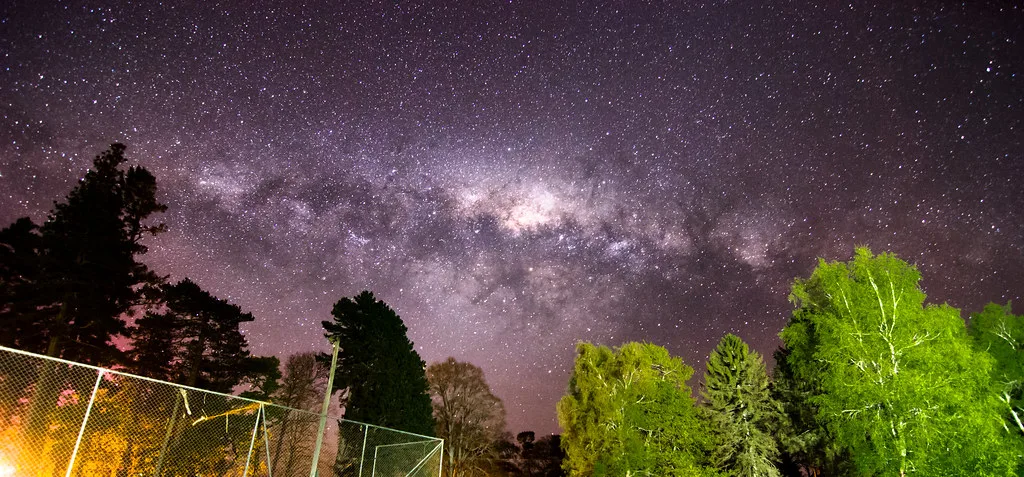
Darkness comes back, and it comes back with the Milky Way. From a genuinely dark site in late August and September, the band runs from the southern horizon up through Cygnus overhead. The Summer Triangle of Vega, Deneb and Altair is directly above you at nightfall, and sweeping along it with binoculars is the single most rewarding thing a beginner can do.
The Perseids peak around 13 August. In 2026 the peak fell at new Moon, which is as good as the conditions get.
Autumn belongs to Andromeda. The Andromeda Galaxy is a faint oval smudge that you can just see with the naked eye from a dark site, and it is the most distant object the unaided human eye can reach, around 2.5 million light years away. Nearby, Cassiopeia makes its W overhead, and between Cassiopeia and Perseus sits the Double Cluster, two open clusters in the same binocular field.
Where you stand matters more in autumn than at any other time, because these are faint targets. Our dark sky sites in the UK and the UK light pollution map will tell you whether your usual spot is good enough.
Late autumn and winter: November and December
The Pleiades climb into the evening sky, Taurus follows, and by mid-December Orion is back over the south-eastern horizon by mid-evening. The Geminids arrive on 14 December, radiating from near Castor in Gemini, and unlike most showers they produce meteors from mid-evening rather than making you wait for the small hours.
How to work out what is up right now
Three habits, in order of how much difference they make.
Check the Moon before anything else. Around full Moon, plan on the Moon itself, bright double stars and planets. Around new Moon, go for galaxies, nebulae and the Milky Way. This single decision outweighs everything about your equipment.
Give your eyes 20 to 30 minutes. Dark adaptation is slow and one glance at a phone screen resets it. Use a red torch, and turn the phone brightness to minimum and switch to a night mode if you must use it.
Then use an app to point you. Hold it up, and it tells you which bright dot is Saturn and which is a passing aircraft. Planets move, so no written guide can tell you where they are on a given night, which is precisely the job apps do well. We compare them in the best stargazing apps, and if you would rather learn the sky properly, how to read a star chart is the slower and better route.
New to all of this? Start with how to start stargazing and naked-eye stargazing for beginners, both of which assume you own nothing at all.
Frequently asked questions
What can I see in the night sky tonight without a telescope? On any clear night from the UK you can see the Moon, whichever bright planets are currently placed for the evening, and the constellations for the season: Orion, Taurus and Sirius in winter, Leo and Ursa Major in spring, the Summer Triangle and Cygnus in summer, and Pegasus, Cassiopeia and Andromeda in autumn. From a dark site the Andromeda Galaxy and the Milky Way are both naked-eye objects.
Why can I see less in June than in December? Because the UK gets no true astronomical darkness from roughly late May to late July. The Sun never drops the required 18 degrees below the horizon, so the sky stays in twilight all night and faint objects are lost. The effect is stronger the further north you are. Aim at the Moon, the planets and noctilucent clouds instead until August.
What time is the lunar eclipse on 28 August 2026 in the UK? The penumbral phase begins at 2.23am BST, the partial phase at 3.33am, and maximum eclipse is at 5.12am with about 93 per cent of the Moon in the Earth’s umbral shadow. The Moon sets around 6.15am in London, before the eclipse ends, so you need a clear south-western horizon.
Do I need a telescope to watch a meteor shower? No, and a telescope actively works against you. Meteors can appear anywhere in the sky, so you want the widest possible view, which means lying back and using your eyes. No optics, no tracking, nothing pointed anywhere in particular. Give yourself half an hour to dark-adapt and be patient.
When is the best meteor shower of the year? The Geminids, peaking on 14 December 2026, with a possible 120 meteors an hour. The 2026 peak is helped by a waxing crescent Moon that sets around 9pm, leaving the rest of the night dark. The Perseids in August are more popular mainly because the weather is warmer.
Does the Moon really ruin stargazing? For faint objects, yes. A full Moon scatters enough light across the sky to hide galaxies, nebulae and most of the Milky Way even from a dark site, which is why experienced observers plan around the lunar cycle rather than the weather alone. For the Moon itself the opposite applies, and the best detail is near the terminator, the line between lit and unlit, rather than at full Moon when the shadows disappear.
Where should I go to see more? Somewhere with a genuinely dark horizon and no direct lights in your eyes, which for most people means driving 30 to 60 minutes out of town. Our list of UK stargazing events and star parties is also worth a look, because a night with a local society will teach you more in three hours than a month of reading.
Clear skies forecast? Get a nudge.
Our weekly email flags the next good UK observing window and one easy target to find.
Join the listMore from Starvest
Keep reading
Best Telescopes for Beginners in the UK (Tested by Price Bracket)
The best beginner telescopes in the UK by budget, from sub-£150 tabletop scopes to app-guided and smart telescopes, with real 2026 prices.
What Can You See with Binoculars at Night? A Realistic Astronomy List
A realistic list of what you can see with binoculars in astronomy, from the Moon and Jupiter's moons to Andromeda, with tips for spotting each from the UK.
How to Set Up and Use Your First Telescope (Step by Step)
How to use a telescope as a beginner: assemble the mount, align the finder, focus, and find your first targets. A clear step-by-step UK guide.