Find the Andromeda Galaxy from the UK: Overhead in November
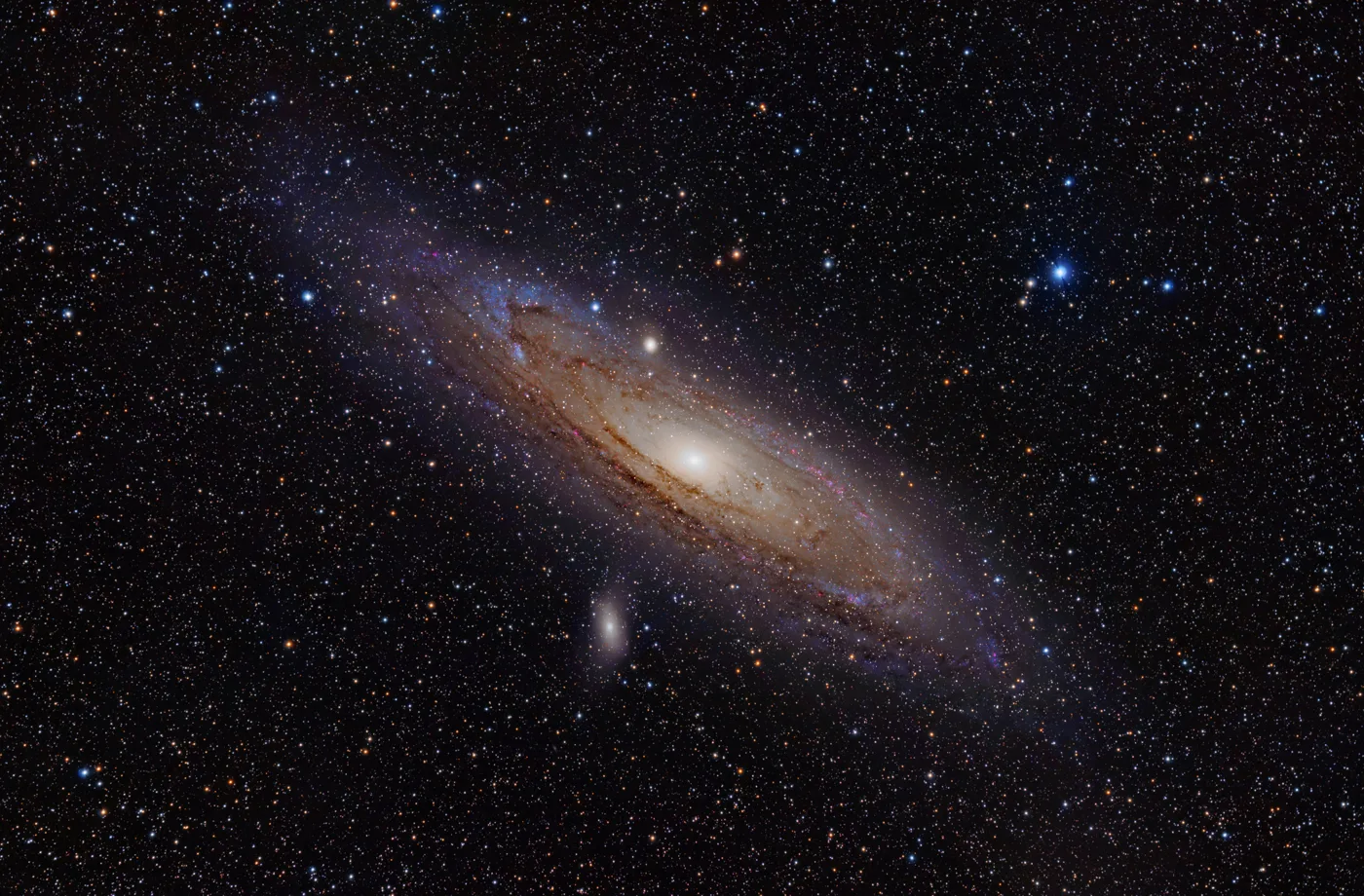
Learning how to find the Andromeda Galaxy is the moment stargazing stops being about the solar system. Everything else you have looked at so far is a few light minutes or light hours away. M31 is around 2.5 million light years off, and the light hitting your retina left it before anything recognisable as a human existed. It is also the one deep-sky object that is genuinely easy from Britain, because it rides almost overhead on autumn evenings rather than skulking in the murk near the horizon the way most famous targets do.
The catch is that almost everyone who finds it for the first time is underwhelmed, and that is a fixable problem. It comes from expecting the photograph. This page covers the star hop, the equipment choice that decides whether you see anything worthwhile, and what the galaxy honestly looks like through an eyepiece.
When to look
M31 sits at declination +41°16’, which is far enough north that from anywhere in Britain it technically never sets. That fact is academic, because for most of the spring it grazes the northern horizon through the thickest, dirtiest air there is. What matters is when it crosses the meridian, high in the south, and that is an autumn and early winter event.
Working from the galaxy’s right ascension of 00h 42m, it reaches its highest point at around midnight in early October, about 10pm in early November, and about 8pm in early December. NASA lists November as the best month for northern-hemisphere observers, and from Britain that is exactly right: a comfortable evening hour, with the galaxy near the top of the sky.
At that highest point M31 stands roughly 80 degrees above the southern horizon from London and about 75 degrees from Edinburgh. You are looking almost straight up, through the thinnest slice of atmosphere available. Nothing else this famous is this well placed from British latitudes.
Two things will still ruin it. A gibbous or full Moon anywhere in the sky raises the background brightness enough to erase a low-contrast target, so check the phase before you commit an evening. And your own eyes need 20 to 30 minutes of full darkness, with no phone screen, before they will show it. Both of these matter more for Andromeda than for the Moon or the planets, which is covered in more detail in our guide to naked-eye stargazing.
The star hop, in three moves
Ignore the constellation Andromeda for a moment and start with a shape you can actually recognise: the Great Square of Pegasus, four roughly equally bright stars forming a large, obvious square high in the south-east through autumn evenings.
Move one. Take the top-left corner of the Square, the star Alpheratz, and follow the chain of stars running up and to the left away from it. The second reasonably bright star along that chain is Mirach, about 8 degrees from Alpheratz. Mirach is distinctly orange, which is a useful confirmation.
Move two. From Mirach, turn roughly 90 degrees and hop up and to the right to Mu Andromedae, around 4 degrees away and noticeably fainter.
Move three. Continue in the same direction and the same sort of step to Nu Andromedae, and M31 sits just beyond it. In total you have travelled a binocular field and a half from Mirach.
The reason this works better than a phone app pointed at the sky is that the three stars are a fixed physical pattern. Once you have done it twice, you can do it in ten seconds from a car park. Our page on reading a star chart covers the same skill applied to the rest of the sky.
If you are under a genuinely dark sky, you can skip the hop entirely: from a Dark Sky Reserve site, Andromeda is a visible smudge to the unaided eye, and you can point straight at it. Under suburban skies you will need the hop.
Binoculars beat a telescope here, and it is not close
This is the single most useful thing on this page.
The Andromeda Galaxy is enormous. Its full extent is about 3 degrees by 1 degree, roughly six full-Moon widths end to end. A pair of 10x50 binoculars has a field of view of around 5 to 6 degrees, so the whole galaxy sits comfortably inside it with its surroundings for context. That context is what makes it read as an object rather than as a stain.
Now put a telescope on it at 100x magnification. Your field of view is a fraction of a degree. You are looking at part of the bright core, filling the eyepiece with featureless grey, with no edges and nothing to compare it to. It looks like a dirty lens. This is why so many people report seeing “nothing” through a perfectly good telescope: they have zoomed straight past the object.
If you are using a telescope, fit the longest focal length eyepiece you own and take the magnification as low as the instrument allows. Even then, most telescopes cannot frame the whole thing. Our binoculars versus telescope comparison makes the general case, and Andromeda is its clearest single example. For what to buy, the stargazing binoculars guide covers the 10x50 and 15x70 options.
What it actually looks like
An elongated oval of soft grey light, brighter towards the middle, fading out at the ends with no defined edge. That is it, and that is correct.
You will not see spiral arms. You will not see colour. The blue and gold in every published image comes from long camera exposures stacking light your eye cannot accumulate. Human night vision is monochrome and reads only the brightest core region.
The magnitude figures are what mislead people. M31 is catalogued at somewhere between magnitude 3.1 and 3.4, which sounds bright, about the same as a moderately obvious naked-eye star. But that light is spread across an area six Moon-widths long, so the surface brightness at any one point is very low. Extended objects always disappoint against their catalogued magnitude, and Andromeda is the extreme case.
Two techniques help enormously.
Averted vision. Look slightly to one side of the galaxy rather than straight at it. The centre of your retina is poor in low light; the off-centre regions are far more sensitive. Andromeda will visibly grow when you look away from it, which feels like a trick and is simply how eyes work.
Sweeping. Move the binoculars or telescope slowly back and forth across the field. Motion makes faint extended light much easier to detect than holding perfectly still.
The bonus objects most people miss
Two of Andromeda’s satellite galaxies sit in the same view, both around eighth magnitude, both reachable from a dark site with binoculars and easy in any telescope.
M32 is a compact, almost star-like knot immediately south of M31’s core. It is easy to dismiss as a slightly fuzzy star, which is exactly what it looks like.
M110 is larger, more diffuse and further out on the other side, and it needs a darker sky than M32 does. Picking up all three in one field is a genuine achievement under British conditions, and a good test of how dark your site really is.
If you have a large telescope and a properly dark sky, the dark dust lanes cutting across the north-western side of the disc start to appear. This is the point where the visual object begins to resemble the photographs, and it takes real aperture plus a site like the ones in our UK dark sky sites list.
A workable plan for one clear night
Pick an evening in October or November with the Moon absent or a thin crescent. Get away from direct streetlights, even if you cannot get out of town. Give your eyes half an hour with no white light. Find the Great Square, hop Alpheratz to Mirach to Mu to Nu, and sweep with 10x50s. Then, and only then, put a low-power telescope eyepiece on it to hunt for M32.
Do it in that order and the first view will land properly. Do it the other way round, starting at high magnification on a phone-lit retina, and you will conclude the galaxy is a myth.
Frequently asked questions
Can you see the Andromeda Galaxy with the naked eye from the UK? Yes, from a dark site. It appears as a faint elongated smudge near the limit of vision, and averted vision makes it obvious. From a town or a suburb the sky background is usually too bright, and you will need binoculars. NASA notes it can be seen unaided even under moderate light pollution, but British suburban skies often exceed that.
What is the best month to see Andromeda from Britain? November, when the galaxy reaches its highest point at about 10pm and stands 75 to 80 degrees above the horizon across the UK. October works if you are happy to stay up until midnight, and December if you start around 8pm. Avoid nights with a gibbous or full Moon whatever the month.
Why does the Andromeda Galaxy look like nothing through my telescope? Almost always because the magnification is too high. M31 is about six full-Moon widths long, so at 100x you are staring at a featureless piece of its core with no edges visible. Fit your longest focal length eyepiece, drop to the lowest power the telescope offers, or use binoculars instead.
Do I need a telescope to see the Andromeda Galaxy? No, and a telescope is often the worse instrument for it. A pair of 10x50 binoculars gives a 5 to 6 degree field that frames the whole galaxy with room to spare, which is what makes it look like a galaxy rather than a grey smear. Binoculars are also faster to aim and far easier to carry.
How do I find Andromeda using Mirach? Locate the Great Square of Pegasus, follow the star chain from its top-left corner Alpheratz about 8 degrees to the orange star Mirach, then hop roughly 4 degrees to Mu Andromedae and the same again to Nu Andromedae. M31 lies just past Nu, a binocular field and a half from Mirach in total.
Will I see the spiral arms and colours from the photographs? No. Those come from long camera exposures that build up light over minutes or hours, while the human eye cannot accumulate light and is colour-blind at low levels. Visually you get a grey oval, brighter in the middle. With a large telescope under a dark sky, the dust lanes on one side start to show.
Sources
Clear skies forecast? Get a nudge.
Our weekly email flags the next good UK observing window and one easy target to find.
Join the listMore from Starvest
Keep reading
Best Telescopes for Beginners in the UK (Tested by Price Bracket)
The best beginner telescopes in the UK by budget, from sub-£150 tabletop scopes to app-guided and smart telescopes, with real 2026 prices.
What Can You See with Binoculars at Night? A Realistic Astronomy List
A realistic list of what you can see with binoculars in astronomy, from the Moon and Jupiter's moons to Andromeda, with tips for spotting each from the UK.
How to Set Up and Use Your First Telescope (Step by Step)
How to use a telescope as a beginner: assemble the mount, align the finder, focus, and find your first targets. A clear step-by-step UK guide.