How to See the Pleiades, and How Many Stars You Can Count
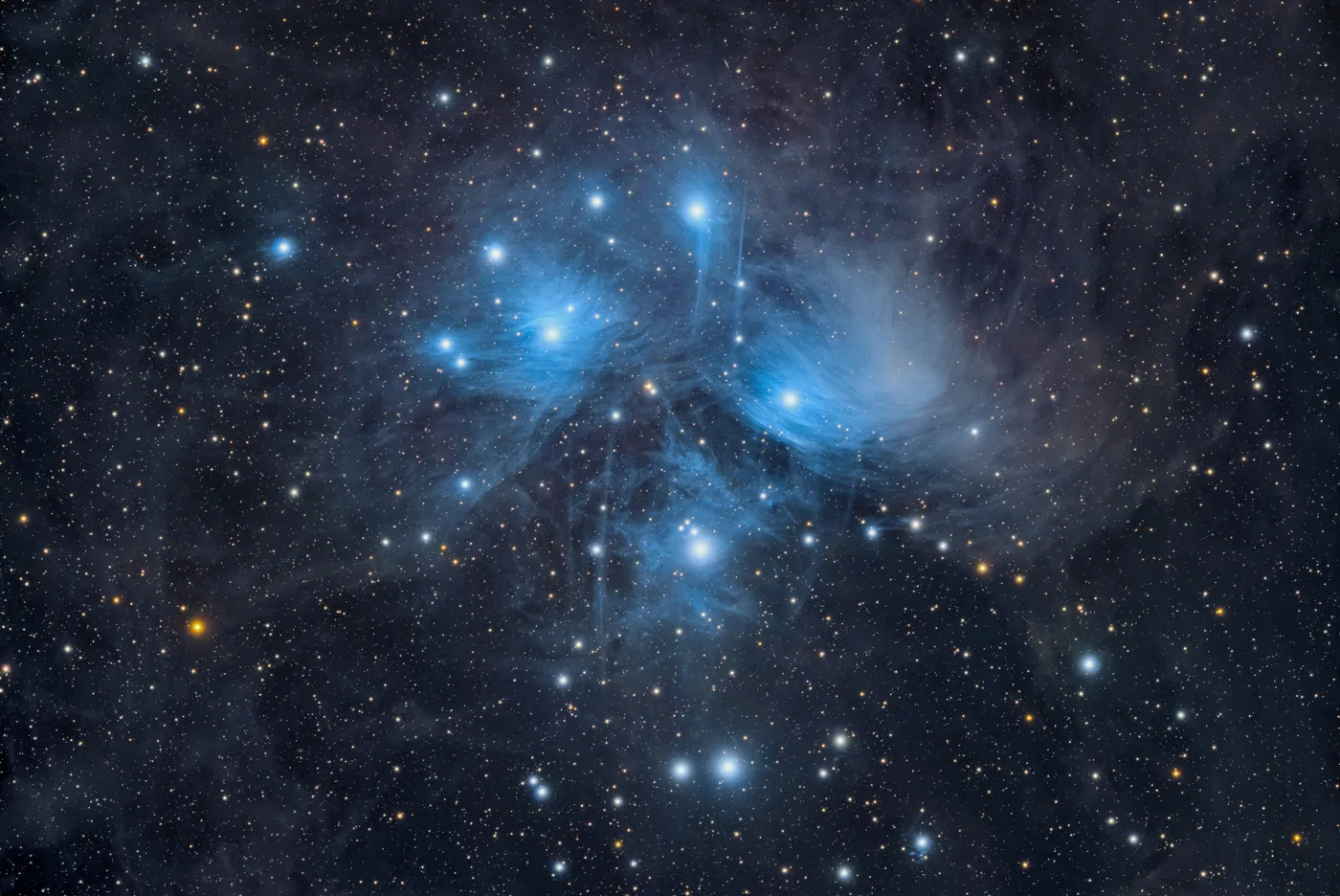
Learning how to see the Pleiades takes about four seconds, because you have almost certainly already seen it and assumed it was something else. That small misty clot of stars over your shoulder on a cold night, the one that looks like a tiny saucepan and vanishes when you stare straight at it, is M45. No equipment, no star-hopping, no app. It is one of the few genuinely spectacular deep-sky objects that asks nothing of you.
The interesting part is not finding it. It is counting it. The number of Pleiades stars you can pick out is one of the fastest and most honest measurements of how good your sky is, and it costs nothing to run.
Where to look, and when
The Pleiades sits in Taurus, at a declination of about +24 degrees. That is high from Britain. Very high.
| From | Maximum height above the horizon |
|---|---|
| London | 63 degrees |
| Manchester | 61 degrees |
| Edinburgh | 58 degrees |
| Inverness | 57 degrees |
Anything above roughly 40 degrees is clear of the worst of the horizon murk and most people’s rooflines, so for the whole country this is an easy object for several hours either side of its highest point.
That highest point, from the UK, falls at these times:
| Date | Highest at |
|---|---|
| 25 September 2026 | 04:32 BST |
| 15 October 2026 | 03:13 BST |
| 1 November 2026 | 01:06 GMT |
| 15 November 2026 | 00:11 GMT |
| 1 December 2026 | 23:08 GMT |
| 15 December 2026 | 22:13 GMT |
| 15 January 2027 | 20:11 GMT |
| 15 February 2027 | 18:09 GMT |
Read that table and the shape of the season falls out of it. In September you are looking at a pre-dawn object. Through November it slides into the small hours. From mid-December onwards it is properly convenient, sitting at its best around ten in the evening and staying high for hours either side. By February it is already high at dusk and setting in the west by late evening.
If you want it overhead at a civilised hour without waiting up, December and January are your months. That matches what the Royal Observatory Greenwich says about the cluster being best between October and April, with November and December the pick.
To find it from scratch, use Orion. Trace the three belt stars up and to the right, past the orange eye of Taurus, Aldebaran, and keep going the same distance again. The Pleiades is the next thing you hit. If Orion is not up yet, just look for the smudge: at magnitude 1.6 overall, it is brighter than most individual stars and is hard to mistake for anything. Our guide to reading a star chart covers the rest of the sky.
What you are actually looking at
| Catalogue name | Messier 45 |
| Constellation | Taurus |
| Distance | about 444 light years |
| Apparent magnitude | 1.6 |
| Apparent size | about 2 degrees |
| Stars in the cluster | over 1,000 |
| Age | about 125 million years |
Two of those numbers do most of the work.
Two degrees is four times the width of the full Moon. Hold that in your head, because it decides which instrument you should be using, and it is the single thing beginners get wrong about this object.
125 million years makes this a young cluster, which is why the bright members are hot blue-white stars. They have not been around long enough to have evolved into anything else. Those stars are genuinely related, born from the same cloud and still travelling together, which is not true of most patterns in the sky.
Counting the stars is a sky test
Most people see six. That is the standard result from a suburban British garden, and it is where the “lost Pleiad” stories come from, because the cluster is called the Seven Sisters and almost nobody counts seven on a casual glance.
Here are the nine named stars with their magnitudes, faintest last:
| Star | Magnitude | |
|---|---|---|
| Alcyone | 2.86 | sister |
| Atlas | 3.62 | father |
| Electra | 3.70 | sister |
| Maia | 3.86 | sister |
| Merope | 4.17 | sister |
| Taygeta | 4.29 | sister |
| Pleione | 5.09 | mother, and variable |
| Celaeno | 5.44 | sister |
| Asterope | 5.64 | sister |
There is a detail in that table worth pausing on. In the myth, the seven sisters are Alcyone, Electra, Maia, Merope, Taygeta, Celaeno and Asterope. Atlas and Pleione are their parents. So the six stars a typical observer counts are five sisters and their father, and to actually see seven sisters you have to pick up Celaeno at magnitude 5.44, which is a properly dark-sky catch. The name has been quietly lying to people for a very long time.
Use the count as a rough grading of your sky:
- Five or six stars. Ordinary suburban sky, limiting magnitude somewhere around 4.5 to 5. Nothing wrong with your eyes.
- Seven. You are doing well. Limiting magnitude around 5.
- Nine, the full named set. A genuinely good site, around magnitude 5.7. Rare from any town.
- A dozen or more. You are somewhere dark and you should be looking at the Milky Way instead.
Two conditions before you trust the result. Give yourself at least 20 minutes without looking at a phone, because dark adaptation is slow and a single glance at a bright screen resets a good part of it. And check the Moon: a gibbous Moon anywhere in the sky will cost you two or three stars on this test. Our light pollution map guide will tell you what you should expect from your postcode before you start.
Use averted vision for the faint ones. Look slightly to the side of where you think the star is and it will appear in the corner of your eye, because the light-sensitive rod cells that pick up faint objects sit off-centre on your retina. Look straight at it and it disappears again. More of this in naked-eye stargazing for beginners.
Why a telescope is usually the wrong instrument
This is where the 2 degrees matters. Your telescope’s true field of view is roughly the apparent field of the eyepiece divided by the magnification, and magnification is the telescope’s focal length divided by the eyepiece’s focal length. Run that for a typical supplied 25mm eyepiece with a 52 degree apparent field:
| Telescope | Focal length | Magnification | True field | Fits M45? |
|---|---|---|---|---|
| Sky-Watcher Heritage 130P | 650mm | 26x | 2.0 degrees | Only just |
| Celestron AstroMaster 130EQ | 650mm | 26x | 2.0 degrees | Only just |
| 70mm refractor | 700mm | 28x | 1.9 degrees | Only just |
| Sky-Watcher Skyliner 200P | 1200mm | 48x | 1.1 degrees | No, about half |
So the honest answer is not “never use a telescope”. It is that only a short-focal-length instrument at its lowest power has any chance of framing the cluster, and even then it fills the entire view with no dark sky around it, which is exactly what makes the Pleiades look good. Put a big Dobsonian on it and you get a handful of bright stars and no cluster.
Binoculars win, and it is not close. A 10x50 pair shows something like 5 to 6 degrees of sky, so the cluster sits in the middle of the field with room to breathe, and the extra aperture over your naked eye pulls in dozens of fainter members. This is the object people buy binoculars for stargazing and then realise they should have bought them first. If you are choosing, our 10x50 vs 15x70 comparison covers the trade-off, and the short version for this target is that 10x50 is the better Pleiades instrument because the wider field matters more than the extra light.
One thing to manage expectations about: the blue nebulosity around Merope that you see in every photograph is a dust cloud the cluster happens to be drifting through, and it is a photographic object. It does not show visually in small instruments from Britain. Do not spend an evening hunting for it and concluding your optics are poor.
Frequently asked questions
Why can I only see six stars when it is called the Seven Sisters? Because the seventh sister, Celaeno, is magnitude 5.44, which is beyond most suburban skies. It is also because one of the six stars most people count is Atlas, the father, not a sister at all. Several cultures have a “lost Pleiad” story that probably reflects exactly this, though Pleione is a variable star and may have been brighter in the past.
Do I need a telescope to see the Pleiades? No, and a telescope usually makes it worse. The cluster is about 2 degrees across, four times the width of the full Moon, so most telescopes cannot fit it in the field of view at all. Binoculars are the right instrument, and the naked eye is a perfectly good one.
When is the best time of year to see the Pleiades from the UK? December and January, when it reaches its highest point in the evening rather than the small hours. On 15 December 2026 it is at its best at 22:13. It is visible from roughly October to April, but in autumn you are up very late and by late winter it is setting early.
Why does it disappear when I look straight at it? Because the cells in your eye that detect faint light sit away from the centre of your retina. Looking slightly to one side of a faint object puts its light onto those cells and it appears. This is called averted vision and it works on almost every faint deep-sky object.
Is the Pleiades the same thing as the Little Dipper? No, and this is a common mix-up. The Pleiades is a compact cluster about 2 degrees wide that does look like a miniature dipper or saucepan. The Little Dipper is Ursa Minor, a large constellation near Polaris containing the Pole Star, and it covers a far bigger area of sky in a completely different direction.
Can I photograph the Pleiades with an ordinary camera? Yes, better than almost any other deep-sky object. It is bright and large, so a camera on a fixed tripod with a short lens and a few seconds of exposure will record the main stars. The blue dust cloud around Merope needs tracked exposures of several minutes, which is where a mount becomes necessary.
Clear skies forecast? Get a nudge.
Our weekly email flags the next good UK observing window and one easy target to find.
Join the listMore from Starvest
Keep reading
Best Telescopes for Beginners in the UK (Tested by Price Bracket)
The best beginner telescopes in the UK by budget, from sub-£150 tabletop scopes to app-guided and smart telescopes, with real 2026 prices.
What Can You See with Binoculars at Night? A Realistic Astronomy List
A realistic list of what you can see with binoculars in astronomy, from the Moon and Jupiter's moons to Andromeda, with tips for spotting each from the UK.
How to Set Up and Use Your First Telescope (Step by Step)
How to use a telescope as a beginner: assemble the mount, align the finder, focus, and find your first targets. A clear step-by-step UK guide.