See Saturn's Rings: What Telescope, and Why 2026 Is Hard
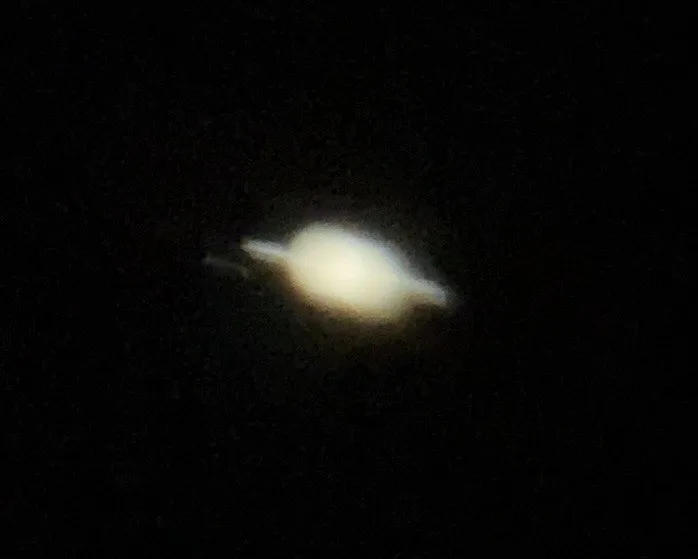
You can see the rings of Saturn with a telescope as small as 60mm at 30x, and almost every guide stops there. The problem with that answer in 2026 is that the rings are nearly edge-on. At the 4 October opposition they are tilted just 7.5 degrees to our line of sight, so the famous ellipse is squashed into something closer to a needle through the planet than a hoop around it. Seeing “rings” this season and seeing structure in them are two very different equipment questions, and the honest answer to both depends on a number the marketing copy never mentions.
The rings are 7.5 degrees open, which is nearly the worst it gets
Saturn’s rings passed exactly edge-on in March 2025, an alignment that happens roughly every 15 years. They are reopening, but slowly, and 2026 is the awkward middle. These are the ring opening angles from NASA’s JPL Horizons ephemeris, converted to the ring plane:
| Date | Rings open |
|---|---|
| 1 August 2026 | 9.1° |
| 14 September 2026 | 8.1° |
| 4 October 2026 (opposition) | 7.5° |
| 1 December 2026 | 6.1° |
| 1 August 2027 | 14.4° |
| Spring 2032 | 26.8° (maximum) |
Two consequences follow. The first is arithmetic: at opposition the ring system spans about 44.7 arcseconds across, but only 5.8 arcseconds top to bottom. That squashed minor axis is smaller than the gap the rings normally show between themselves and the globe, which is why beginners looking through a small scope this year report seeing “a line” rather than rings.
The second is about contrast. When the rings are wide open you see them from above, lit and bright against the sky. Near edge-on you are looking along them, the southern face is presented at a shallow angle, and the whole system throws less light. Saturn is still an easy object, sitting at magnitude 0.33 at opposition, but its rings are working against you.
The minimum telescope that actually shows rings
The threshold is magnification rather than aperture, and it is about 30x.
At 25x the rings are a bulge, the shape Galileo could not interpret. At 30x they separate into something you would recognise as a ring, and any working telescope can reach 30x. So a 60mm or 70mm refractor at 30 to 40x shows the rings this autumn. It shows them as a thin bright line crossing a small yellow disc, which is genuinely a view of Saturn’s rings, and it is also the view that disappoints people who arrived expecting the Cassini spacecraft’s photographs.
Binoculars, even 15x70s on a tripod, will not do it. They show Saturn as a distinctly non-round star, and that is the ceiling. Our comparison of telescopes and binoculars covers where that boundary sits for other targets.
What each aperture adds
60mm to 80mm. Rings as a clean ellipse, the ring shadow cast on the globe on a good night, and Titan as an obvious point of light nearby. Titan is magnitude 8.3 at this opposition, so it is visible in anything. Four or five of the brighter moons are within reach of an 80mm if you know where to look.
100mm to 130mm. The globe starts to show belting, a dusky band or two rather than the crisp detail Jupiter offers. The ring shadow becomes reliable. In steady air a 130mm will show the outer A ring as slightly duller than the bright B ring, which is the first hint of ring structure.
150mm and up. This is where Cassini’s division becomes realistic. The division between the A and B rings is about 4,800 km wide, which at Saturn’s opposition distance of 8.43 astronomical units subtends 0.785 arcseconds. Put that through the Dawes criterion and you get 148mm of aperture, which is why 150mm is the number quoted so often.
That figure deserves one caveat in both directions. A long dark gap is a contrast detection rather than a resolution problem, so experienced observers do pick it up at the ring ansae, the extreme tips east and west of the planet, with 100mm in exceptional air. But the ansae are also the only place it is realistic this year: everywhere else along the rings the division is foreshortened by that 7.5 degree tilt into a fraction of an arcsecond. The Encke gap, often mentioned in the same breath, is 325 km wide and subtends 0.05 arcseconds. No amateur telescope on Earth resolves that, whatever the rings are doing.
Magnification: 100x to 200x, and nothing on the box
Saturn’s disc is 19.7 arcseconds wide at opposition. To work on a planet that small you want it magnified to a comfortable apparent size, which puts the useful window at roughly 100x to 200x.
A practical rule is 2x per millimetre of aperture as an upper limit in good conditions, so 200x on a 100mm and 300x on a 150mm, and that upper limit is only reachable on the rare still night. Most evenings from the UK, 150x will show more than 250x because the image is steadier and brighter. Work out which eyepieces give you that range before you go out; our guide to telescope eyepieces sets out the arithmetic.
Ignore the magnification printed on a telescope box entirely. A 76mm reflector advertised at 525x cannot usefully exceed about 150x, and the eyepiece supplied to hit that headline number produces a dim, mushy blur. Aperture sets what is there to be seen; our explainer on telescope aperture covers why.
Seeing decides your night, not your telescope
On Saturn this matters more than the instrument, and 2026 is a mixed year for it from Britain.
Saturn sits at declination +1° 50’ at this opposition, essentially on the celestial equator. From central England that means it culminates roughly 40 degrees above the southern horizon, which is a substantial improvement on the low-in-Sagittarius years but still puts you through a fair thickness of atmosphere. The implications are concrete:
- Observe within an hour or two of culmination, when Saturn is highest. In early October that falls around local midnight.
- Let the telescope cool. A scope brought straight from a warm house into the garden has air currents inside the tube that will destroy 200x. Reflectors above 150mm need 30 to 60 minutes.
- Avoid looking over rooftops, chimneys and driveways. Heat rising off masonry ruins planetary detail far more than mild light pollution does, and Saturn is bright enough that light pollution barely matters.
- Keep watching. Detail on a planet comes and goes with the atmosphere. Ten minutes at the eyepiece will include moments of clarity that the first thirty seconds does not.
Our piece on astronomical seeing explains what to look for in a forecast before you bother setting up.
When to look, this year and next
Saturn reaches opposition on 4 October 2026, when it is closest, brightest and visible all night. The apparent disc measures 19.70 arcseconds, which is as large as it gets this year, and the difference either side of that date is small: any clear night from late August to December gives you effectively the same target.
If your interest is specifically the rings, be patient. The opening angle drops to 6.1 degrees by December 2026 before reversing, then climbs to 14.4 degrees by the 2027 apparition and keeps going until spring 2032, when the rings stand 26.8 degrees open. A modest telescope in 2032 will show more ring than a large one does now. For choosing the instrument itself, our roundup of telescopes for planets and the beginners’ buying guide both weigh aperture against what you will realistically carry outside.
Frequently asked questions
What size telescope do I need to see Saturn’s rings? Any telescope that reaches 30x will show the rings, so a 60mm or 70mm refractor is enough. To see the Cassini division between the rings you want 150mm of aperture, or 100mm in unusually steady air and only at the ring tips.
Why do Saturn’s rings look like a line rather than a ring? Because they are nearly edge-on. They passed exactly edge-on in March 2025 and are only 7.5 degrees open at the October 2026 opposition, so the ring ellipse measures about 44.7 arcseconds across but under 6 arcseconds top to bottom.
What magnification is best for Saturn? Between 100x and 200x for most telescopes and most UK nights. The theoretical ceiling is about 2x per millimetre of aperture, but atmospheric seeing usually limits you below that, and a steady 150x beats a wobbling 300x every time.
Can you see Saturn’s rings with binoculars? No. Even 15x70 binoculars on a tripod only show that Saturn is not quite round, because ring separation needs roughly 30x. Binoculars are, however, enough to find Saturn and to pick up Titan.
When is the best time to see Saturn in 2026? Opposition is 4 October 2026, when Saturn is at magnitude 0.33 and 19.70 arcseconds wide, and it is well placed from September through to December. Observe near culmination, which is around local midnight in early October, since Saturn only reaches about 40 degrees altitude from the UK.
Can I see Saturn’s moons in a small telescope? Yes. Titan is magnitude 8.3 and shows in a 60mm as a nearby point of light. Rhea, Tethys, Dione and Iapetus need 80mm to 100mm and a chart to identify, because they look exactly like faint field stars.
Clear skies forecast? Get a nudge.
Our weekly email flags the next good UK observing window and one easy target to find.
Join the listMore from Starvest
Keep reading
Best Telescopes for Beginners in the UK (Tested by Price Bracket)
The best beginner telescopes in the UK by budget, from sub-£150 tabletop scopes to app-guided and smart telescopes, with real 2026 prices.
What Can You See with Binoculars at Night? A Realistic Astronomy List
A realistic list of what you can see with binoculars in astronomy, from the Moon and Jupiter's moons to Andromeda, with tips for spotting each from the UK.
How to Set Up and Use Your First Telescope (Step by Step)
How to use a telescope as a beginner: assemble the mount, align the finder, focus, and find your first targets. A clear step-by-step UK guide.