Best Telescopes for Seeing Planets and the Moon
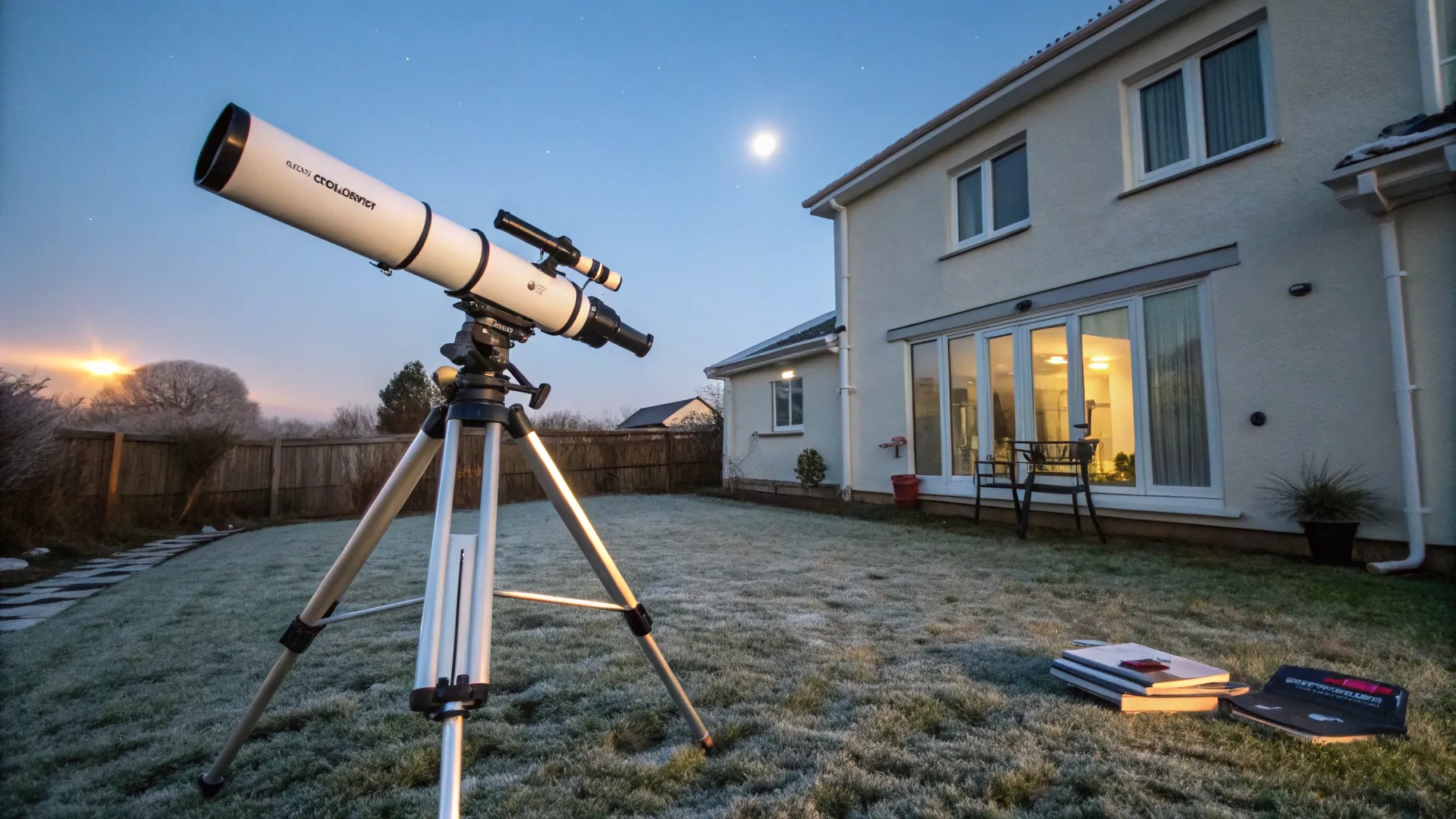
Most “best telescope for planets” lists you will find are written for the US market, with US prices, US shops and a heavy lean towards smart imaging scopes that are poor at planets. This guide is for UK observers: real models you can buy from First Light Optics, the Widescreen Centre, Rother Valley Optics or amazon.co.uk, paired with honest expectations about what each one shows on Saturn, Jupiter, Mars and the Moon, and the British seeing conditions that actually decide how good those views are.
If you only take one thing from this page: for planets and the Moon, a long focal length and high contrast beat raw size. A modest 90mm to 130mm scope on a steady night will out-perform a big, badly cooled, poorly collimated reflector on a turbulent one.
What actually matters for planets and the Moon
Aperture: 70mm is the floor
Aperture is the diameter of the main lens or mirror, and it sets how much light the scope gathers and how much fine detail it can resolve. For planets and the Moon the practical minimum is 70mm. Below that you will see the Moon’s craters and a hint of Saturn’s rings, but the planets stay small and soft.
More aperture helps, but with diminishing returns for planets specifically, because the British atmosphere usually blurs the image before a large mirror can show its full resolution. A 100mm to 150mm scope is the sweet spot for most UK back gardens.
Focal length and focal ratio: longer is better here
Focal length (in mm) is the distance light travels inside the scope before it focuses. Divide it by your eyepiece focal length to get magnification. A beginner scope sits somewhere in the 400mm to 1,000mm range, and for planets you want the upper end of that.
A worked example: a 700mm focal length with a 10mm eyepiece gives 70x, which roughly fills the eyepiece field with the full Moon. That is a very usable Moon view from a fairly ordinary scope.
Focal ratio (the f-number) is focal length divided by aperture. Slow ratios of f/10 to f/15 are ideal for planets: they give high native magnification, a narrow high-contrast field, and they are forgiving of cheaper eyepieces. This is why Maksutov-Cassegrains (often f/12 to f/15) and long refractors are the classic planetary instruments.
Magnification: the rules that matter
Two numbers govern realistic planetary magnification.
- Magnification = telescope focal length divided by eyepiece focal length. A 1,500mm scope with a 10mm eyepiece gives 150x.
- Maximum useful magnification is about 2x the aperture in mm (roughly 50x per inch). A 100mm scope tops out near 200x; a 127mm scope near 250x. Push past that and the image gets dimmer, narrower and mushier rather than more detailed.
In real UK conditions the atmosphere usually caps useful planetary magnification around 150x to 200x, regardless of what the box claims. Any cheap scope advertising “525x” is selling you a number, not a view. Headline magnification claims are a reliable red flag on budget telescopes; what you can resolve is set by aperture and the sky, not by swapping in a tiny eyepiece.
What you will actually see
This is the question most pages dodge. Here is the honest version, at sensible magnifications through a 90mm to 130mm scope on a decent night.
| Target | What is visible | Magnification |
|---|---|---|
| Moon | Craters, mountain ranges, maria in sharp relief; the terminator (the day and night line) shows the most | 50x to 150x |
| Saturn | Rings detectable from 25x to 50x; clearly detached from the disc at 80x to 100x; the Cassini Division (gap between the A and B rings) at 100x to 150x | 80x to 150x |
| Jupiter | Disc with two main cloud bands; the four Galilean moons (even in binoculars); the Great Red Spot needs 100x or more, best at 150x to 200x | 50x to 200x |
| Mars | A small orange disc; polar cap and a few dark markings only near opposition (every 26 months or so) | 150x+ |
| Venus | A bright crescent or gibbous phase, no surface detail (it is permanently cloud-covered) | 60x+ |
| Uranus and Neptune | A tiny blue-green dot or disc, nothing more, even in large scopes | 150x+ |
Two things to be clear about. You will not see vivid colour or surface landscapes; planets show as small, bright, detailed discs, and the reward is the detail (rings, bands, the moving moons), not photographic colour. And Mars is genuinely unimpressive except in the few months around opposition, so do not buy a scope expecting a space-probe view of the red planet.
The Moon and the bright planets cut straight through light pollution, so you do not need dark skies for any of this. City observers can enjoy the Moon and bright planets from their own street; light pollution only really hurts faint deep-sky objects.
Which type of telescope suits planets
There are three relevant designs, and for planets the order of preference is fairly settled.
Maksutov-Cassegrain (best contrast, low maintenance)
A compact sealed tube with a long focal length folded inside it. Maks like the Sky-Watcher Skymax range run at f/12 to f/15, hold their alignment more or less permanently, and give crisp, high-contrast planetary images. The trade-off is a narrow field and a tube that needs a while to cool to outside temperature. For a dedicated planetary and lunar scope, this is the design most UK observers settle on.
Refractors (sharp, sealed, simple)
A lens at the front, no mirror to align. A good achromatic refractor gives sharp, contrasty views of the Moon and brighter planets with effectively zero maintenance. Cheaper achromats show a little false colour (a purple fringe) on the Moon’s bright limb, which is normal and not a fault.
Newtonian reflectors and Dobsonians (most aperture per pound)
A mirror at the back, open tube. You get far more aperture for your money, and a 130mm or 150mm reflector shows the planets very well. The catch is collimation: the mirrors need occasional alignment, and a reflector that is out of collimation gives soft planetary views no matter how good the optics are. Tabletop Dobsonians are the best value entry point if you are happy to learn that one skill. For more on the trade-offs between designs, see our guide to buying a telescope in the UK.
The shortlist: real models on sale in the UK
Stock and pricing move, so always check the current price before you buy. Everything here is genuinely available from UK retailers.
Best all-round planetary scope: Sky-Watcher Skymax-127
- Type: Maksutov-Cassegrain
- Aperture: 127mm | Focal length: 1,500mm (f/12)
This is the model most often recommended when someone specifically wants planets and the Moon. The long 1,500mm focal length gives high native magnification, and the sealed Mak design delivers high contrast: reviewers consistently describe Saturn’s rings as sharply defined and it performs strongly on Mars and Saturn. GoTo versions (the AZ-GTi and the Virtuoso GTi tabletop) are driven from a free phone app and slew to thousands of objects, which helps once you move on to deep-sky targets, though planets are easy enough to find by hand. Check current price at UK retailers.
Best value: Sky-Watcher Heritage-130P FlexTube
- Type: Tabletop Dobsonian (Newtonian)
- Aperture: 130mm | Focal length: 650mm (f/5)
The standing recommendation for a first scope on a budget, and a capable planetary performer once you align the red-dot finder. Reviewers single out the Moon as particularly impressive and report sharp images across the board. The f/5 focal ratio is short, so you will want a higher-power eyepiece or a Barlow lens to reach planetary magnifications, and a Moon filter takes the glare off the full Moon. It collapses for storage and transport. Check current price at UK retailers. It also features in our best telescopes under 200 pounds roundup.
Best step up: Sky-Watcher Heritage 150P / 150P Virtuoso GTi
- Type: Tabletop Dobsonian (manual) or GoTo Dob (Virtuoso GTi)
- Aperture: 150mm | Focal length: 750mm (f/5)
The Virtuoso GTi version is a BBC Sky at Night Magazine reviewed scope. The 150mm mirror gathers roughly a third more light than the 130mm, which shows as extra detail on the planets and a brighter Moon. The Virtuoso GTi version adds tracking and phone-driven GoTo while keeping the tabletop format. If your budget stretches and you have somewhere to store a slightly larger tube, this is the better long-term scope.
Best for finding things without GoTo: Celestron StarSense Explorer DX 130AZ
- Type: Newtonian reflector
- Aperture: 130mm | Focal length: 650mm (f/5)
The StarSense Explorer system uses your phone’s camera to plate-solve the sky and walk you to a target with on-screen arrows, no motors required. For planets you barely need it (they are bright and obvious), but it makes the scope far less frustrating for a beginner moving on to fainter objects. A 102AZ refractor version exists if you prefer a lens-based scope. Check current price at UK retailers.
Best budget refractor: Sky-Watcher Evostar-90 (AZ Pronto)
- Type: Achromatic refractor
- Aperture: 90mm | Focal length: 660mm (f/7.3)
A BBC Sky at Night Magazine reviewed scope and a clean, low-maintenance entry to planetary viewing. The sealed tube never needs collimation, and the AZ Pronto mount is simple to point. At 90mm you are at the practical lower end for detail, but the Moon and the bright planets are well within reach. Check current price at UK retailers.
Premium planetary specialists
If budget is not the constraint, two scopes are worth knowing. The Celestron NexStar 8SE is a 203mm (8-inch) Schmidt-Cassegrain at 2,032mm f/10 on a computerised fork mount: a lot of aperture and reach in a portable package. The Sky-Watcher Skymax-180 Pro is a 180mm Mak at 2,700mm f/15, a long-focus instrument built specifically for high-magnification planetary and lunar work. Both want a steady mount and a willingness to spend.
Do you need a GoTo or computerised mount?
For planets, no. The Moon, Jupiter, Saturn, Venus and Mars are among the brightest objects in the sky and easy to find with a simple finder and a star chart app. A manual alt-azimuth mount (the up-down, left-right kind) is perfectly fine, and your money is better spent on aperture and a good eyepiece.
GoTo and tracking earn their keep two ways: when you move on to faint deep-sky objects that are genuinely hard to locate, and at high planetary magnification, where the planet drifts out of a non-tracking field within a minute or two and you have to keep nudging the scope. If you expect to spend a lot of time above 150x, a tracking mount is a real convenience. Otherwise it is optional.
Skip the smart telescopes for planets
The Seestar S30 and S50, the Dwarf 3 and the Vaonis Hestia dominate “best beginner telescope” lists right now, and they are clever devices. They are also the wrong tool for planets. They use small apertures and are built to stack long exposures of faint, large deep-sky objects (nebulae and galaxies), which is the opposite of the small, bright, high-magnification target a planet presents. Point one at Jupiter and you get a tiny overexposed blob. If your main interest is planets and the Moon, buy an optical scope from the list above. If you mostly want to photograph nebulae, that is a different guide; see our astrophotography for beginners page.
Eyepieces, Barlows and filters
The scope is only half the optical system. A new telescope usually ships with one or two basic eyepieces, and a couple of cheap additions transform planetary viewing.
- A higher-power eyepiece or a Barlow lens. A 2x Barlow doubles the magnification of any eyepiece, so a 10mm becomes the equivalent of a 5mm. On short f/5 reflectors this is how you reach planetary powers at all. Stay within the 2x-aperture ceiling.
- A Moon filter. The full Moon is genuinely dazzling through any decent scope. A neutral-density Moon filter cuts the glare so you can pick out detail comfortably, and it costs very little.
- A decent finder. A red-dot finder is fine for the Moon and bright planets; just align it carefully in daylight on a distant chimney pot before you start.
You do not need a drawer full of eyepieces. One low-power (wide view, for finding things), one medium and one high-power, plus a Barlow, covers everything planetary.
UK seeing: the part US guides leave out
For planets, the steadiness of the atmosphere (“seeing”) matters more than aperture. A large scope on a turbulent night shows a boiling, soft image; a small one on a still night shows crisp detail. You cannot buy your way past bad seeing, but you can choose when to observe.
- Time of year. UK seeing is typically best from July to October, worst around December, and improving again through February and March.
- Time of night. The two hours just after sunset are poor, because the ground is dumping the day’s heat into the air and stirring up turbulence. Stability is usually best after midnight and before dawn.
- Altitude. Let the planet climb to at least 25 degrees above the horizon before you observe. Low down you are looking through more air and more haze, and the view shimmers.
- Cool the scope. Put a reflector or a Mak outside 30 to 60 minutes before you observe so the tube reaches air temperature. Tube currents from a warm scope blur planetary detail.
- Collimation. If you buy a reflector, learn to collimate it. A scope that is out of alignment will never show sharp planets, and it is the single most common reason a good reflector under-performs.
For current UK model recommendations, the BBC Sky at Night Magazine best telescopes for observing the planets list is a useful authoritative reference.
How to choose, by budget and intent
- Smallest budget, planets and Moon first: Sky-Watcher Heritage-130P. Best optics per pound; just budget for a Barlow and a Moon filter. See also our best telescopes for beginners.
- A bit more to spend, want the cleanest planetary contrast: Sky-Watcher Skymax-127. The classic dedicated planetary Mak.
- Want more aperture and a bit of help finding things: Heritage 150P / 150P Virtuoso GTi, or the StarSense Explorer DX 130AZ.
- Low maintenance above all, refractor preference: Sky-Watcher Evostar-90.
- Budget no object, high-magnification specialist: Celestron NexStar 8SE or Sky-Watcher Skymax-180 Pro.
If you are still working out the basics of mounts, eyepieces and what your money buys, start with how to buy a telescope in the UK.
Frequently asked questions
What size telescope do I need to see Saturn’s rings? A 70mm scope will show the rings as a clear feature around the planet. To see them properly detached from the disc you want about 80x to 100x magnification, which most 90mm and larger scopes manage easily. To split the Cassini Division (the gap between the A and B rings) you need around 100x to 150x and steady seeing, which a 100mm or larger scope on a good night can deliver.
What magnification do I need to see planets? Most planetary detail appears in the 50x to 200x range. Saturn’s rings show from 80x, Jupiter’s Great Red Spot from about 100x (best at 150x to 200x), and the Moon is rewarding anywhere from 50x to 150x. Remember the ceiling: maximum useful magnification is roughly twice the aperture in mm, and UK atmospheric seeing usually caps real-world planetary views around 150x to 200x whatever the box claims.
Can you actually see colour and detail, or just dots? You see real detail, but not vivid colour. Saturn’s rings, Jupiter’s cloud bands and four moons, and the Moon’s craters are all clearly visible as fine detail. What you will not see is photographic colour or surface landscapes; planets appear as small, bright, detailed discs. Uranus and Neptune do stay as tiny dots even in large scopes.
Refractor, reflector or Maksutov: which is best for planets? For pure planetary and lunar contrast with minimal fuss, a Maksutov-Cassegrain (like the Skymax-127) is the usual winner: long focal length, high contrast, no collimation needed. A long refractor is similarly low-maintenance and sharp. A Newtonian reflector or Dobsonian gives you the most aperture for your money and shows the planets very well, with the trade-off that you must keep the mirrors collimated.
Do I need a GoTo or computerised mount for planets? No. The planets and the Moon are bright and easy to find with a simple finder, so a manual mount is fine and your money is better spent on aperture. GoTo and tracking become genuinely useful when you move on to faint deep-sky objects, or if you spend a lot of time above 150x where a non-tracking planet drifts out of view quickly.
What is the best telescope for planets under 200 pounds? The Sky-Watcher Heritage-130P FlexTube is the standard recommendation at this budget: a 130mm reflector with sharp optics, a particularly impressive Moon, and a collapsible tube. Add a Barlow lens and a Moon filter to get the most from it. Our best telescope under 200 pounds page covers the alternatives.
Can I see planets from a city with light pollution? Yes. The Moon and the bright planets (Jupiter, Saturn, Venus, Mars) are easily bright enough to cut through light pollution, so you can observe them from a city street or a back garden. Light pollution mainly hurts faint deep-sky objects like nebulae and galaxies, not planets.
Do I need special eyepieces or a Barlow? A couple of cheap additions help a lot. A higher-power eyepiece or a 2x Barlow lens lets you reach planetary magnifications, which matters most on short f/5 reflectors. A neutral-density Moon filter cuts the glare of the full Moon. You do not need many eyepieces: one low, one medium, one high, plus a Barlow, covers planetary viewing.
Are smart telescopes like the Seestar or Dwarf good for planets? No. Smart telescopes are designed to stack long exposures of large, faint deep-sky objects, and they use small apertures. Point one at a planet and you get a tiny, overexposed blob. For planets and the Moon, choose an optical telescope from the list above; smart scopes are a tool for nebula and galaxy imaging.
When is the best time of year to view planets in the UK? Atmospheric steadiness, which matters more than anything for planets, is typically best from July to October and worst around December. On any given night, the views are usually steadiest after midnight and before dawn, once the ground has stopped releasing the day’s heat. Let the planet rise to at least 25 degrees above the horizon before you observe.
Clear skies forecast? Get a nudge.
Our weekly email flags the next good UK observing window and one easy target to find.
Join the listMore from Starvest
Keep reading
Best Telescopes for Beginners in the UK (Tested by Price Bracket)
The best beginner telescopes in the UK by budget, from sub-£150 tabletop scopes to app-guided and smart telescopes, with real 2026 prices.
What Can You See with Binoculars at Night? A Realistic Astronomy List
A realistic list of what you can see with binoculars in astronomy, from the Moon and Jupiter's moons to Andromeda, with tips for spotting each from the UK.
How to Set Up and Use Your First Telescope (Step by Step)
How to use a telescope as a beginner: assemble the mount, align the finder, focus, and find your first targets. A clear step-by-step UK guide.