Full Moon Dates 2027 UK: All 12, With UK Times and Names
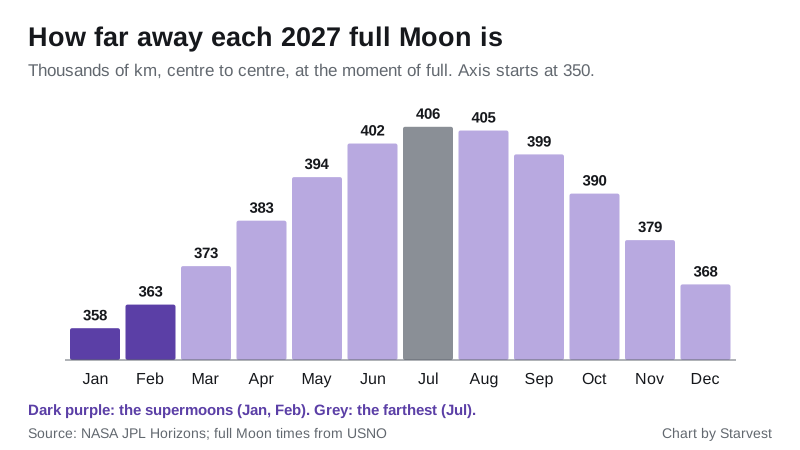
These are the full moon dates for 2027 in UK clock time: twelve full Moons, starting with the Wolf supermoon at 12.17pm on Friday 22 January and ending with the Cold Moon at 4.09pm on Monday 13 December. There is no calendar blue moon in 2027, but there is a seasonal one in May, a penumbral lunar eclipse you can watch from the UK on 20 February, and a clear split between the year’s closest full Moon (January) and its farthest (July).
Every time below comes from the US Naval Observatory’s Moon phases table, which gives Universal Time. We have converted each one to UK clock time: GMT until 28 March 2027, BST (one hour ahead) from 28 March to 31 October, then GMT again. Several popular lists skip that step and print UTC all summer, which puts the September full Moon on the wrong day.
Full moon dates 2027 at a glance
| Date | UK time | Name | Best evening to look (London moonrise) |
|---|---|---|---|
| Fri 22 January | 12.17pm GMT | Wolf Moon, supermoon | Fri 22 Jan (4.34pm) |
| Sat 20 February | 11.23pm GMT | Snow Moon, supermoon, eclipse | Sat 20 Feb (5.01pm) |
| Mon 22 March | 10.44am GMT | Worm Moon | Mon 22 Mar (6.49pm) |
| Tue 20 April | 11.27pm BST | Pink Moon | Tue 20 Apr (8.08pm) |
| Thu 20 May | 11.59am BST | Flower Moon, seasonal blue moon | Thu 20 May (9.42pm) |
| Sat 19 June | 1.44am BST | Strawberry Moon | Fri 18 Jun (9.34pm) |
| Sun 18 July | 4.45pm BST | Buck Moon, farthest of the year | Sun 18 Jul (9.18pm) |
| Tue 17 August | 8.29am BST | Sturgeon Moon | Mon 16 Aug (8.00pm) |
| Thu 16 September | 12.03am BST | Harvest Moon | Wed 15 Sep (6.47pm) |
| Fri 15 October | 2.47pm BST | Hunter’s Moon | Fri 15 Oct (5.34pm) |
| Sun 14 November | 3.26am GMT | Beaver Moon | Sat 13 Nov (3.19pm) |
| Mon 13 December | 4.09pm GMT | Cold Moon | Mon 13 Dec (3.17pm) |
Moonrise times are for London from the USNO rise and set calculator. Elsewhere in the UK they differ by up to about 20 minutes, and hills or buildings on the eastern horizon delay what you actually see.
The “best evening” is the one closest to the exact moment of full. When full falls in the small hours (June, September, November), the evening before is the night to look; when it falls in the morning or early afternoon, either evening works, because the Moon looks full to the eye for about a day either side. A full Moon always rises close to sunset, so the moonrise time is also roughly when it appears in the east.
The two supermoons and the farthest full Moon
A supermoon is a full Moon near perigee, the closest point of the Moon’s slightly oval orbit. We took the Moon’s distance at the moment of each full Moon from NASA JPL’s Horizons ephemeris:
- 22 January: about 357,640 km, the closest full Moon of 2027. Full details on our January 2027 full Moon page.
- 20 February: about 363,300 km, the second closest, and a supermoon under the common definition.
- 18 July: about 405,980 km, the farthest of the year, sometimes called a micromoon.
January’s full Moon is about 14% wider and about 29% brighter than July’s. Side by side the difference would be obvious; a month apart, nobody can tell by eye. The chart above shows how the distance swings through the year, closest in winter and farthest in high summer.
The eclipse on 20 February
The February full Moon passes through the outer part of Earth’s shadow, the penumbra, in a penumbral lunar eclipse. From the UK the whole thing is visible, all in GMT:
- Eclipse begins: 9.12pm, Saturday 20 February
- Greatest eclipse: 11.13pm
- Eclipse ends: 1.13am, Sunday 21 February
The Moon misses the dark central shadow by a whisker, so this is about as deep as a penumbral eclipse gets. Even so, do not expect a red Moon. Around 11pm look for a soft grey shading on one side of the disc, easiest to judge in a photo or with binoculars. A phone on a tripod helps (see how to photograph the Moon with a phone).
The two other lunar eclipses of 2027 cannot be seen from the UK. On 18 July the Moon only grazes the penumbra in UK daytime, and on 17 August the eclipse starts at 6.24am BST, after the Moon has set in London.
The seasonal blue moon in May
There is no month in 2027 with two full Moons, so there is no “calendar” blue moon. There is a seasonal one. Spring 2027 runs from the March equinox (8.25pm GMT on 20 March) to the June solstice (3.11pm BST on 21 June) and holds four full Moons: 22 March, 20 April, 20 May and 19 June. By the older rule, the third of four full Moons in a season is the blue moon, which makes it Thursday 20 May. It will not look blue.
Harvest Moon and Hunter’s Moon
The Harvest Moon is the full Moon nearest the September equinox, which falls at 7.02am BST on 23 September 2027. The 16 September full Moon is a week away from it, against three weeks for October’s, so September takes the name and October’s becomes the Hunter’s Moon.
Watch for the date change. The September full Moon is at 11.03pm UTC on 15 September, which most international lists print, but at 12.03am BST on Thursday 16 September in UK time. Either way, Wednesday 15 September is the evening to look.
Where the names come from
The names in the table (Wolf, Snow, Worm and so on) are the ones popularised by North American almanacs and now used on most UK sites. Older English and Anglo-Saxon calendars used different ones, and none of them is official. What is fixed is the astronomy: the dates, the times and the distances.
The full Moon also sits in a different constellation each month, and astrology sites often name the wrong one. On Horizons, the January full Moon is among the stars of Cancer, February’s in Leo, March and April in Virgo, May in Libra, June and July in Sagittarius, August in Capricornus, September and October in Pisces, November in Aries and December in Taurus. Summer full Moons sit low in the south from the UK because they are in the southern constellations; winter ones ride high.
How to watch a full Moon
You need nothing but a clear horizon. For a moonrise, find a view east (north-east in winter, south-east in summer) and be there five minutes before the London time above, adjusted for your town. Binoculars show the large dark seas and the bright rays from the crater Tycho. A small telescope at full Moon is dazzling and flat, because there are no shadows; the first and last quarter phases show far more relief. Our guide to how to observe the Moon covers what to look for, and the moon phase calculator gives the phase for any date.
Frequently asked questions
When is the first full moon of 2027 in the UK? Friday 22 January 2027 at 12.17pm GMT. It is the Wolf Moon and the closest full Moon of the year. Look on the evening of Thursday 21 or Friday 22 January.
How many full moons are there in 2027? Twelve, one in each month. There is no calendar blue moon (two full Moons in one month) in 2027.
Are there any supermoons in 2027? Yes. The full Moons of 22 January (about 357,640 km away) and 20 February (about 363,300 km) are the year’s supermoons. January’s is the closer of the two.
Is there a lunar eclipse visible from the UK in 2027? Yes, one: a penumbral eclipse on Saturday 20 February, from 9.12pm to 1.13am GMT, greatest at 11.13pm. It shows as faint shading on one side of the Moon, not a red Moon. The July and August eclipses are not visible from the UK.
When is the Harvest Moon in 2027? At 12.03am BST on Thursday 16 September 2027, so the evening to look is Wednesday 15 September.
Are these times in GMT or BST? Both, as the clocks are: GMT for January to March and November to December, BST for April to October. The clocks go forward on 28 March 2027 and back on 31 October 2027.
Sources
- US Naval Observatory, Moon phases, rise and set times, and Earth’s seasons, 2027, read 7 November 2026.
- NASA JPL Horizons ephemeris, Moon distance and constellation at each full Moon.
- Contact times for the 20 February penumbral eclipse as published from NASA’s eclipse predictions (Espenak).
Clear skies forecast? Get a nudge.
Our weekly email flags the next good UK observing window and one easy target to find.
Join the listMore from Starvest
Keep reading
Best Telescopes for Beginners in the UK (Tested by Price Bracket)
The best beginner telescopes in the UK by budget, from sub-£150 tabletop scopes to app-guided and smart telescopes, with real 2026 prices.
What Can You See with Binoculars at Night? A Realistic Astronomy List
A realistic list of what you can see with binoculars in astronomy, from the Moon and Jupiter's moons to Andromeda, with tips for spotting each from the UK.
How to Set Up and Use Your First Telescope (Step by Step)
How to use a telescope as a beginner: assemble the mount, align the finder, focus, and find your first targets. A clear step-by-step UK guide.