How to Find the Orion Nebula: The Fuzzy Star in the Sword
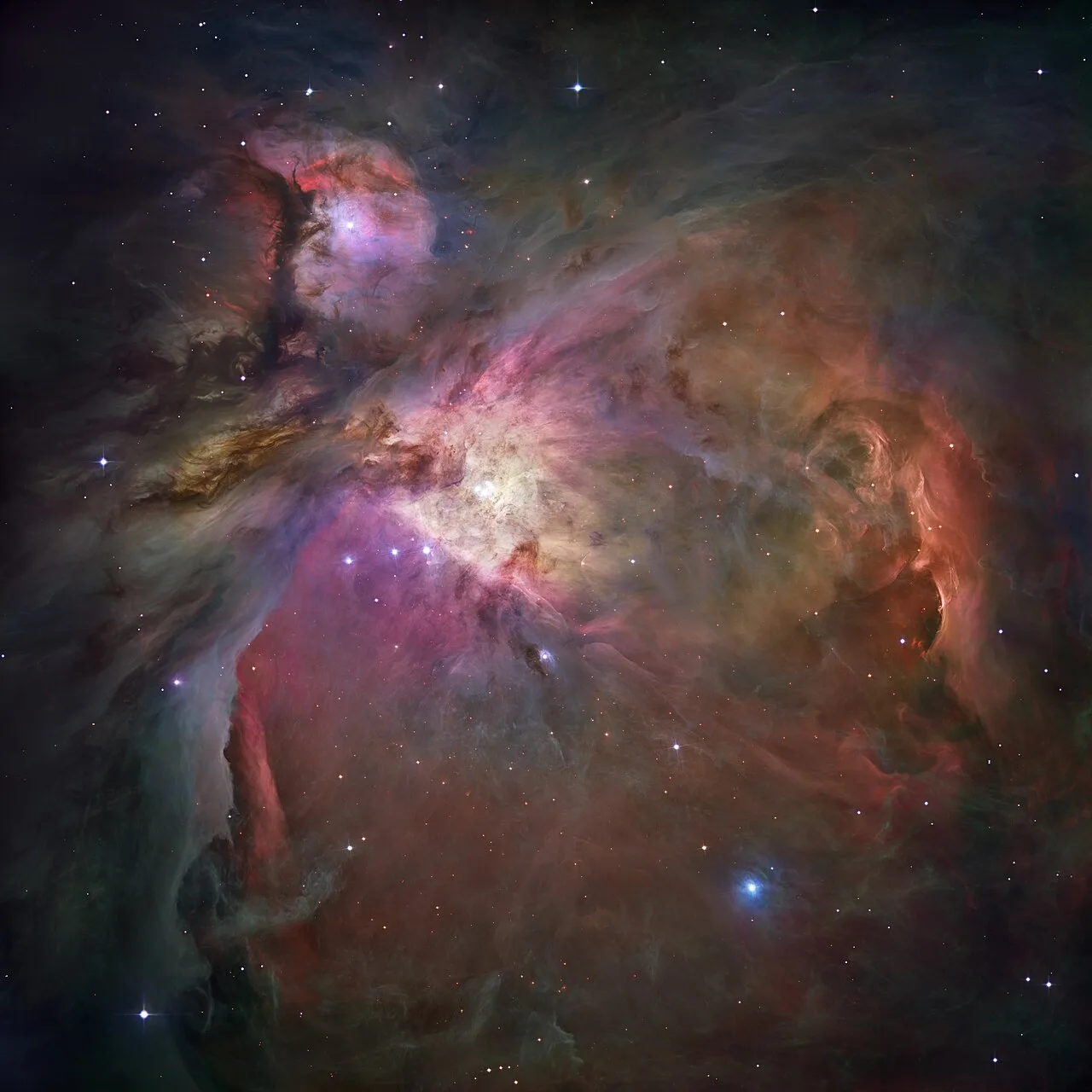
Learning how to find the Orion Nebula takes about thirty seconds once someone shows you the trick, and it is the single best thing to point a first telescope at. Find Orion’s Belt, drop down to the three fainter stars hanging beneath it, and look at the middle one. It is not a star. It is a cloud of glowing gas roughly 1,500 light years away, bright enough that the fuzziness gives itself away in binoculars and turns into a structured, wing-shaped thing in even a small scope.
This is the deep-sky object that converts people. Andromeda is bigger and further, but from a British back garden it usually looks like a smudge. The Orion Nebula gives you detail on the first night.
Step one: find Orion’s Belt
Three bright stars in a short, straight, evenly spaced line. Nothing else in the sky looks like that, which is why the Belt has been the beginner’s landmark for as long as people have been pointing at things. From the UK, Orion sits in the southern half of the sky, standing more upright than the pictures in old star atlases suggest.
If you are not sure you have the right stars, check the two bright ones bracketing the Belt: orange Betelgeuse above and to the left, blue-white Rigel below and to the right. The colour difference is obvious to the naked eye once you look for it.
Step two: drop to the Sword
Below the Belt hangs a shorter, fainter, slightly ragged line of three points. That is the Sword. From a dark site it is easy naked-eye; from a town you may need binoculars to pick it out at all.
The middle object in the Sword is the Orion Nebula, catalogued as Messier 42 or M42. At magnitude 4.0 it is naked-eye visible under a dark sky, and it is the only Messier object most people have accidentally seen without knowing what it was. Look slightly to one side of it and it swells: that is averted vision, and it works on every faint object.
Step three: point something at it
- Naked eye. A soft, slightly swollen point that refuses to sharpen. That is the giveaway.
- Binoculars, 10x50 or bigger. A definite grey patch with a bright core and a wedge shape. Steady the binoculars against a wall or fence and the shape resolves properly. Our binoculars for stargazing guide covers what else works at this size.
- A 70mm to 90mm refractor. The wings appear, curving away from the core like a bird in flight, with a dark notch biting into the bright centre.
- A 130mm to 200mm reflector. Faint outer nebulosity, clear texture, and the dark lane splitting M42 from its smaller neighbour M43 becomes obvious. This is where the object stops being a smudge and starts being a landscape.
The Trapezium: four stars inside the glow
At the heart of the nebula sits a tight knot of hot young stars called the Trapezium. Four of them are within reach of a small telescope, and they are the stars lighting the whole cloud up.
The trick is magnification. At 25x or 30x the Trapezium looks like a single bright blob. Push to 100x or more and it splits cleanly into four points arranged in a lopsided quadrilateral. A fifth and sixth component exist, fainter and much harder, and whether you see them depends on aperture and on how steady the air is that night. Our guide to astronomical seeing explains why the same scope shows four stars one night and six the next.
Why it looks grey, not pink
Every photograph of the Orion Nebula is magenta and teal. Through an eyepiece it is grey, sometimes with a faint green cast. Nothing is wrong with your telescope.
Human colour vision needs more light than the nebula delivers to your eye in real time. A camera accumulates photons over minutes; your retina resets every fraction of a second. The green tint that some observers report in larger scopes is real and comes from doubly ionised oxygen, which sits near the peak of dark-adapted eye sensitivity. Anyone who tells you they see pink at the eyepiece is describing a photograph.
When to look from the UK
Orion is a winter constellation from Britain, and the useful evening season runs from late November to early April. It is best placed around the turn of the year, when it crosses the meridian near local midnight in mid-December and sits due south in the early evening through January and February. NASA lists January as the best month to observe M42, which matches British experience.
Right now, in September, Orion is a pre-dawn object. It clears the horizon after midnight and sits low in the southeast before the sky brightens, which is why some observers call it the ghost of the summer dawn. It is worth catching that way if you are up early, but wait for winter for a proper look.
One thing nobody warns beginners about: the Orion Nebula never gets very high from the UK. M42 sits about five degrees south of the celestial equator, so its maximum altitude is roughly ninety degrees minus your latitude minus five. From southern England that is about 33 degrees above the horizon at best, from central Scotland closer to 28. You are always looking through a thicker slice of atmosphere than an observer in Spain, so pick a night of good transparency and a view south that is not blocked by a roofline.
Getting more out of it
- Let your eyes adapt. Twenty minutes with no white light. A red torch is the standard fix, and phone screens undo the whole thing in seconds.
- Use low power first. Find it at wide field, then increase magnification once it is centred. See how to find objects with a telescope for the general technique.
- Try a UHC filter. A narrowband nebula filter cuts skyglow and lifts the fainter outer structure, which matters more the closer you live to a town. It does nothing for the Trapezium stars themselves.
- Check the Moon. A full Moon anywhere in the sky flattens the contrast. Aim for the week either side of new Moon.
- Go somewhere darker if you can. The core survives suburban light pollution; the outer wings do not. Our dark sky sites list covers where to go.
What to look at next
Once M42 is easy, the same corner of sky has more. M43 is the comma-shaped patch just north of the main nebula, separated by the dark lane. Further north again, NGC 1977 carries the nickname the Running Man, though it is a reflection nebula and needs dark skies and patience to show visually. And the Belt itself hides Sigma Orionis, a multiple star that splits beautifully at moderate power, covered in our double stars for small telescopes guide.
For a wider seasonal plan, the Royal Observatory Greenwich night sky guide lists what else is up month by month, and our best time of year for stargazing in the UK page covers the weather side of the same question.
Frequently asked questions
Where exactly is the Orion Nebula? It is the middle object in Orion’s Sword, the short line of three fainter points hanging below Orion’s Belt. In catalogue terms it sits at around 5h 35m right ascension and 5 degrees south declination, in the constellation Orion.
Can you see the Orion Nebula with the naked eye? Yes, under a reasonably dark sky. At magnitude 4.0 it shows as a fuzzy, unfocusable point in the Sword. From a lit town centre you will probably need binoculars to see it at all, and averted vision helps in both cases.
What telescope do I need to see the Orion Nebula properly? Any telescope shows it. A 70mm refractor gives the wing shape and the dark notch; a 130mm or larger reflector adds outer nebulosity and clear texture. Aperture buys detail here rather than access, which is unusual for a deep-sky object. Our best telescope for beginners guide covers the sizes worth buying.
Why does the Orion Nebula look grey through my telescope? Because your eye cannot register colour at that light level. Photographs stack minutes of exposure; your retina cannot. Larger apertures sometimes show a faint green tinge, which is genuinely there, but the pinks and reds in images are beyond visual reach.
How far away is the Orion Nebula? NASA quotes 1,500 light years. Other measurements put it nearer 1,300, and the spread reflects how hard it is to pin down distances to a region that is still forming stars. Either way it is the closest large star-forming region to us.
When is the best time of year to see it from the UK? Late November to early April in the evening, with December to February the sweet spot. In September it is only available before dawn, low in the southeast.
Clear skies forecast? Get a nudge.
Our weekly email flags the next good UK observing window and one easy target to find.
Join the listMore from Starvest
Keep reading
Best Telescopes for Beginners in the UK (Tested by Price Bracket)
The best beginner telescopes in the UK by budget, from sub-£150 tabletop scopes to app-guided and smart telescopes, with real 2026 prices.
What Can You See with Binoculars at Night? A Realistic Astronomy List
A realistic list of what you can see with binoculars in astronomy, from the Moon and Jupiter's moons to Andromeda, with tips for spotting each from the UK.
How to Set Up and Use Your First Telescope (Step by Step)
How to use a telescope as a beginner: assemble the mount, align the finder, focus, and find your first targets. A clear step-by-step UK guide.