How to See a Comet in the UK: Magnitudes That Matter
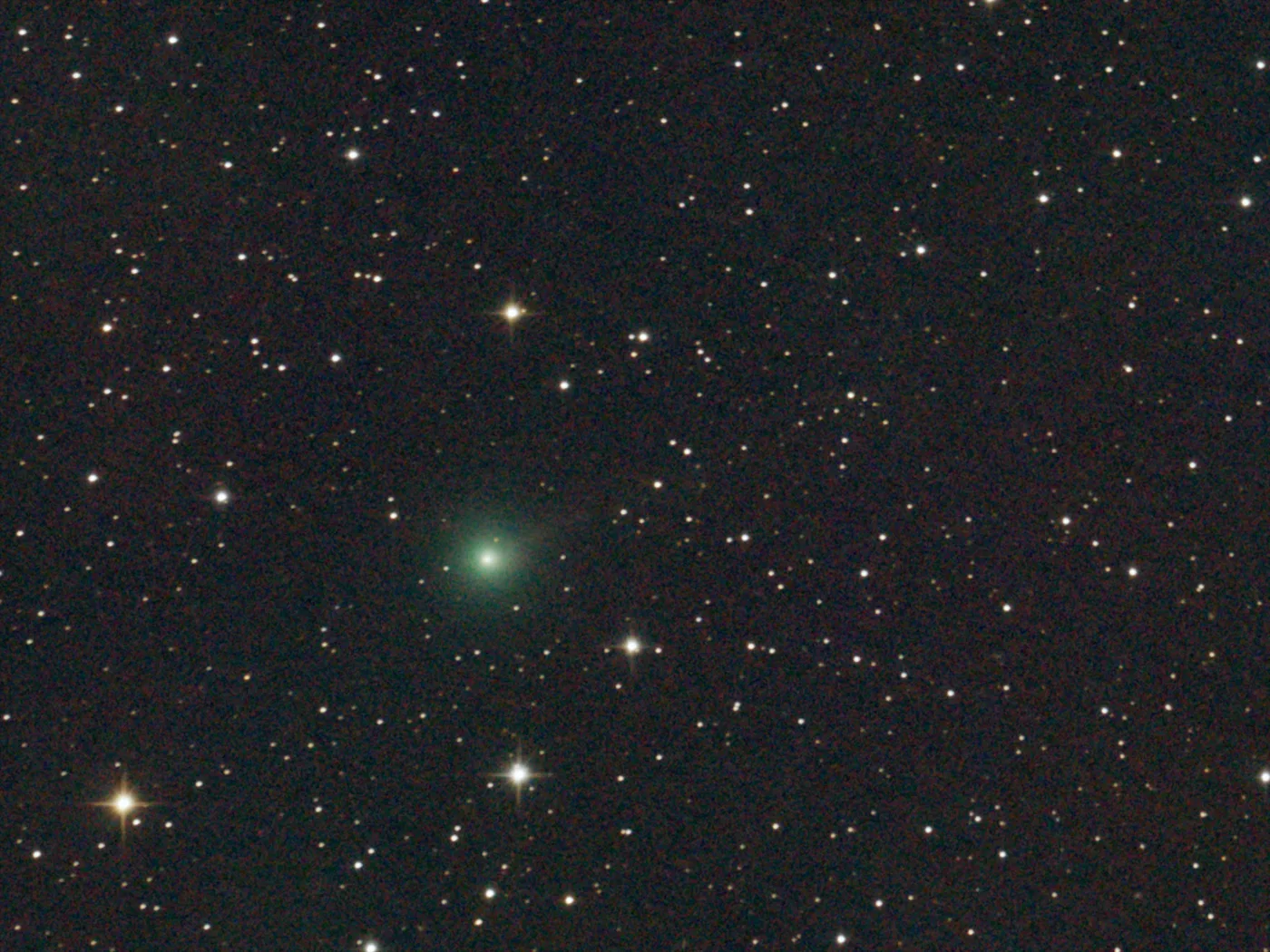
If you want to know how to see a comet in the UK, start with an honest fact: in early October 2026 there is no comet you can see without optical help. The brightest one around, 10P/Tempel, is fading from about magnitude 10 to 12.5 through the month and sits low in the southern evening sky, a small telescope target at best from Britain. The next good chance is 2P/Encke in late January 2027, which the British Astronomical Association calls one of its best returns for northern observers since 2003.
So this page is about getting ready. It covers what the published brightness figures actually mean, why so many comets disappoint, the special problems of seeing them from British latitudes, and where to check what is up before you go out.
What a comet’s magnitude really tells you
Astronomers rate brightness on the magnitude scale, where smaller numbers are brighter. Each step of one magnitude is about 2.5 times brighter or fainter. The catch with comets is that their published magnitude is the light of the whole fuzzy head added together, as if squeezed into a point. A star of magnitude 6 is a sharp pinprick. A comet of magnitude 6 is that same light smeared over a patch that can be bigger than the Moon, so it looks far fainter than the number suggests.
As a working guide for a UK observer:
| Comet’s total magnitude | What you need | What you will see |
|---|---|---|
| Brighter than 3 | Your eyes, even from a town | An obvious fuzzy star, often with a visible tail |
| 3 to 5 | Eyes from a dark rural site; binoculars from a town | A faint smudge by eye, clearer in binoculars |
| 5 to 8 | 10x50 binoculars or larger | A grey glow, sometimes with a brighter centre |
| 8 to 11 | A 100 to 150mm telescope, dark sky | A small, faint patch you find by star-hopping |
| Fainter than 11 | 200mm or more, or a smart telescope | A tiny smudge, or a stacked image |
These bands are approximate. A comet with a small, tightly condensed head is easier than one with a large, diffuse head at the same magnitude. For more on what different optics show, see our pages on what you can see with binoculars and 10x50 vs 15x70 binoculars.
Why comets so often underperform
Comet brightness is forecast from how a comet has behaved so far, but comets are loose balls of ice and dust and do not always follow the curve. Three things go wrong regularly:
- The forecast assumes steady brightening. A comet that is new to the inner solar system can flare early, then level off. Headlines are written from the early surge.
- They break up. Comet C/2026 A1 (MAPS), a sungrazer found in January 2026, brightened fast and drew “great comet” coverage. It fell apart a few hours before its closest approach to the Sun on 4 April 2026. Even before that, it was placed better for southern observers than for Britain.
- The brightest moment is the hardest to see. A comet is usually brightest near the Sun, which means it is also nearest the Sun in our sky, low down in bright twilight.
Sometimes it works the other way. C/2025 A6 (Lemmon) ended up about 400 times brighter than early predictions and reached roughly magnitude 3.5 to 4.4 in October 2025. It was circumpolar from latitudes north of 48 degrees, so it never set from anywhere in Britain, and it was visible by eye from dark sites in the evening sky.
The lesson: treat any comet forecast more than a few weeks ahead as a possibility, and check real observations closer to the time.
The UK problems: twilight, latitude and the horizon
Britain sits between about 50 and 60 degrees north. That shapes comet watching in three ways.
Low altitude in twilight. A comet near the Sun appears either in the west after sunset or the east before dawn, often only 5 to 15 degrees up while the sky is still bright. You need a flat, clear horizon in the right direction. A hillside, a coast facing west or east, or a top-floor window can make the difference. Houses and trees on a town horizon will hide it completely.
Summer nights never get properly dark. From late May to late July, much of Britain gets no full astronomical darkness, and Scotland gets very little at all. A faint comet in midsummer is hard work wherever it sits.
Southern comets stay low. Anything well south of the celestial equator rises only briefly and barely clears the horizon. That is why 10P/Tempel is a poor target from here this autumn while southern hemisphere observers get a better view.
Our dark sky sites and light pollution map pages help you find somewhere with a low, clean horizon.
Step by step: finding a comet
- Check the current magnitude using the sources below, not a news article. Real observations beat a forecast written weeks earlier.
- Get its position for your date. Comets move against the stars, sometimes several degrees a day, so a chart from last week will be wrong. Planetarium apps such as Stellarium and SkySafari can download current comet positions; our stargazing apps guide covers which ones do it.
- Pick your window. For an evening comet, start as the sky darkens and before it sets. For a morning comet, the hour before dawn.
- Find a bright marker nearby, such as a named star, a planet or a cluster, and star-hop from there. If you are new to that, read how to find objects with a telescope first.
- Sweep slowly with binoculars around the marked spot. Look for something soft-edged that does not sharpen when you focus.
- Use averted vision. Look slightly to one side of where the comet should be. The edge of your eye is more sensitive to faint light.
- Give your eyes 20 minutes away from phone screens and white light. A red torch keeps your night vision intact.
The next one worth planning for: 2P/Encke, January 2027
The BAA Comet Section’s Comet Prospects for 2027 expects Encke to brighten rapidly through January and possibly reach 5th magnitude by the end of the month, well placed in the evening sky. On 29 January 2027 it passes 8 degrees from the globular cluster M2 in Aquarius and should be a little brighter than it, a handy marker. Encke reaches perihelion on 10 February, by which time it is heading into the Sun’s glare.
That makes the last two weeks of January the window. Expect a binocular object low in the west after sunset, not a bright tail across the sky. Our monthly what to see in the night sky page will carry the positions as it approaches.
Where to check current comet brightness
- BAA Comet Section: lists the comets currently in range of visual observers, updated at the start of each month.
- COBS (Comet Observation Database): the portal where amateur observers log magnitude estimates. A run of recent estimates tells you how bright a comet actually is right now.
- Seiichi Yoshida’s Weekly Information about Bright Comets (aerith.net): light curves and finder charts for every comet within reach.
- Planetarium apps: update their comet data before you use them, as orbits for new comets are refined over the first weeks.
Frequently asked questions
Can you see a comet from the UK tonight? Not without a telescope in early October 2026. The brightest comet up, 10P/Tempel, is around magnitude 10 to 12.5 and low in the south. Check the BAA Comet Section list for the current month before you plan a night.
What magnitude does a comet need to be to see with the naked eye? From a dark rural site, a comet usually needs to be magnitude 5 or brighter to be seen without binoculars, and brighter than about 3 to stand out from a town. Comets look fainter than stars of the same magnitude because their light is spread out.
When is the next bright comet visible from the UK? The best predictable one is 2P/Encke in late January 2027, which may reach magnitude 5 in the evening sky. New comets are found every year, though, and one could appear with only weeks of notice.
Do I need a telescope to see a comet? Usually not. Most comets worth chasing are best in 10x50 binoculars, which show the whole fuzzy head and any tail at once. A telescope helps with faint comets but its narrow view can cut off a long tail.
Why are comets so hard to see when the news says they are bright? Their stated magnitude is the total light spread over a large area, and the brightest phase is often close to the Sun in twilight. Some, like C/2026 A1 (MAPS), also break up before they reach their peak.
Which direction should I look for a comet? It depends on the comet, but bright comets are usually seen low in the west after sunset or low in the east before dawn. Check the comet’s position for your date in a planetarium app.
Sources
- BAA Comet Section, Comet Prospects for 2027
- BAA Comet Section: currently observable comets
- Comet Chasing (skyhound.com), comets visible in October 2026, by aperture
Clear skies forecast? Get a nudge.
Our weekly email flags the next good UK observing window and one easy target to find.
Join the listMore from Starvest
Keep reading
Best Telescopes for Beginners in the UK (Tested by Price Bracket)
The best beginner telescopes in the UK by budget, from sub-£150 tabletop scopes to app-guided and smart telescopes, with real 2026 prices.
What Can You See with Binoculars at Night? A Realistic Astronomy List
A realistic list of what you can see with binoculars in astronomy, from the Moon and Jupiter's moons to Andromeda, with tips for spotting each from the UK.
How to Set Up and Use Your First Telescope (Step by Step)
How to use a telescope as a beginner: assemble the mount, align the finder, focus, and find your first targets. A clear step-by-step UK guide.