Northern Lights UK: The Sun Is Still at 2014 Levels
The usual line about the northern lights in the UK is that you missed them. Solar maximum was in 2024, the story goes, the sun is winding down, and the great displays of May and October 2024 were a once-in-a-generation thing. The sunspot numbers say otherwise, and this page starts with them rather than with a list of Scottish laybys.
It then covers the one alerting service built specifically for UK latitudes, its four alert levels in its own words, the free data feed almost nobody uses, and why every app promising you a forecast for Thursday is doing something the scientists deliberately refuse to do.
The number that decides your odds
The NOAA Space Weather Prediction Center publishes the monthly sunspot record as an open data file, so this is checkable rather than atmospheric.
Solar Cycle 25 peaked on the smoothed measure at 160.9 in October 2024. The single busiest month by raw count was August 2024, at 216.0 sunspots. Since then the trend has been down: the last smoothed figure NOAA had published at the time of writing was 104.2 for January 2026, and the raw monthly counts for 2026 so far run between 77.4 and 115.0, averaging 90.3.
Here is what those numbers actually mean, and it is not what the “you missed it” story implies.
Two comparisons make the point.
Solar Cycle 24, the whole of the previous cycle, never got much busier than this. Its smoothed peak was 116.4, in April 2014. January 2026’s smoothed 104.2 is about nine tenths of that, and it is on the way down rather than up.
Not one month between January 2017 and December 2020 reached July 2026’s level. Forty-eight consecutive months, and the best of them was 43.7 sunspots against July 2026’s 78.1. If you started stargazing in that stretch, this is a considerably better sky than the one you learned on.
There is a further wrinkle in our favour. The Met Office’s space weather team puts it plainly: “Extreme events that cause the largest impacts can occur at any time during the 11 year solar cycle.” Big storms are not neatly stacked around the peak, and the declining phase has a long history of producing individually severe ones as the sun’s field reorganises.
The alert service that is built for the UK
Most aurora advice online is written for Alaska, Iceland or northern Norway and repackaged for a British audience. The Kp thresholds quoted, the “look for the green arc overhead” advice, the tour operator seasons: none of it is calibrated for a country sitting between 50 and 61 degrees north.
There is one service that is. AuroraWatch UK is run by the Space and Planetary Physics group in the Department of Physics at Lancaster University. It does not model the solar wind or read NOAA’s satellites. It reads magnetometers on the ground in Britain, at Lancaster and Crooktree in Aberdeenshire, plus a separate instrument at Sumburgh Head in Shetland, and it raises an alert when the local magnetic field is actually being disturbed.
Its four alert levels, in its own words:
| Level | Description | What it means |
|---|---|---|
| Green | No significant activity | Aurora is unlikely to be visible by eye or camera from anywhere in the UK. |
| Yellow | Minor geomagnetic activity | Aurora may be visible by eye from Scotland and may be visible by camera from Scotland, northern England and Northern Ireland. |
| Amber | Amber alert: possible aurora | Aurora is likely to be visible by eye from Scotland, northern England and Northern Ireland; possibly visible from elsewhere in the UK. Photographs of aurora are likely from anywhere in the UK. |
| Red | Red alert: aurora likely | It is likely that aurora will be visible by eye and camera from anywhere in the UK. |
Read the yellow row carefully, because it is the row that gets misquoted. At yellow, southern England is not on the list at all, not even for a camera. The amber row is where a camera becomes worth pointing north from anywhere in the country, and the difference between “visible by camera” and “visible by eye” is the single most common cause of disappointment on an aurora night.
The free feed almost nobody uses
AuroraWatch UK publishes its current status as a plain XML document with no key, no sign-up and no app in the way:
https://aurorawatch-api.lancs.ac.uk/0.2/status/current-status.xml
It returns a timestamp and a status_id of green, yellow, amber or red. That is the whole thing. If you keep a Raspberry Pi, a smart display or a bookmarked shortcut, that URL is the most direct answer in the country to “is it worth going outside tonight”. The matching descriptions live at status-descriptions.xml on the same host, and the whole network, including the Shetland magnetometer at 59.85 degrees north, is enumerated under project-list.xml.
The data is licensed for non-commercial reuse with attribution to Lancaster University, which is worth honouring if you build anything with it.
Why there is no forecast
AuroraWatch UK does not tell you about tomorrow. It has a standing FAQ entry titled “Why doesn’t AW UK issue alerts in advance?”, and the reason is structural rather than modest: the service measures a disturbance that is already happening in the magnetic field above Britain. By the time it goes amber, the particles have arrived.
This matters when you are choosing what to install. Apps that promise a three-day aurora forecast are working from solar wind and CME arrival modelling, which is genuinely useful for deciding whether to keep an eye out but is far less certain than it looks on a colour-coded dial. Use the forecast to plan the week and the AuroraWatch status to decide whether to put your coat on. Our guide to the best stargazing apps covers which ones do which.
When to go out
Around the equinoxes. Geomagnetic storms cluster around late March and late September, and the mechanism has a name: the Russell-McPherron effect, described in 1973. Earth’s tilted magnetic axis lines up more favourably with the interplanetary magnetic field near the equinoxes, so a given gust of solar wind couples into our magnetosphere more effectively. The practical version is that a modest solar event in late September can do what a stronger one in June cannot.
In the dark half of the year. This is the constraint that beats everything else in Britain. In June, astronomical twilight never ends across most of Scotland, so even a red alert has nothing dark to appear against. The season effectively runs from late August to early April.
On a moonless night, away from town. A full moon washes out a faint arc as thoroughly as a nearby retail park. Our dark sky sites guide and the UK light pollution map are the practical tools here, and stargazing spots in Scotland is the relevant page if you are within reach of the places where a yellow alert is enough.
Between about 10pm and 2am, though this is a tendency rather than a rule. Geomagnetic substorms often intensify around local magnetic midnight, but a strong storm will produce a display whenever it arrives.
What it will actually look like
Set the expectation correctly and you will enjoy the night far more.
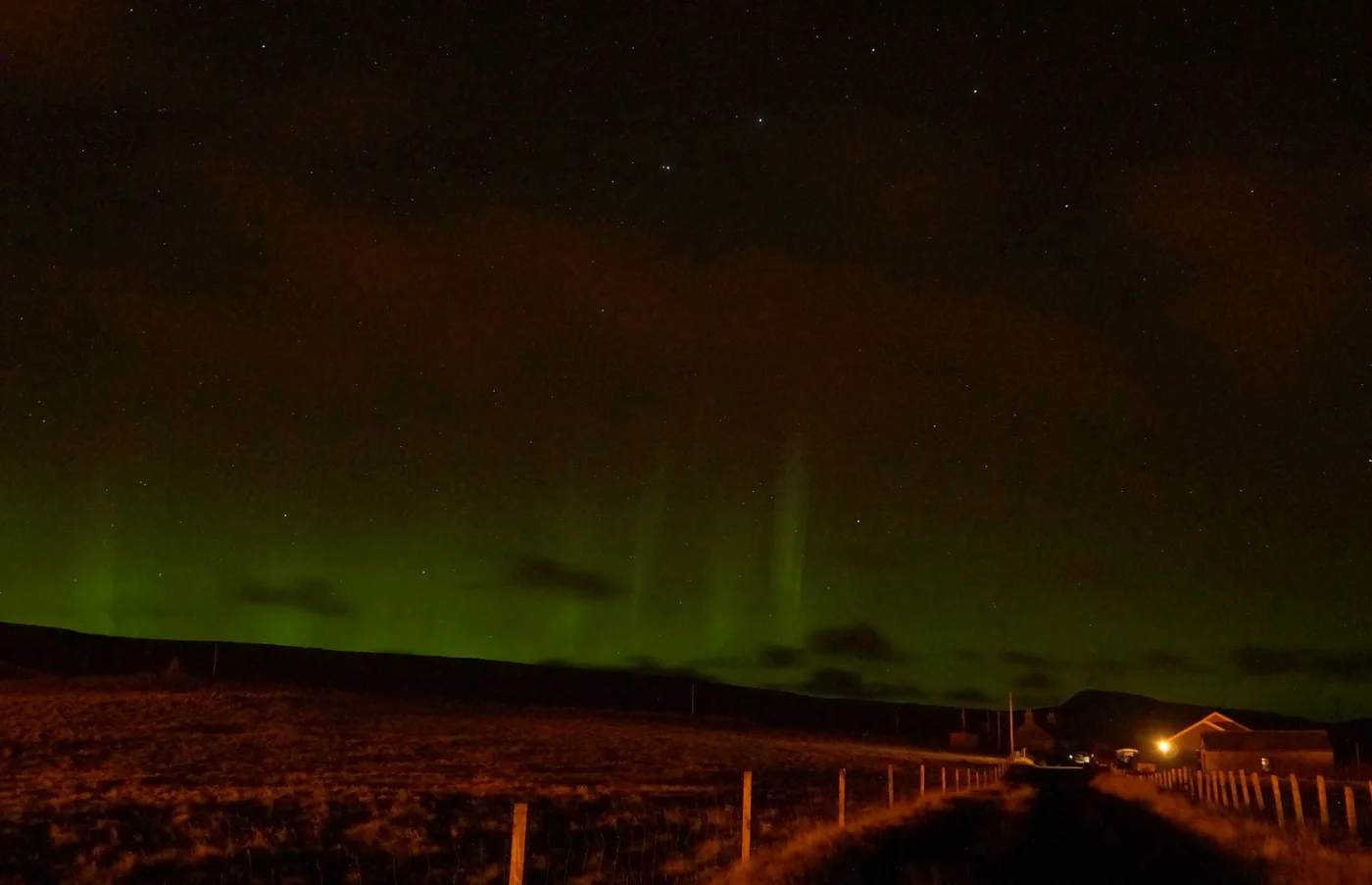
From Scotland on a good night, the aurora looks like a pale grey-green glow low on the northern horizon, sometimes with vertical structure moving through it. From the Midlands on a strong night, it is more often a faint colourless brightening in the north that you notice mainly because it is where a glow should not be. The vivid pinks and reds in the photographs are real, but they are the camera’s account of the same scene, not a lie.
The reason is that the human eye’s colour receptors barely function at low light, while a sensor integrating for several seconds does not have that problem. A modern phone in night mode, propped on a wall pointing north with a three to ten second exposure, will routinely show a green arc that you cannot see at all. This is why the AuroraWatch levels distinguish “by eye” from “by camera” and why so many people conclude nothing happened.
Look north, and low. A common mistake is scanning overhead. Only in a severe storm does the auroral oval push far enough south for the display to be above you in Britain, and on those nights you will not need advice on where to point.
If you are new to finding your way around after dark, naked-eye stargazing for beginners and what to see in the night sky will make the waiting more productive. A pair of binoculars is no help with the aurora itself, which is far too large and diffuse, but is excellent for everything else you will be standing under. Star camps are another good route in, and we list the autumn dates in UK stargazing events and star parties.
Frequently asked questions
Can you see the northern lights in the UK? Yes, and more often than most people think. Scotland, Northern Ireland and northern England get several viewable nights in an active year, and during a strong geomagnetic storm the aurora has been seen and widely photographed from the south coast of England. AuroraWatch UK’s four alert levels are built around exactly this geography, with Scotland alerted at yellow and the whole country only at red.
Where in the UK is best for the northern lights? Anywhere as far north as you can manage with a dark, unobstructed northern horizon. The northern isles, Caithness, the north coast of Scotland and the Hebrides come first, then the Northumberland and Galloway dark sky areas, then the Lake District and the North York Moors. The horizon matters as much as the latitude: a hill or a town to your north will hide a low arc completely.
Is 2026 a good year for the aurora in the UK? Better than its reputation. Solar Cycle 25 peaked in October 2024 at a smoothed sunspot number of 160.9, and 2026 is in the decline, but the raw monthly counts so far this year average 90.3, which is higher than every calendar year from 2015 to 2022 and well above anything recorded between 2017 and 2020.
What Kp number do I need to see the aurora in the UK? Kp is a global three-hourly index and a blunt tool for this question. As a rough guide, Kp 5 puts the aurora within reach of northern Scotland, Kp 6 to 7 brings northern England and Northern Ireland into play, and Kp 8 or above is the sort of storm that reaches southern England. For UK decisions on the night, the AuroraWatch UK colour status is more directly useful because it measures the disturbance over Britain rather than around the globe.
Do I need a camera to see the northern lights from England? Often, yes. From the Midlands and south, most events register as a camera-only display, which is precisely what AuroraWatch UK’s amber level describes. A phone on night mode, held still or propped on something solid, facing north, with a three to ten second exposure, is enough.
How much warning will I get? Very little from the reliable sources, and that is by design. AuroraWatch UK deliberately does not issue advance alerts because it detects disturbance that is already under way over the UK. Solar wind and CME modelling can give a day or two of notice that conditions may be favourable, but the confirmation only comes on the night.
Which way should I look, and at what time? North, and low on the horizon. Activity often picks up between about 10pm and 2am, but a strong storm produces a display whenever it arrives, so if an alert goes amber or red at 8pm it is worth going out at 8pm.
Clear skies forecast? Get a nudge.
Our weekly email flags the next good UK observing window and one easy target to find.
Join the listMore from Starvest
Keep reading
Best Telescopes for Beginners in the UK (Tested by Price Bracket)
The best beginner telescopes in the UK by budget, from sub-£150 tabletop scopes to app-guided and smart telescopes, with real 2026 prices.
What Can You See with Binoculars at Night? A Realistic Astronomy List
A realistic list of what you can see with binoculars in astronomy, from the Moon and Jupiter's moons to Andromeda, with tips for spotting each from the UK.
How to Set Up and Use Your First Telescope (Step by Step)
How to use a telescope as a beginner: assemble the mount, align the finder, focus, and find your first targets. A clear step-by-step UK guide.