Jupiter Opposition 2027 UK: 11 Feb, 54° High From London
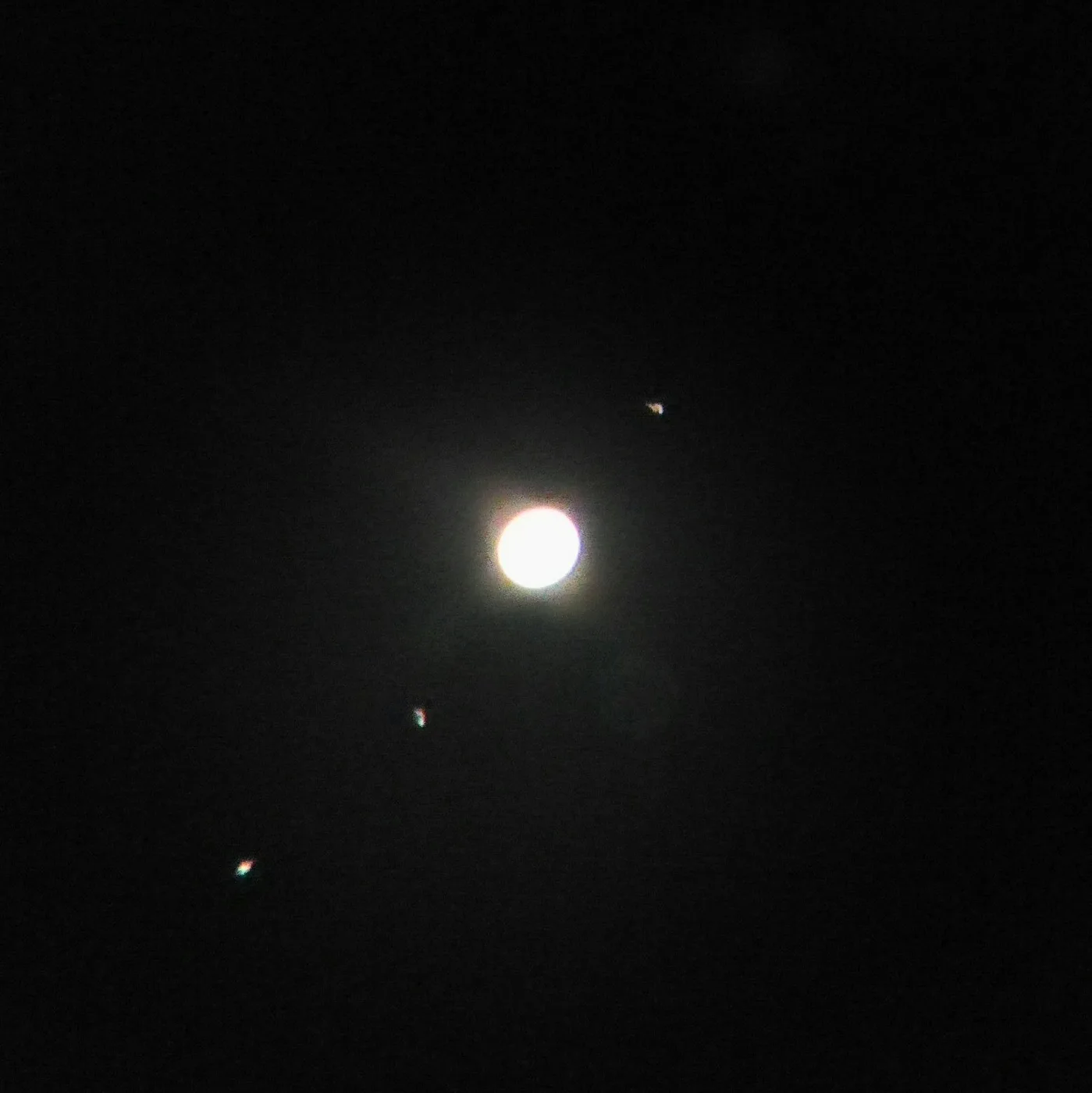
The Jupiter opposition of 2027 falls at 00:29 GMT on Thursday 11 February 2027, so for British observers it is the night of Wednesday 10 into Thursday 11 February. Earth passes between the Sun and Jupiter, which puts the planet opposite the Sun in the sky: it rises at dusk, stands due south around a quarter past midnight and sets at dawn. It will be in Leo, shining at magnitude -2.6 and showing a disc 45 arcseconds across, the biggest and brightest it gets until 2028.
Some calendars print the date as 10 February. That is not an error, just the clock: the moment of opposition is half an hour after midnight GMT, which is still the evening of 10 February in the Americas. EarthSky gives 00:21 UTC; the small difference comes from how each source defines the moment. It makes no difference at the eyepiece, because Jupiter looks the same for weeks either side.
We worked out every time and angle on this page from NASA JPL’s DE421 planetary ephemeris for London, Plymouth and Edinburgh, and cross-checked the date and magnitude against published 2027 almanacs.
Jupiter opposition 2027 at a glance
| Opposition | 11 February 2027, 00:29 GMT |
| Closest to Earth | 10 February 2027, about 15:30 GMT, 652.4 million km (4.36 au) |
| Brightness | Magnitude -2.6 |
| Disc size | 45.2 arcseconds across the equator |
| Constellation | Leo, about 8 degrees west (right, as you face south) of Regulus |
| Highest from London | 54 degrees at 00:16 GMT |
| Highest from Plymouth | 55 degrees at 00:32 GMT |
| Highest from Edinburgh | 49 degrees at 00:28 GMT |
| Moon | 18% lit crescent, sets 21:44 GMT from London |
Closest approach comes about nine hours before opposition because Jupiter’s orbit is slightly elliptical. The gap in distance is a few thousand kilometres out of 652 million, so it changes nothing you can see.
How high it gets from the UK
Height matters more than anything else for planet watching from Britain. A planet low in the south is seen through a long, turbulent column of air and smears into a shimmering blob; a high one holds still enough for a telescope to show real detail.
On opposition night Jupiter rises in the east-north-east at about 16:54 GMT in London, before the end of twilight (sunset is 17:06). By 22:00 it is well up in the south-east, and at 00:16 it crosses the meridian 54 degrees above the southern horizon. It sets in the west-north-west at about 07:39.
That is very good, though not the best of this cycle. At the January 2026 opposition, in Gemini, Jupiter reached 61 degrees from London. Now it is slipping south along the ecliptic: by the next opposition, on 12 March 2028, it will top out at 43 degrees. If you have been putting off a proper look at Jupiter, this winter is still a high one and the next few will be lower.
What you will see
With the naked eye: apart from Venus, the brightest point of light in the night sky, a steady cream-white “star” that does not twinkle like the stars of Leo around it. Look east after dark, south around midnight.
With binoculars: a tiny disc and up to four pinpoints in a line either side of it. Those are the Galilean moons, Io, Europa, Ganymede and Callisto, and their positions change from night to night and even hour to hour. Brace the binoculars on a wall or a tripod; our guide to seeing Jupiter’s moons covers what to expect.
With a small telescope (70 to 100mm): the two dark equatorial belts, the North and South Equatorial Belts, at 40x to 80x. On steady nights you will see the polar regions are darker and the belts are not straight edges.
With a 150mm telescope or larger: festoons trailing from the North Equatorial Belt, the thinner temperate belts and, when it faces us, the Great Red Spot. Around 150x to 200x is the useful range on a typical British night; past that, the air usually wins. Our page on the best magnification for planets explains why.
The Great Red Spot: catching it on the right night
Jupiter spins once every 9 hours 56 minutes, so the Red Spot is only on the side facing Earth for roughly half of each rotation, and it is best seen within about an hour of crossing the middle of the disc. That crossing is called a transit, and there are two or three each day.
The spot drifts in longitude from month to month, so transit times cannot be worked out from a fixed formula far in advance. For February 2027, take the times from a source updated with recent measurements: the British Astronomical Association’s Jupiter Section publishes the current longitude, and Sky & Telescope prints monthly transit tables. Then pick a transit between about 20:00 and 04:00 GMT, when Jupiter is more than 30 degrees up from most of the UK.
Expect it to look pale salmon or pinkish-grey rather than red, and smaller than in older photographs: it has shrunk a great deal over the last century. It is easiest to spot as a notch in the southern edge of the South Equatorial Belt, called the Red Spot Hollow.
Mars joins it eight days later
On 19 February 2027, eight days after Jupiter, Mars reaches its own opposition, also in Leo. On opposition night the two planets are about 12.5 degrees apart with Regulus roughly between them, and by 19 February the gap has closed to about 10.6 degrees. That is a rare pairing: two planets at opposition in the same part of the sky within the same fortnight. The details for Mars are on our Mars opposition 2027 page.
The Moon: dark on opposition night, then a close pass
The Moon is kind to opposition night. It is an 18% lit crescent that sets at 21:44 GMT from London, so Jupiter has a dark sky for most of the night.
On the night of 19 to 20 February the nearly full Moon slides past Jupiter, with the closest approach about 1 degree apart at around 05:00 GMT on 20 February. It is a lovely binocular sight, but leave telescope work for another night: the Moon’s glare washes out the faint moons and the detail on the belts.
Practical tips for a British winter night
- Let the telescope cool. Put it outside 30 to 60 minutes before you observe, or the warm air inside the tube will blur the view more than the sky does.
- Wait for it to climb. The view at 22:00, with Jupiter 40 degrees up, is usually worse than the view at midnight with it at 54.
- Watch for a few minutes, not seconds. Detail appears in brief moments of steady air; your eye catches them if you stay at the eyepiece.
- Check the weather pattern, not just cloud cover. A clear night under a strong jet stream can be useless for planets. Clear, still nights after a high pressure has settled are the ones to wait for.
For the wider picture of February’s sky, see our astronomy calendar for 2027. NASA’s Jupiter overview has the planet’s physical facts if you want them.
Frequently asked questions
When is Jupiter at opposition in 2027? At 00:29 GMT on 11 February 2027. From the UK that is the night of 10 to 11 February, and the view is almost identical for a couple of weeks either side.
Where do I look for Jupiter in February 2027? East after dark, due south around midnight, west before dawn. It is in Leo, the brightest point of light in that part of the sky, with the star Regulus about 8 degrees to its left as you face south.
Can I see Jupiter’s moons with binoculars? Yes. Steady 10x50 binoculars show up to four of the Galilean moons as tiny points close to the planet. A tripod or a wall to rest on makes a big difference.
How big does Jupiter look at opposition? 45 arcseconds across, about 1/40th of the Full Moon’s width. At 40x magnification it looks about as wide as the Moon does to the naked eye.
Is Jupiter at opposition the same night as Mars? No, Mars reaches opposition eight days later, on 19 February 2027. Both are in Leo, about 10 to 12 degrees apart, so you can see the pair together all through late February.
When is the next Jupiter opposition after 2027? On 12 March 2028, also in Leo. It will be slightly smaller and lower from the UK, reaching about 43 degrees from London.
Clear skies forecast? Get a nudge.
Our weekly email flags the next good UK observing window and one easy target to find.
Join the listMore from Starvest
Keep reading
Best Telescopes for Beginners in the UK (Tested by Price Bracket)
The best beginner telescopes in the UK by budget, from sub-£150 tabletop scopes to app-guided and smart telescopes, with real 2026 prices.
What Can You See with Binoculars at Night? A Realistic Astronomy List
A realistic list of what you can see with binoculars in astronomy, from the Moon and Jupiter's moons to Andromeda, with tips for spotting each from the UK.
How to Set Up and Use Your First Telescope (Step by Step)
How to use a telescope as a beginner: assemble the mount, align the finder, focus, and find your first targets. A clear step-by-step UK guide.