Astronomy Calendar 2027 UK: Every Night Worth Going Out
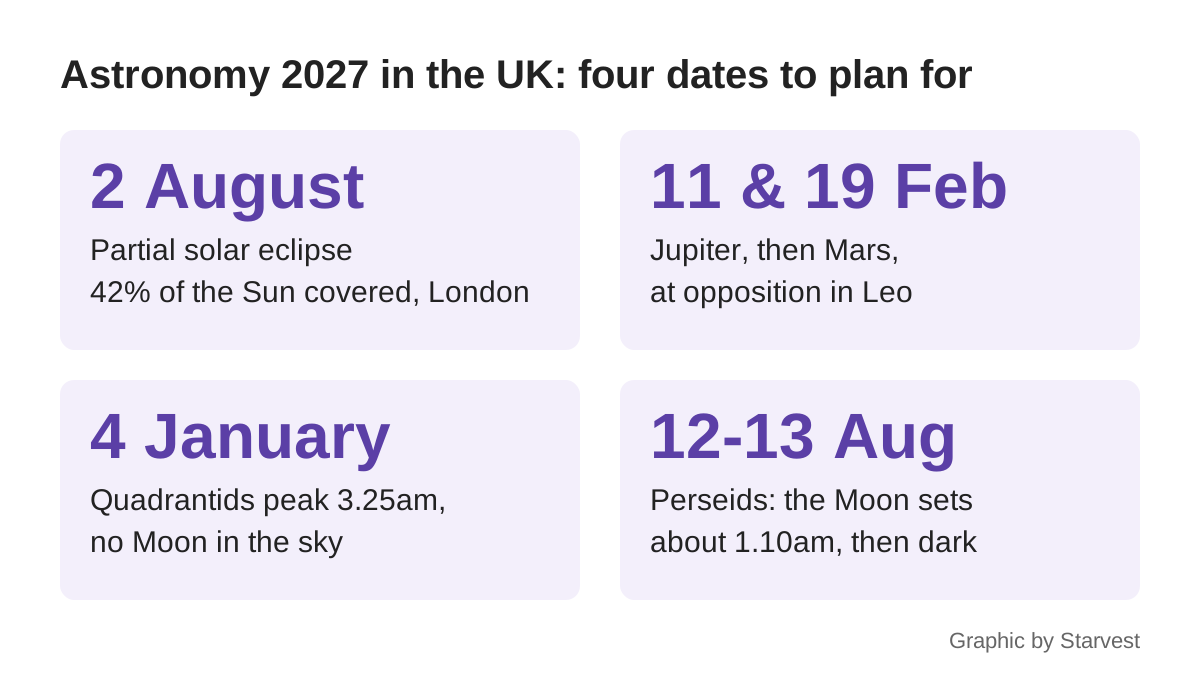
This astronomy calendar for 2027 in the UK lists every date worth going out for, month by month, with times in GMT or BST rather than the American times most calendars default to. The highlights are a partial solar eclipse on the morning of Monday 2 August, when about 42% of the Sun is covered from London, Jupiter and Mars both at opposition in Leo within eight days of each other in February, and a Quadrantid peak on 4 January with no Moon in the sky.
The weaker news first, so you can plan around it: the Geminids, usually the best shower of the year, peak the night after a full Moon, and the April Lyrids are drowned out by a Moon that is 95% lit.
How we worked it out. Meteor peaks come from the International Meteor Organization’s 2027 calendar. Moon phases come from US Naval Observatory data, the same figures behind our full Moon dates for 2027 and new Moon dates for 2027. Planet, season and eclipse times were calculated from NASA JPL’s DE421 ephemeris for London, then checked against published eclipse tables. Times are rounded to the nearest minute, and a few minutes either way will not matter for anything you can see by eye.
UK clocks go forward at 1am GMT on Sunday 28 March and back at 2am BST on Sunday 31 October, so times between those dates are BST.
2027 at a glance: the ten dates to put in your diary
| Date | Event | Why it matters |
|---|---|---|
| Mon 4 January | Quadrantids peak, 3.25am GMT | Peak in UK darkness with no Moon up |
| Wed 3 February | Mercury at its best evening view | About 9 degrees up in the west-south-west at dusk |
| Thu 11 February | Jupiter at opposition | Biggest and brightest of the year, up all night |
| Fri 19 February | Mars at opposition | First good Mars since January 2025 |
| Sat 20 February | Penumbral lunar eclipse | Whole eclipse visible from the UK, greatest 11.13pm |
| Mon 2 August | Partial solar eclipse | About 42% of the Sun covered from London at 10am |
| Thu 12 to Fri 13 August | Perseids | Moon sets about 1.10am, leaving dark hours before dawn |
| Mon 18 October | Saturn at opposition | Best Saturn of the year, in Pisces |
| Thu 4 November | Mercury at its best morning view | About 11 degrees up in the east-south-east at dawn |
| Thu 23 December | Ursids peak, 4am GMT | Small shower, but a dark sky after the Geminids washout |
January 2027
- Sun 3 January: Venus at greatest western elongation. Venus is 47 degrees from the Sun and blazing in the south-east before dawn, rising around 4am. Earth is also at perihelion that morning, its closest point to the Sun of the year. Our Venus morning star page has rise times week by week.
- Mon 4 January: Quadrantids peak at 3.25am GMT. This is the best meteor night of 2027. The Moon is a thin waning crescent that does not rise until about 6am, and the radiant in the north-east is high before dawn. Go out from 1am. Full detail in our Quadrantids 2027 guide.
- Thu 7 January: new Moon, 8.24pm GMT. Dark skies for deep-sky targets through the following weekend.
- Fri 22 January: full Wolf Moon, 12.17pm GMT. A supermoon, the first of two in a row.
February 2027
February is the month to have a telescope ready.
- Wed 3 February: Mercury at greatest eastern elongation. The best evening view of Mercury all year: about 9 degrees above the west-south-west horizon at 5.28pm. You need a flat western horizon. See how to see Mercury from the UK.
- Sat 6 February: new Moon, 3.56pm GMT. It is also an annular solar eclipse, but the ring of fire is seen from South America and the South Atlantic, not from the UK.
- Thu 11 February: Jupiter at opposition in Leo. Jupiter is opposite the Sun, so it rises at sunset, sets at sunrise and stands high in the south around midnight. Any telescope shows the cloud belts and the four big moons; our guide to seeing Jupiter’s moons explains what to look for.
- Fri 19 February: Mars at opposition in Leo. Mars reaches 13.8 arcseconds across and magnitude -1.3, standing 54 degrees up from London when it is due south. That is small for Mars, but it is the best view until 2029. We cover what a 100 to 150mm telescope shows in Mars opposition 2027.
- Sat 20 February: full Snow Moon and a penumbral lunar eclipse. The full Moon falls at 11.23pm GMT and is a supermoon. The whole eclipse is visible from the UK: it starts at 9.12pm, is greatest at 11.13pm and ends at 1.13am on Sunday 21 February. A penumbral eclipse is subtle, but this one is deep, so one edge of the Moon looks noticeably dusky for half an hour either side of 11pm.
March 2027
- Mon 8 March: new Moon, 9.29am GMT. The last properly long dark nights of the winter, with about nine hours of astronomical darkness in London.
- Wed 17 March: Mercury at greatest western elongation. A poor morning show from the UK, less than a degree above the horizon at dawn. Skip it.
- Sat 20 March: March equinox, 8.24pm GMT. Day and night are roughly equal and spring begins astronomically.
- Mon 22 March: full Worm Moon, 10.44am GMT.
- Sun 28 March: clocks go forward one hour at 1am, to BST.
April 2027
- Wed 7 April: new Moon, 12.51am BST. Galaxy season: Leo, Virgo and the Plough are well placed in the evening.
- Tue 20 April: full Pink Moon, 11.27pm BST.
- Fri 23 April: Lyrids peak about 2.40am BST. The IMO rates this the worst-placed major shower of 2027. The Moon is 95% lit and does not set until after 6am, so expect only the brightest few of a shower that only manages around 18 an hour in a dark sky.
May 2027
- Thu 6 May: Eta Aquariids peak about 10am BST, and new Moon at 11.58am BST. There is no moonlight, but the radiant barely clears the south-east horizon before dawn from the UK, so you may see a handful of long, fast meteors between 3am and 4am.
- Thu 20 May: full Flower Moon, 11.59am BST. A seasonal blue moon, the third full Moon of four in the spring.
- Fri 28 May: Mercury at greatest eastern elongation. The second good evening view of the year: about 9 degrees up in the west-north-west at 9.47pm.
June 2027
- Fri 4 June: new Moon, 8.40pm BST.
- Sat 19 June: full Strawberry Moon, 1.44am BST. Best seen low in the south on the evening of Friday 18 June.
- Mon 21 June: summer solstice, 3.10pm BST. There is no true astronomical darkness in London from late May to late July, and none at all in Scotland, which makes this the season for noctilucent clouds low in the north after midnight rather than faint galaxies.
July 2027
- Sun 4 July: new Moon, 4.02am BST.
- Mon 5 July: Earth at aphelion, its farthest from the Sun.
- Thu 15 July: Mercury at greatest western elongation. A moderate morning view, about 4 degrees up in the east-north-east at dawn, slightly better a week later.
- Sun 18 July: full Buck Moon, 4.45pm BST. The smallest full Moon of the year. There is a penumbral eclipse, but the Moon is below the UK horizon throughout.
- Sat 31 July: Southern Delta Aquariids peak. About 25 an hour in ideal skies, far fewer from the UK because the radiant stays low. Early Perseids are already flying.
August 2027
- Mon 2 August: partial solar eclipse. The total eclipse of 2027 crosses southern Spain, Gibraltar and North Africa, and from the UK the Moon takes a bite out of the Sun in the late morning. From London it runs from about 9.05am to 11am BST, greatest around 10am, with about 42% of the Sun’s disc covered. Further south-west takes more (about 47% from Penzance), further north less (about 27% from Edinburgh and 15% from Lerwick). New Moon is at 11.05am BST the same morning. Never look at the Sun directly or through binoculars or a telescope without a certified solar filter; eclipse glasses must meet ISO 12312-2. The Royal Observatory Greenwich’s eclipse advice covers safe viewing.
- Thu 12 to Fri 13 August: Perseids. The IMO puts the peak at 9am to 11am BST on Friday 13 August, in daylight, so the night to watch is Thursday 12 into Friday 13. The waxing Moon sets in London about 1.10am, leaving roughly three hours of dark sky before dawn as the radiant climbs high in the north-east. Rates in a dark sky can pass 100 an hour at the peak. Our UK meteor shower guide explains how to watch.
- Tue 17 August: full Sturgeon Moon, 8.29am BST. Best seen rising on the evening of Monday 16 August. There is a penumbral eclipse, but it happens after the Moon has set over the UK.
September 2027
- Thu 16 September: full Harvest Moon, 12.03am BST. Look for it rising on the evening of Wednesday 15 September.
- Thu 23 September: September equinox, 7.01am BST.
- Fri 24 September: Mercury at greatest eastern elongation. Below the horizon at dusk from London, so not one for the UK.
- Tue 28 September: Neptune at opposition in Pisces. At magnitude 7.8 it needs binoculars and a finder chart, or a telescope to show its small blue disc.
- Thu 30 September: new Moon, 3.36am BST. Dark evenings return, with about eight and a half hours of astronomical darkness in London.
October 2027
- Sat 9 October: Draconids. A minor shower, usually around five an hour, peaking in daylight at about 8am BST.
- Fri 15 October: full Hunter’s Moon, 2.47pm BST.
- Mon 18 October: Saturn at opposition in Pisces. Saturn is up all night and at its brightest. The rings are opening up again after appearing edge-on in 2025, so they show more clearly than last year. Our Saturn’s rings guide covers the view through small telescopes.
- Fri 22 October: Orionids peak. A waning gibbous Moon rises about 11.25pm BST, around the time the radiant gets high enough to be useful, so this is a poor year.
- Fri 29 October: new Moon, 2.36pm BST.
- Sun 31 October: clocks go back one hour at 2am, to GMT.
November 2027
- Thu 4 November: Mercury at greatest western elongation. The best morning view of the year, about 11 degrees up in the east-south-east at 6.23am.
- Early to mid November: Taurid fireballs. The Southern Taurids peak around 6 November and the Northern Taurids around 13 November. Rates are low, but they are known for slow, bright fireballs.
- Sun 14 November: full Beaver Moon, 3.26am GMT. Best on the evening of Saturday 13 November.
- Thu 18 November: Leonids peak about 6am GMT. The Moon is 82% lit, so only the brighter Leonids will show.
- Sun 28 November: new Moon, 3.24am GMT.
- Tue 30 November: Uranus at opposition in Taurus. At about magnitude 5.6 it is just visible to the naked eye from a dark site, and easy in binoculars near the Pleiades. See how to see Uranus.
December 2027
- Mon 13 December: full Cold Moon, 4.09pm GMT.
- Tue 14 December: Geminids peak. Normally the richest shower of the year, with up to 150 an hour in ideal skies, but the Moon is 99% lit and up all night. Watch anyway if it is clear: Geminids are bright enough that some always get through.
- Wed 22 December: winter solstice, 2.42am GMT. The longest night of the year.
- Thu 23 December: Ursids peak about 4am GMT. Around ten an hour from a radiant near the Little Dipper, which stays up all night from the UK.
- Mon 27 December: new Moon, 8.12pm GMT.
- Late December: Venus returns. After passing behind the Sun on 12 August, Venus is 35 degrees from it by New Year’s Eve and climbing into the south-western evening sky, ready to dominate the evenings of early 2028.
What makes 2027 different
Two things. February has a double opposition: Jupiter and Mars in the same constellation, eight days apart, with a deep lunar eclipse the following night. You will rarely get a better fortnight to show someone the planets through a small telescope; our guide to seeing the planets explains where to start.
And 2 August brings a second summer eclipse in a row, a year after the deep partial eclipse of 12 August 2026. It is a weekday morning in the school holidays, so plan where you will watch it and get proper solar viewers well before the day, because they sell out in eclipse years.
Frequently asked questions
What is the best astronomy event of 2027 in the UK? The partial solar eclipse on Monday 2 August, when around 42% of the Sun is covered from London at about 10am BST, and close to half from Cornwall. For night-sky watchers, the Quadrantids on 4 January and the Perseids on 12 to 13 August both peak without the Moon getting in the way.
Is there a total solar eclipse visible from the UK in 2027? No. The total eclipse on 2 August 2027 crosses southern Spain, Gibraltar, North Africa and Egypt. The UK sees a partial eclipse, from about 15% coverage in Shetland to about 47% in Cornwall. The next total eclipse in Britain is not until 23 September 2090.
When are the meteor showers in 2027? The main peaks are the Quadrantids on 4 January, Lyrids on 23 April, Eta Aquariids on 6 May, Perseids on 13 August, Orionids on 22 October, Leonids on 18 November, Geminids on 14 December and Ursids on 23 December. The Quadrantids and Perseids have the best moonlight conditions this year.
When can I see Mars and Jupiter at their best in 2027? In February. Jupiter reaches opposition on 11 February and Mars on 19 February, both in Leo, so both are up all night and highest around midnight. They stay well placed through March.
What time do the clocks change in 2027? They go forward one hour at 1am on Sunday 28 March and back one hour at 2am on Sunday 31 October.
Are there any lunar eclipses visible from the UK in 2027? One: the penumbral eclipse on the night of Saturday 20 February, greatest at 11.13pm GMT. The penumbral eclipses on 18 July and 17 August happen while the Moon is below the UK horizon.
Clear skies forecast? Get a nudge.
Our weekly email flags the next good UK observing window and one easy target to find.
Join the listMore from Starvest
Keep reading
Best Telescopes for Beginners in the UK (Tested by Price Bracket)
The best beginner telescopes in the UK by budget, from sub-£150 tabletop scopes to app-guided and smart telescopes, with real 2026 prices.
What Can You See with Binoculars at Night? A Realistic Astronomy List
A realistic list of what you can see with binoculars in astronomy, from the Moon and Jupiter's moons to Andromeda, with tips for spotting each from the UK.
How to Set Up and Use Your First Telescope (Step by Step)
How to use a telescope as a beginner: assemble the mount, align the finder, focus, and find your first targets. A clear step-by-step UK guide.