Light Pollution Filter: Worth It Under UK LED Streetlights?
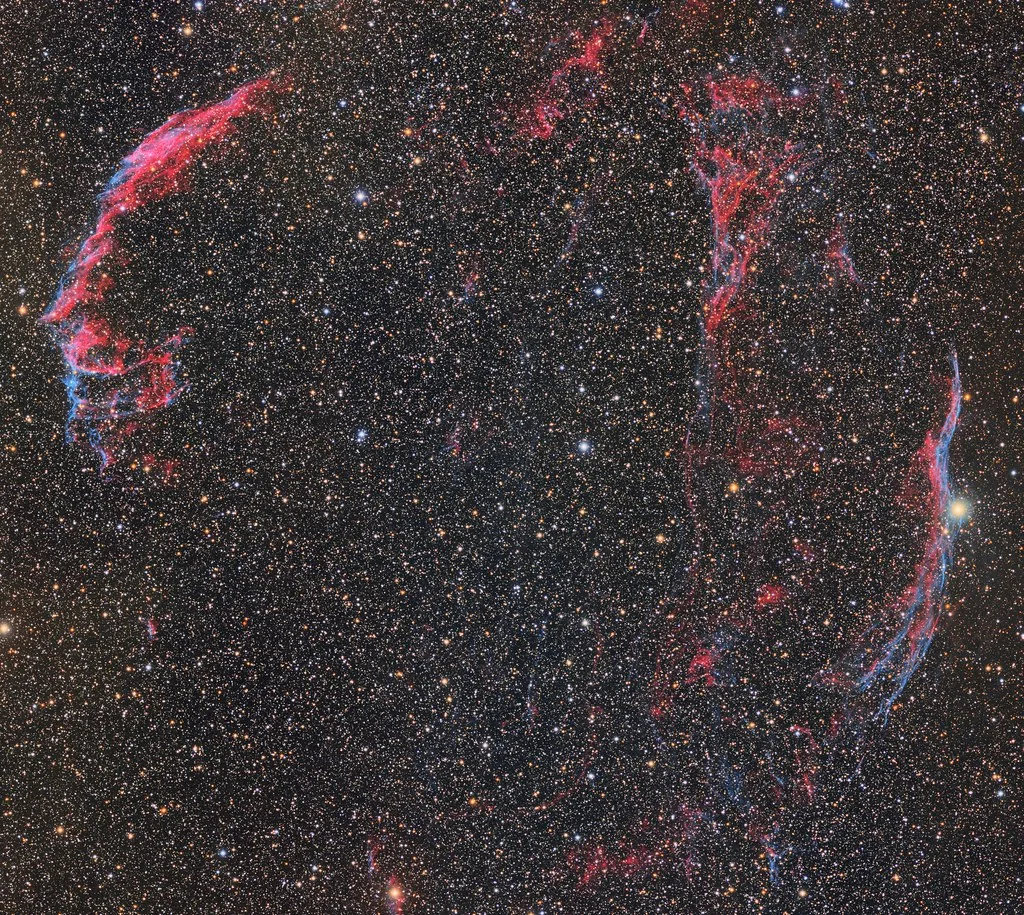
A light pollution filter is worth buying only if you want to look at emission nebulae, and only if you pick the right type for the lights that now surround you. A narrowband UHC or OIII filter still makes the Orion Nebula and the Veil stand out from a suburban sky. A broadband “light pollution reduction” filter, the kind sold as a general fix, was designed for the orange sodium streetlights that much of Britain has now replaced with white LEDs, and it does very little against them. No filter of any kind makes a galaxy or a star cluster easier to see.
That is the whole page in three sentences. The rest explains why, which filter to choose for your telescope, and what to expect when you screw one in.
Why filters worked better in the sodium era
Old low-pressure sodium streetlights put almost all of their light into one narrow yellow band near 589nm. High-pressure sodium and mercury lamps were messier, but still emitted in a handful of bright lines. A filter only had to block those lines and let everything else through, and the sky went darker while stars and nebulae barely dimmed. That is what broadband filters (sold as LPR, CLS or “skyglow” filters) were built to do.
White LED streetlights do not work like that. They emit a continuous spread of light from blue through to red, overlapping the colours that stars, galaxies and most nebulae give off. A University of Liverpool talk on astro filters by Dr Steve Barrett sums it up in a table: against LED lighting, filters are “ineffectual” for stars and galaxies, sodium-targeting filters fail on nebulae, and only narrowband (dual, tri or quad band) filters still help on nebulae (Tri-Band Tribulations, slide 29).
So the useful question is no longer “should I get a light pollution filter?” but “do I want to look at emission nebulae?”
The three types of visual filter
| Type | Passes | Best on | Typical name on the box |
|---|---|---|---|
| Broadband | A wide band of blue-green light, blocks sodium and mercury lines | Little under LED skies; slight help under remaining sodium lighting | LPR, CLS, Skyglow, Neodymium |
| UHC (narrowband) | Hydrogen-beta and doubly ionised oxygen (OIII) lines, blocks most else | Emission nebulae in general: M42, M8, M17, the Rosette | UHC, UHC-S, UHC-E |
| OIII (line) | Only the two OIII lines near 496nm and 501nm | Planetary nebulae and supernova remnants: the Veil, M57, M27 | OIII, O-III |
Emission nebulae shine because their gas glows at a few exact wavelengths, mainly from hydrogen and oxygen. A narrowband filter lets those wavelengths through and blocks almost everything else, including the LED glow. The nebula loses a little brightness; the sky behind it loses a lot more. That contrast gain is what you see.
A galaxy is billions of stars, so its light is spread across the whole spectrum just like an LED’s. Any filter that darkens the sky darkens the galaxy by the same proportion. The same is true of star clusters and of reflection nebulae such as the haze around the Pleiades.
What you will actually see with each filter
UHC: the first filter to buy
A UHC filter is the best single choice for most owners of a 100mm to 200mm telescope. Expect:
- Orion Nebula (M42): more of the faint outer wings visible, and a darker background around the bright core. The improvement is clear from a suburban garden. Our Orion Nebula guide covers finding it.
- Lagoon (M8) and Swan (M17): better defined, though both sit low in the south from Britain in summer, so you are fighting the horizon as well.
- Rosette Nebula and the North America Nebula: these are large and faint, and a UHC is often the difference between seeing something and seeing nothing, especially at low power in a wide-field scope.
- Stars: noticeably dimmer, often with a slight green tint. This is normal.
Astronomik’s guidance, repeated by its retailers, is that its standard UHC suits telescopes of 100mm and up under urban skies, and that the wider-band UHC-E is the better pick below 125mm, because a smaller telescope cannot afford to lose as much light.
OIII: the specialist, and best in bigger scopes
An OIII filter cuts more light than a UHC. On the right targets the effect is striking, and on the wrong ones it simply makes the view dark.
- Veil Nebula in Cygnus: the showcase. Without a filter many observers see nothing at all from a town; with an OIII the filaments appear. Use your lowest-power eyepiece.
- Ring Nebula (M57), Dumbbell (M27), Owl (M97): planetary nebulae glow strongly in OIII, so they take on sharper edges against a near-black sky.
- Bright emission nebulae like M42: an OIII works, but a UHC usually gives the more natural view.
Because it blocks so much, an OIII suits apertures of about 200mm and over. Astronomik suggests owners of telescopes over 250mm may want an OIII as their first filter rather than a UHC.
Broadband: rarely worth it now
On a visual telescope under white LED lighting a broadband filter mostly dims everything a little and tints the view. It can still help where the nearest streetlights are older sodium lamps, and some observers like a neodymium “Moon and skyglow” filter for a little extra contrast on the Moon and planets. As a fix for light pollution it is not worth the money for most British gardens today.
Visual filters are not imaging filters
Filters for photography work on the same principle but are built differently:
- Smart telescopes and one-shot colour cameras use dual-band filters, which pass hydrogen-alpha and OIII together. The Seestar S50 and S30 and the Dwarf 3 have one built in; our Seestar S50 review shows what it does to nebulae.
- Hydrogen-alpha is deep red, where the eye is almost blind at night. A dual-band imaging filter can look nearly black when you hold it to your eye, so it is a poor buy for visual observing.
- Galaxies in photographs are improved by software and longer total exposure, not by a filter. Barrett’s table puts it bluntly: for stars and galaxies, filters are “ineffectual” and processing is the answer.
Choosing size and brand
Filters screw into the bottom of an eyepiece barrel, so buy the size that matches your eyepieces: 1.25-inch for most beginner telescopes, 2-inch if you use 2-inch eyepieces. A 2-inch filter can sit in a 2-inch diagonal and serve every eyepiece, which is useful if you own several. Our telescope eyepieces explained page covers barrel sizes.
Visual UHC and OIII filters on sale from UK specialist retailers include the Astronomik UHC, UHC-E and OIII, the Baader UHC-S, the Optolong UHC, the Explore Scientific UHC and O-III, and the Astro Essentials UHC and OIII. The established names (Astronomik, Baader, Explore Scientific) publish their transmission curves; that is a fair test of any filter, because a “UHC” with a vague curve may be passing more of the LED glow than it should. Check current price with a specialist retailer before you buy.
When a filter is not the answer
Before spending money, try the free fixes. Turn off or shield nearby lights, use your house to block a streetlight, give your eyes 20 minutes in the dark, and use averted vision. A hood or dew shield stops stray light entering the tube. Our light pollution map of the UK shows how much darker the sky gets with a short drive, and moving from a Bortle 7 town to a Bortle 4 village does more for every kind of object than any filter, galaxies included. For a list of places to go, see dark sky sites in the UK.
Frequently asked questions
Do light pollution filters work with LED streetlights? Broadband filters barely do, because white LEDs emit across the whole visible spectrum. Narrowband UHC and OIII filters still work on emission nebulae, because they pass only the few wavelengths those nebulae emit and block nearly everything else.
Will a light pollution filter help me see galaxies? No. A galaxy’s light is spread across the spectrum like the sky glow, so a filter dims the galaxy as much as the sky. The only real help for galaxies is a darker site.
Should I buy a UHC or an OIII filter first? A UHC for most telescopes under 200mm, because it works on more nebulae and dims the view less. An OIII makes most sense as a second filter, or as the first one for telescopes over 250mm.
Is a light pollution filter worth it for a small telescope? On a 70mm or 80mm scope a UHC can help on the Orion Nebula and other bright emission nebulae, but the dimming is more noticeable. A wider-band filter such as the Astronomik UHC-E suits small apertures better than a strict OIII.
Can I use a visual nebula filter for astrophotography? It will work in a limited way, but imaging filters are designed for camera sensors, which are sensitive to hydrogen-alpha in the deep red. Dual-band filters made for one-shot colour cameras are the better choice for photographing nebulae.
Why do stars look green through my nebula filter? UHC and OIII filters pass mainly blue-green light near 486nm to 501nm, so stars take on that colour and look fainter. It is normal and does not mean the filter is faulty.
Sources
- Dr Steve Barrett, University of Liverpool, Tri-Band Tribulations, March 2023: street light spectra and the filter summary table.
- Astronomik UHC filter application notes, as published by its retailers: aperture guidance for the UHC, UHC-E and OIII.
- First Light Optics UHC and OIII visual filter range, checked 14 October 2026.
Clear skies forecast? Get a nudge.
Our weekly email flags the next good UK observing window and one easy target to find.
Join the listMore from Starvest
Keep reading
Best Telescopes for Beginners in the UK (Tested by Price Bracket)
The best beginner telescopes in the UK by budget, from sub-£150 tabletop scopes to app-guided and smart telescopes, with real 2026 prices.

What Can You See with Binoculars at Night? A Realistic Astronomy List
A realistic list of what you can see with binoculars in astronomy, from the Moon and Jupiter's moons to Andromeda, with tips for spotting each from the UK.
How to Set Up and Use Your First Telescope (Step by Step)
How to use a telescope as a beginner: assemble the mount, align the finder, focus, and find your first targets. A clear step-by-step UK guide.