Night Sky November 2026 UK: 4 Planets at Dawn, Key Dates
The night sky in November 2026 gives UK observers five planets in one night, and most of it happens before breakfast. From mid-month, Mercury, Venus, Jupiter and Mars stretch in a line from low in the east-south-east to high in the south in the hour before sunrise. Mars and Jupiter pass just over a degree apart on the morning of 16 November. In the evening, Saturn sits in the south after dark, and Uranus reaches opposition on 25 November.
Below is the month as a list of dates, then a planet-by-planet guide with rise times. All times are GMT (the clocks went back on 25 October) and, unless stated, are our own calculations for central England at 52.5 degrees north. London is a few minutes earlier for most events; Scotland’s mornings are darker for longer but its planets sit a few degrees lower.
November 2026 at a glance
| Date | What to see | When and where |
|---|---|---|
| Sun 1 Nov | Last quarter Moon, 8.28pm | Rises late evening |
| Mon 2 Nov | Half-lit Moon about 4 degrees from Mars | Before dawn, high in the south |
| Tue 3 Nov | Moon less than 2 degrees from Regulus, with Jupiter just below | Before dawn, high in the south |
| Thu 5 Nov | Southern Taurids peak | Late evening to small hours |
| Sat 7 Nov | Thin crescent Moon, 4% lit, about 2 degrees from Venus, with Spica alongside | About 6.15am, very low in the east-south-east |
| Mon 9 Nov | New Moon, 7.02am. Venus closest to Spica, a little over a degree apart | Before dawn, low in the south-east |
| Thu 12 Nov | Northern Taurids peak | Late evening to small hours |
| Mon 16 Nov | Mars and Jupiter about 1.2 degrees apart | Before dawn, about 50 degrees up in the south |
| Tue 17 Nov | First quarter Moon, 11.48am. Leonids peak 11.45pm | Watch the small hours of the 18th |
| Fri 20 Nov | Gibbous Moon about 5 degrees from Saturn | Early evening, south-east to south |
| Sat 21 Nov | Mercury at greatest western elongation, nearly 20 degrees from the Sun | About 6.45am, low in the east-south-east |
| Tue 24 Nov | Full Moon, a supermoon, 2.53pm. Moon about 6 degrees from the Pleiades that evening | Rises around sunset in the north-east |
| Wed 25 Nov | Uranus at opposition | All night, in Taurus near the Pleiades |
| Mon 30 Nov | Moon about 2 degrees from Jupiter, with Regulus and Mars close by | Before dawn, south to south-west |
The Moon’s separations are for the time of observation from central England; the Moon moves about half a degree an hour against the stars, so a few hours either way changes the gap noticeably.
The dawn planet line
From about 12 November to the end of the month, go out 45 to 60 minutes before sunrise and you can see four planets at once. Sunrise in central England is 7.22am on 12 November and 7.46am on 26 November, so aim for roughly 6.30am to 6.50am.
At 6.45am on 21 November, from central England:
- Mercury is about 8 degrees up in the east-south-east. That is low: a flat horizon with no houses or trees is essential.
- Venus is about 18 degrees up in the south-east, above and to the right of Mercury, and far brighter than anything else in the sky apart from the Moon.
- Jupiter and Mars are about 50 degrees up, just west of due south, near Regulus, the brightest star in Leo.
Join them up and you have a long diagonal line, the path of the planets along the ecliptic. The magazine BBC Sky at Night lists the same four planets for its November and December 2026 planet alignment and gives the same advice on timing.
A safety rule that matters this month. Mercury and Venus sit in the part of the sky where the Sun is about to rise. Finish looking at them, and especially stop using binoculars or a telescope, well before sunrise. Never sweep binoculars along the eastern horizon once the Sun could be up.
Planet by planet
Mars and Jupiter: the close pairing on 16 November
Both planets are in Leo and both rise before midnight: Jupiter at about 11.50pm on 1 November and 10.10pm on 30 November, Mars at about 11.15pm on 1 November and 10.30pm on 30 November. They are best seen high in the south in the last hours of darkness.
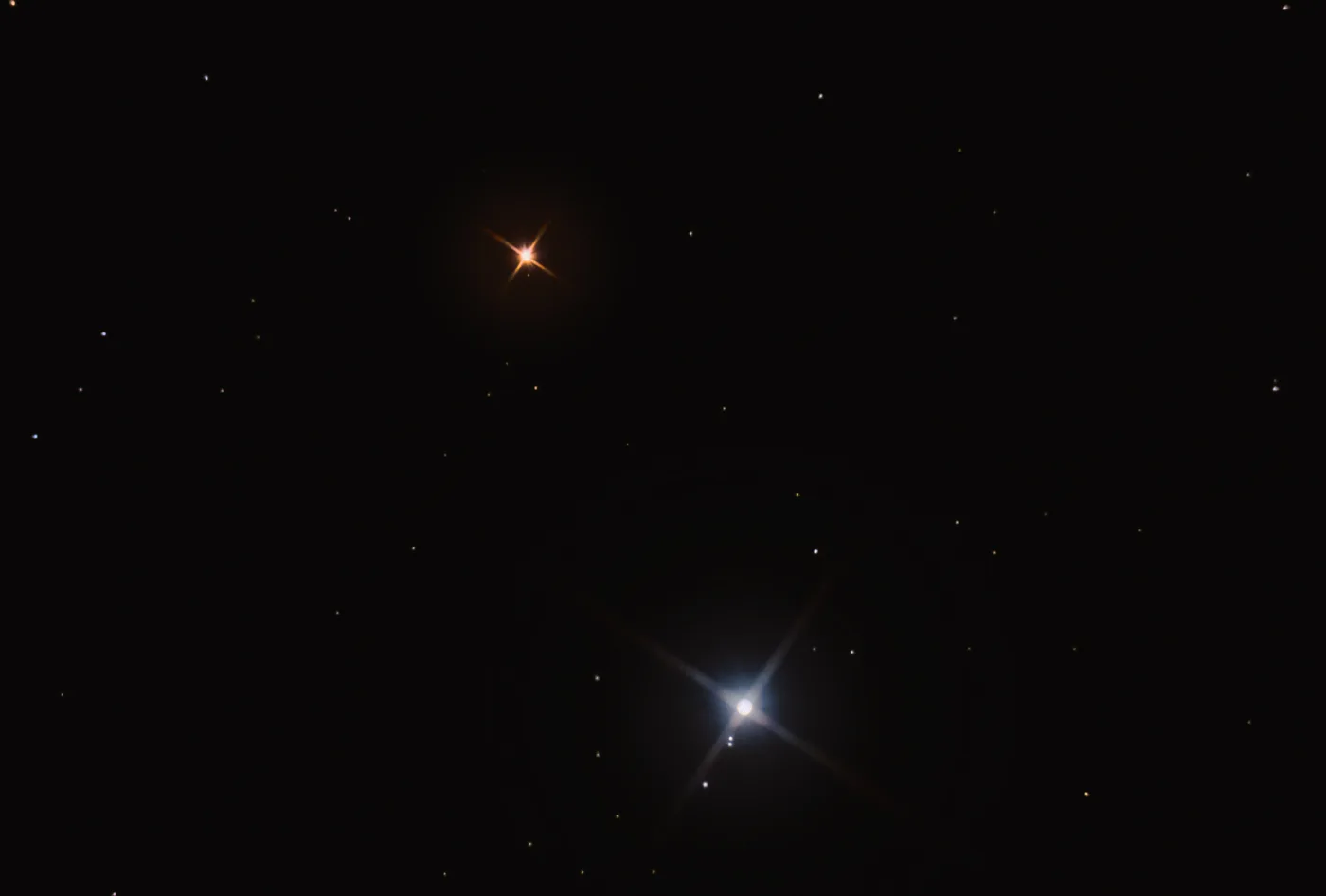
They close in on each other all month. On the morning of 16 November they are about 1.2 degrees apart, a little more than twice the width of the full Moon, so they fit easily in the same binocular field. Jupiter is the brighter (magnitude -1.9 to -2.0) and white; Mars is fainter (about +0.7) and visibly orange. In a small telescope Jupiter shows its cloud belts and up to four moons in the same view as Mars, which is a good chance to try spotting Jupiter’s moons. Sky at Night notes that a few days later, around 22 November, Mars, Jupiter and Regulus form a tight triangle.
Venus: the morning star returns
Venus passed the Sun in late October and climbs out of the dawn twilight through November. It rises at about 5.40am on 5 November, 4.55am on 12 November and 4am by 30 November, at magnitude -4.1 to -4.5. For the first half of the month it sits within about one and a half degrees of Spica, the brightest star in Virgo, closest on about 9 November. On the morning of 7 November a very thin crescent Moon joins the pair, about 2 degrees from Venus, but it is only around 7 degrees up at 6.15am, so you need a clear south-eastern horizon.
Mercury: best from about 15 November
Mercury passes between us and the Sun at the start of the month and is lost in the glare until around 12 November. From then it rises about an hour and three-quarters before the Sun and brightens quickly, reaching magnitude -0.3 by 19 November. Greatest western elongation, its furthest point from the Sun in the morning sky, comes on 21 November at nearly 20 degrees. It stays visible into the first days of December. Look for it below and to the left of Venus, roughly 8 degrees up at 6.45am.
Saturn: the evening planet
Saturn is the planet for the evening. It is already up in the south-east as the sky darkens, due south at about 10pm on 1 November and 9pm by mid-month, and sets around 4am at the start of November and 2am by the end. At magnitude +0.5 to +0.7 it is the brightest point in that part of the sky. On the evening of 20 November the gibbous Moon sits about 5 degrees from it at 7pm. A telescope at 50x or more shows the rings; our guide to the best magnification for planets explains why steady air matters more than power.
Uranus: opposition on 25 November
Uranus is at opposition on 25 November, opposite the Sun and visible all night, in Taurus between the Pleiades and the Hyades. At magnitude 5.6 it is at the edge of naked-eye visibility from a truly dark site and an easy binocular target with a chart. Choose a night in the first half of the month, or the days around new Moon, rather than opposition night itself, when the full Moon is only a few degrees from the Pleiades.
The Moon in November 2026
| Phase | Date and time (GMT) |
|---|---|
| Last quarter | Sun 1 Nov, 8.28pm |
| New Moon | Mon 9 Nov, 7.02am |
| First quarter | Tue 17 Nov, 11.48am |
| Full Moon | Tue 24 Nov, 2.53pm |
| Last quarter | Tue 1 Dec, 6.08am |
The darkest evenings for deep-sky observing run from about 5 to 14 November, when the Moon is a thin crescent or absent. That window also covers both Taurid peaks. For the supermoon on 24 November, with moonrise times for six UK cities, see our full Moon November 2026 page.
Meteor showers
- Southern Taurids, peak around 5 November, and Northern Taurids, around 12 November: slow, sometimes bright meteors at 5 to 10 an hour at best, with the new Moon between the two peaks. Peak dates are from the International Meteor Organization’s 2026 Meteor Shower Calendar. Full plan: Taurids 2026 UK.
- Leonids, peak 11.45pm on 17 November: the Moon sets just before the peak, and the best hours are 1am to 5.30am on the 18th. Full plan: Leonids 2026 UK.
How to use this page
Most of these sights need nothing more than your eyes and a clear horizon. Binoculars help with Uranus, the Moon near Venus and Spica, and the Mars and Jupiter pair. If you are starting out, our month-by-month guide to what to see in the night sky and our page on how to see the planets cover finding your way around.
Frequently asked questions
What planets can I see in November 2026 from the UK? All five naked-eye planets. Mercury, Venus, Jupiter and Mars are in the morning sky before dawn, and Saturn is in the evening sky. Uranus, at opposition on 25 November, is a binocular target all night.
When is the planet alignment in November 2026? The four morning planets line up from roughly 12 November to the end of the month. Look 45 to 60 minutes before sunrise, around 6.30am to 6.50am in central England, from low in the east-south-east (Mercury) up to high in the south (Jupiter and Mars).
When do Mars and Jupiter meet in November 2026? They are closest, about 1.2 degrees apart, on the morning of Monday 16 November. They are high in the south before dawn and look like a bright white and orange double star, close to Regulus in Leo.
When is the new Moon in November 2026? Monday 9 November at 7.02am GMT. The evenings from about 5 to 14 November are the darkest of the month.
Can I see Mercury in November 2026? Yes, in the second half of the month. It reaches greatest western elongation on 21 November and is about 8 degrees up in the east-south-east at 6.45am. You need a flat eastern horizon, and should stop looking well before sunrise.
What time is the full Moon in November 2026? 2.53pm GMT on Tuesday 24 November. It is a supermoon, and the best nights to see it are 23 to 25 November.
Clear skies forecast? Get a nudge.
Our weekly email flags the next good UK observing window and one easy target to find.
Join the listMore from Starvest
Keep reading
Best Telescopes for Beginners in the UK (Tested by Price Bracket)
The best beginner telescopes in the UK by budget, from sub-£150 tabletop scopes to app-guided and smart telescopes, with real 2026 prices.
What Can You See with Binoculars at Night? A Realistic Astronomy List
A realistic list of what you can see with binoculars in astronomy, from the Moon and Jupiter's moons to Andromeda, with tips for spotting each from the UK.
How to Set Up and Use Your First Telescope (Step by Step)
How to use a telescope as a beginner: assemble the mount, align the finder, focus, and find your first targets. A clear step-by-step UK guide.