Geminids 2026 UK: Watch 13 Dec, 9pm to 6am, Moon Gone
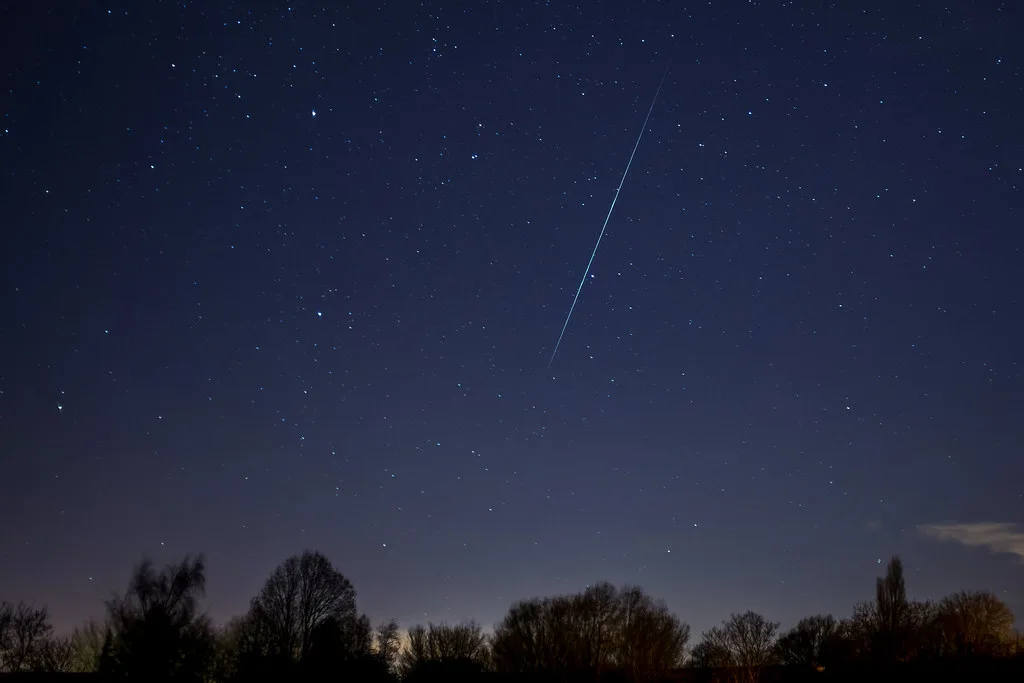
The Geminids 2026 reach their maximum at about 2pm GMT on Monday 14 December, in daylight, so no one in Britain will see the peak itself. The night to go out is the one before it: Sunday 13 into Monday 14 December. A thin crescent Moon, about a fifth lit, sets around 8pm, and from then until dawn at 6am the sky is dark and the radiant climbs steadily. Monday night, 14 to 15 December, is the back-up.
With the Moon out of the way for most of the night, this is a good year to make the effort. Here is when to look, where to look, and what you will really count.
The two nights, at a glance
| Sun 13 to Mon 14 Dec | Mon 14 to Tue 15 Dec | |
|---|---|---|
| Moon | 19% lit, sets about 8.05pm | 28% lit, sets about 9.20pm |
| Fully dark from | about 6pm | about 6pm, Moon-free from 9.20pm |
| Radiant 20 degrees up | 7.35pm | 7.30pm |
| Radiant highest | about 2am, near 70 degrees up | about 2am |
| Dawn twilight starts | about 6.00am | about 6.00am |
| Distance from the peak | 8 to 18 hours before | 6 to 16 hours after |
Times are GMT for central England (52.5 degrees north), from our own calculation. Edinburgh’s Moon sets a few minutes earlier and its radiant peaks about 5 degrees lower; Plymouth’s Moon sets about 20 minutes later. The peak time comes from the International Meteor Organization’s standard solar longitude for the Geminid maximum, 262.2 degrees, which falls at 2pm GMT on 14 December this year. Some American sites give 5.44am UTC instead; both put the best British viewing on the same night.
Which night is better
Go out on Sunday 13 December if you only get one chance. Geminid activity builds slowly over several days and falls away faster after the maximum, so the hours before the peak tend to be richer than the hours after it. The Moon is also slimmer and sets an hour earlier.
Monday night is a good second choice, and if Sunday is clouded out it is far from a consolation prize. Its evening hours are moonlit until about 9.20pm, so save it for after 10pm.
Hour by hour on Sunday night
| Time (GMT) | Radiant height, central England | What to expect |
|---|---|---|
| 8pm | about 24 degrees | Moon just set. Slow, long meteors skimming the horizon, few of them |
| 10pm | about 42 degrees | Rates picking up properly |
| Midnight | about 60 degrees | Good rates; a sensible time for a family to stop |
| 2am | about 71 degrees | Radiant at its highest: the best hour of the night |
| 4am | about 62 degrees | Still excellent and the sky is at its darkest |
| 6am | about 44 degrees | Dawn twilight begins; pack up |
Unlike most showers, the Geminids are worth watching from mid-evening, because the radiant in Gemini is already above the horizon at dusk. You do not need to set a 3am alarm to see some. You do need to stay out past midnight for the bulk of them.
What you will really count
The figure you will see quoted everywhere, around 150 meteors an hour, is the zenithal hourly rate (ZHR): what one observer would count with the radiant straight overhead under a perfect sky where stars of magnitude 6.5 are visible. Neither condition exists in Britain. Our meteor shower rate calculator does the correction for your own sky, using the IMO’s formula and the Geminids’ population index of 2.6.
Run it for 2am, with the radiant about 70 degrees up, and even a ZHR of 150 gives:
- A properly dark rural sky (faintest stars around magnitude 5.5): about 54 an hour.
- A village or outer-suburban sky (around magnitude 4.5): about 21 an hour.
- A town garden (around magnitude 3.5): about 8 an hour.
Those are upper figures, because on Sunday night you are several hours away from the maximum and the true ZHR will be somewhat lower. The lesson is the size of the gap between a garden and a dark site, not the precise count: a short drive to darker skies triples your rate. Our dark sky sites list and light pollution map guide will find you one.
Where to look
Not at Gemini. The meteors appear to come from a point near the bright star Castor, but they can show up anywhere in the sky, and those well away from the radiant have longer, more impressive trails. Face whichever direction gives you the darkest, widest view of sky, lie back so you are looking about halfway up, and let your eyes cover as much sky as possible.
If you want to find the radiant anyway: look east in the evening and high in the south after midnight for the two bright stars Castor and Pollux, above and to the left of Orion.
Geminids are slower than the August Perseids and often white or yellowish, with the odd bright fireball. They are one of the few showers that come from an asteroid, 3200 Phaethon, rather than a comet.
How to watch in December without giving up after 20 minutes
- No equipment. Binoculars and telescopes narrow your view to a tiny patch; meteors are a naked-eye event. Leave the scope indoors.
- A reclining chair or a camping mat, plus a sleeping bag. Standing with your head tilted back will not last.
- Dress for two degrees colder than the forecast. Hat, gloves, two pairs of socks, and a flask.
- Give your eyes 20 minutes in the dark and keep your phone screen off or dimmed red. Our page on a red torch for stargazing explains why.
- Watch for at least an hour. Meteors arrive in clumps: ten minutes of nothing, then three in a minute.
If you are taking photos, a wide lens on a tripod with continuous 15 to 25 second exposures pointed about 45 degrees away from the radiant gives the best odds. The Royal Astronomical Society has a short explainer on the shower and its asteroid parent. For the rest of the winter’s showers, including the Quadrantids on 4 January 2027, see our UK meteor shower calendar.
Frequently asked questions
When is the best time to see the Geminids in 2026 in the UK? Between midnight and 5am on the night of Sunday 13 into Monday 14 December, with 2am the single best hour. The Moon sets around 8pm, so you can start after 9pm and still see a fair number.
Will the Moon spoil the Geminids in 2026? No. It is a thin crescent, about a fifth lit, and sets around 8pm on 13 December and 9.20pm on 14 December. For the hours that matter, the sky is Moon-free.
How many Geminids will I see per hour? From a properly dark rural site at around 2am, up to about 50 an hour. From an outer suburb, around 20. From a lit town garden, fewer than 10. The quoted 150 an hour assumes a perfect sky with the radiant overhead.
Which direction should I look for the Geminids? Anywhere with a wide view of dark sky, about halfway up. The radiant near Castor in Gemini is in the east in the evening and high in the south after midnight, but meteors appear all over the sky.
Can I see the Geminids on other nights? Yes, at lower rates. Activity runs from early December to around the 20th, and the nights of 12 to 13 and 14 to 15 December are both worth a look if the 13th is cloudy.
Do I need a telescope or binoculars? No. Meteors move too fast and appear too unpredictably for either. Your eyes, a dark site and patience are all it takes.
Clear skies forecast? Get a nudge.
Our weekly email flags the next good UK observing window and one easy target to find.
Join the listMore from Starvest
Keep reading
Best Telescopes for Beginners in the UK (Tested by Price Bracket)
The best beginner telescopes in the UK by budget, from sub-£150 tabletop scopes to app-guided and smart telescopes, with real 2026 prices.
What Can You See with Binoculars at Night? A Realistic Astronomy List
A realistic list of what you can see with binoculars in astronomy, from the Moon and Jupiter's moons to Andromeda, with tips for spotting each from the UK.
How to Set Up and Use Your First Telescope (Step by Step)
How to use a telescope as a beginner: assemble the mount, align the finder, focus, and find your first targets. A clear step-by-step UK guide.