Meteor Shower Tonight UK: Every Peak Date to January 2027
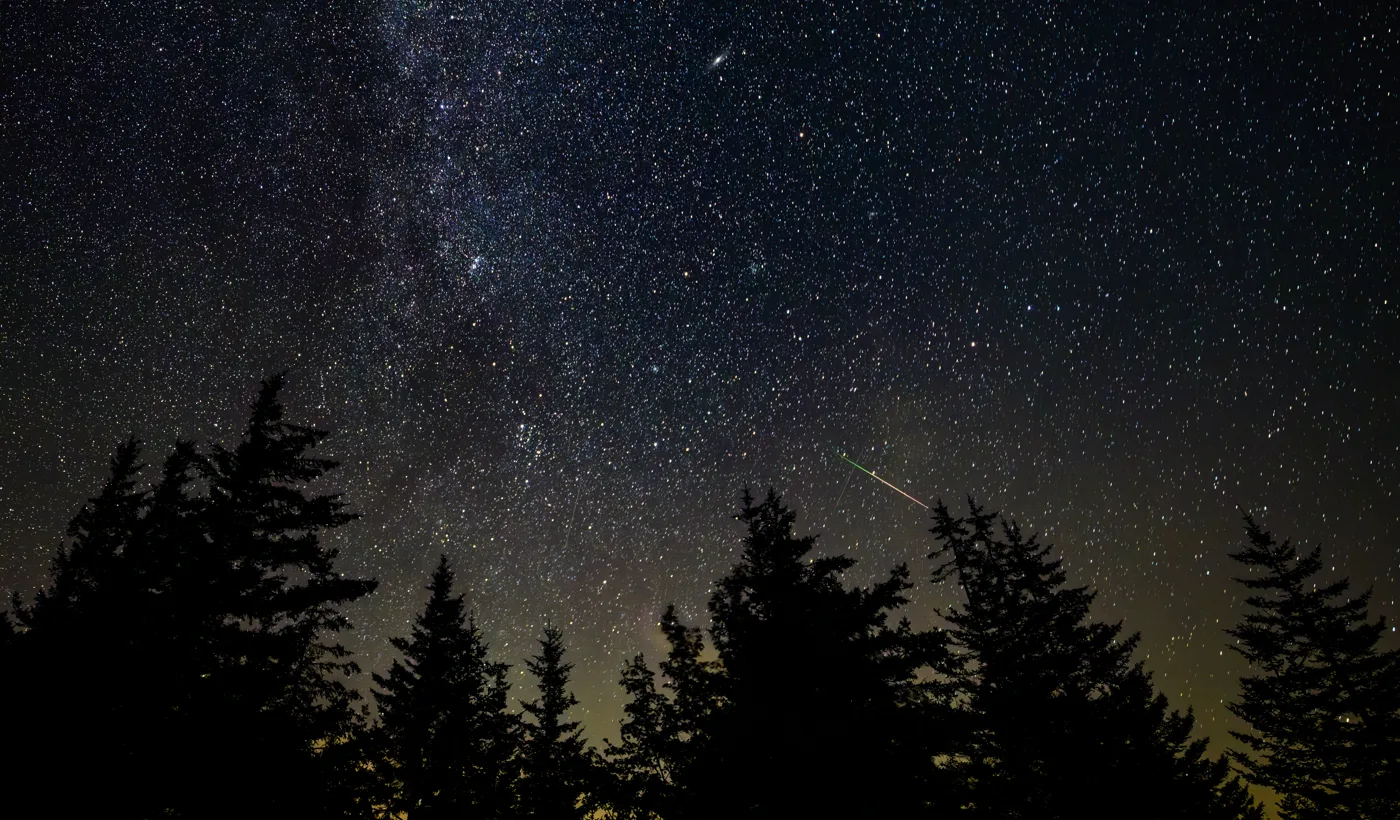
If you have searched for a meteor shower tonight in the UK on a random evening in late August 2026, the honest answer is no, not really. The Perseids finished on 24 August. The kappa Cygnids limp on until 28 August at about three meteors an hour under a perfect sky, and tonight the Moon is full, so you will see almost none of them. The next shower worth setting an alarm for is the Draconids on the evening of Friday 9 October.
That is the answer nobody publishes, because “no” does not make a good headline. What follows is the rest of it: every peak between now and January 2027, converted into British time, checked against when the radiant is actually above the horizon from Britain, and paired with what you can realistically expect to see rather than the numbers on the tin.
Tonight, and the next fortnight
| Night | What is on | Worth going out? |
|---|---|---|
| 27 August 2026 | kappa Cygnids, about 3/hr at best. Full Moon | No |
| Early hours of 28 August | Deep partial lunar eclipse, about 93% of the Moon in shadow at 5.12am BST | Yes, but for the eclipse, not meteors |
| 28 Aug to 5 September | Aurigids, peak 1 September, about 6/hr at best | Marginal |
| 5 to 21 September | September epsilon Perseids, peak 9 September, about 8/hr. New Moon 11 September | Worth an hour if the sky is clear |
| 9 October | Draconids. The first proper event of the autumn | Yes |
Eclipse timings are from the Royal Observatory Greenwich, and there is more on the rest of the autumn sky in our guide to what to see in the night sky.
Every remaining peak, in British time
Peak times below come from the International Meteor Organization’s 2026 and 2027 shower calendars, which are the reference documents the other calendars are built from. Moon data is from the US Naval Observatory, computed for a central England site at 53.0 degrees north.
| Shower | Peak (UK time) | Moon at peak | Best UK hours on the peak night |
|---|---|---|---|
| Draconids | Fri 9 Oct, 2.00am BST | 5% lit, set 5.30pm, dark all night | 8.20pm to 1.50am, the evening of Thu 8 Oct |
| Orionids | Wed 21 Oct, 7.35pm BST | 76% lit, sets 2.53am | 2.53am to 5.43am, the morning of Thu 22 Oct |
| Southern Taurids | Thu 5 Nov, 7.04pm | 8% lit, does not rise until 3.58am | 8.06pm to 3.58am |
| Northern Taurids | Thu 12 Nov, 6.21pm | 10% lit, set at 5.35pm | 7.26pm to 5.26am, all night |
| Leonids | Tue 17 Nov, 11.45pm | 50% lit, sets 11.32pm | 1.21am to 5.31am, the morning of Wed 18 Nov |
| Geminids | Mon 14 Dec, 2.00pm | 24% lit, sets 9.17pm | 9.20pm to 5.59am, see below |
| Ursids | Tue 22 Dec, 10.00pm | 96% lit, up all night | None worth the cold |
| Quadrantids | Mon 4 Jan 2027, 3.25am | 16% lit, does not rise until 6.00am | 12.50am to 6.10am |
Two peak times in that table are not published anywhere else, and it is worth saying why. The IMO gives the Orionids and both Taurid branches only as a date, because their maxima are broad, but it does give the exact solar longitude of each: 208 degrees for the Orionids, 223 for the Southern Taurids, 230 for the Northern Taurids. Solar longitude converts to a clock time. Doing that conversion puts the Orionid maximum at 18:35 UT on 21 October, the Southern Taurid maximum at 19:04 UT on 5 November and the Northern Taurid maximum at 18:21 UT on 12 November. Checked against the six showers where the IMO publishes both the solar longitude and the time, the same conversion lands within 24 minutes every time, so those three figures are good to well under an hour.
Three of these peaks happen when Britain cannot watch
This is the part that most UK meteor pages get wrong, because they print the peak time and leave you to assume it is the moment to be outside.
The Geminid maximum falls at 2.00pm on Monday 14 December. The Sun is nine degrees above the horizon over central England at that moment and the Gemini radiant is four degrees below it. The peak is simply not available from Britain.
The Orionid maximum, at 7.35pm BST on 21 October, is worse in a different way: the sky is dark but the radiant is 16 degrees below the horizon and does not rise for another two hours. Both Taurid maxima land in early evening with their radiants barely 16 degrees up, at the point in the night when they are least productive.
Only the Draconids, Leonids, Ursids and Quadrantids peak at a time when a British observer can actually be looking at a radiant that is up and a sky that is dark. That is four out of eight.
What “120 meteors an hour” really means
Every published rate is a zenithal hourly rate, or ZHR. It is a laboratory figure: the number a single observer would count with the radiant directly overhead, under a sky where the faintest visible star is magnitude 6.5. Nowhere in Britain has a magnitude 6.5 sky, and no radiant sits overhead all night.
The IMO’s own correction runs the other way, and it is simple arithmetic. Observed rate equals ZHR multiplied by the sine of the radiant’s altitude, divided by the population index r raised to the power of (6.5 minus your limiting magnitude). The population index is published per shower. Both terms punish you hard.
The Geminids are the clearest case. A published 150 becomes about 87 an hour from a genuinely dark British site with the radiant 70 degrees up, and about 34 an hour from an ordinary suburban garden where you can just make out fifth-magnitude stars. Move into a lit town and it falls to roughly 21. That is still a meteor every three minutes, which is a good night out. It is not 150.
The same arithmetic destroys the minor showers. The Draconids’ ZHR of 5 becomes about one an hour from a dark site and well under one from a garden. If a page tells you a shower produces five an hour, it is telling you that you will probably see nothing.
If you want to know which of those columns applies to you, our Bortle scale calculator and limiting magnitude calculator will get you there, and the UK light pollution map will show you how far you need to drive.
The Geminids: watch Monday night, not Sunday
Almost every UK guide names the night of 13 into 14 December. The arithmetic says otherwise this year.
The maximum is at 2.00pm on Monday 14 December. Astronomical darkness on the night of 13 into 14 December ends at 6.04am, which is just under eight hours before the peak. Darkness on the night of 14 into 15 December begins at 5.59pm, four hours after it. So the second night is twice as close to the maximum, and it is the only one of the two that gets anywhere near it.
The IMO records that the Geminids hold a ZHR above 100 for roughly ten to twelve hours around the peak, which puts that plateau at about 8am to 8pm on the 14th. Only the first two hours of British darkness that evening, 6pm to 8pm, fall inside it, and the radiant is only 10 to 26 degrees up then. Britain misses most of the best of this shower in 2026 no matter what it does.
The IMO also notes that during most returns a larger share of bright Geminids arrives towards the end of the maximum period. That is another reason to favour Monday evening.
The practical answer: go out on Monday 14 December from about 8pm, when the radiant clears 26 degrees, and stay out. The Moon is a 24% crescent and sets at 9.17pm. If you can only manage one night and want the highest radiant, the small hours of either night put Gemini around 70 degrees up at 2am.
Shower by shower
Draconids, Friday 9 October, peak 2.00am BST. The one shower that works in the evening. The radiant sits in Draco at declination +54, which is circumpolar from Britain, and it is highest at dusk rather than dawn. From 8.20pm on Thursday 8 October the radiant is already at 64 degrees. The IMO calls the moonlight conditions perfect, and the USNO confirms it: a 2% crescent that sets before sunset. The catch is the rate, a ZHR of five with a question mark next to it. The Draconids are also the shower most capable of surprising you, with storms in 1933 and 1946 and outbursts as recently as 2018, though nothing is predicted for 2026. Parent comet 21P/Giacobini-Zinner passed perihelion in March 2025.
Orionids, Wednesday 21 October. Debris from Halley’s Comet, fast at 66 km/s, ZHR 20 or better. The radiant is only useful after about half past midnight, and a 76% gibbous Moon sits in the sky until 2.53am. That leaves a clean window from 2.53am to 5.43am on the morning of Thursday 22 October, when the radiant reaches 53 degrees. Under three good hours, but they are properly dark hours.
Taurids, 5 and 12 November. Two branches of the same stream from Comet 2P/Encke, both slow, both modest, both known for producing the occasional fireball worth the wait. Rates are five to ten an hour at best under a perfect sky, so expect one or two. Both peaks fall in a moon-free stretch around the new Moon of 9 November, and the Northern Taurid radiant is above 25 degrees all night on 12 into 13 November.
Leonids, Tuesday 17 November, peak 11.45pm. Fast meteors at 71 km/s, ZHR about 15. The radiant is only 12 degrees up at the moment of maximum and climbs to 57 degrees by 5.31am, so the real Leonid window is the pre-dawn of Wednesday 18 November. The first-quarter Moon sets at 11.32pm, thirteen minutes before the nodal peak. Modelling by Vaubaillon and Sato shows several encounters with old, thin dust trails between 17 and 19 November, none dense enough for an outburst.
Ursids, Tuesday 22 December. Skip it. The radiant is circumpolar and would be above 25 degrees all night, but the Moon is 96% lit and up from 1.44pm to 6.52am. The IMO’s own verdict is that the chances of reliable data are small.
Quadrantids, Monday 4 January 2027, peak 3.25am. The best-placed peak of the whole run. The Moon is a 16% waning crescent that does not rise until 6.00am, so the night is dark throughout, and at the moment of maximum the radiant is 44 degrees up. ZHR is quoted at 80 but varies between about 60 and 200. Against that, the Quadrantid peak is famously narrow, only a few hours wide, so a cloudy 3am costs you the shower entirely.
Why the published dates disagree with each other
If you compare the Royal Observatory Greenwich’s 2026 meteor shower calendar with the IMO’s, they do not match, and it is worth knowing why before you decide one of them is wrong.
The clearest gap is the Southern Taurids. Greenwich gives 10 October. The IMO gives 5 November. Neither is a mistake. The IMO’s shower calendar states that the main Southern Taurid maximum, at a ZHR of five to ten, falls around 5 November, but that there is an earlier maximum with a ZHR near five around 13 October, “a date which often was listed as actual STA maximum”. The October date is the older convention, and the stream genuinely does have two humps. If you want the better night, take November.
The rate columns differ too, and that is a units problem rather than a disagreement. Greenwich lists 120 an hour for the Geminids and the IMO lists 150; Greenwich lists 15 for the Orionids and the IMO lists 20 or more. These are estimates of the same quantity from different analyses, and both are ZHR figures that need the correction above before they mean anything in a British garden.
The Leonid date differs by one day, 18 November against 17 November. That one is not a disagreement at all: the IMO’s nodal crossing is at 11.45pm on the 17th, which is the night of the 17th into the 18th.
Actually watching one
None of this needs a telescope, and a telescope makes it worse. Meteors can appear anywhere in the sky, so magnification is exactly the wrong tool. What matters, in order:
- Get away from lights. The population-index term in that formula is the brutal one. Going from a suburban garden to a proper dark site more than doubles what you count, and it costs nothing but a drive. Start with the UK’s dark sky sites.
- Dark-adapt for at least 20 minutes and do not look at a phone afterwards without a red filter.
- Do not stare at the radiant. Meteors near the radiant are foreshortened to short streaks. Look about 40 degrees away from it and roughly two-thirds of the way up the sky.
- Lie down. A reclining chair or a sleeping bag on a groundsheet. An hour of standing with your head back is not sustainable, and shower counting is an endurance activity.
- Dress for far colder than you expect. You are motionless outdoors in December. Two layers more than feels sensible.
- Give it a full hour minimum. Meteor arrivals cluster. Twenty minutes of nothing followed by four in ninety seconds is completely normal.
If you want company for the December showers, several of the UK’s star parties run through the autumn, and a pair of binoculars is worth having for the rest of the sky between meteors.
Frequently asked questions
Is there a meteor shower tonight in the UK? On most nights, no. Only about eight showers a year produce enough to be worth going outside for, and in late August 2026 there is nothing major running. The next worthwhile peak is the Draconids on the evening of Thursday 8 into Friday 9 October, followed by the Orionids on the morning of 22 October.
What is the best meteor shower to watch from Britain in 2026? The Geminids on 14 December, by a wide margin. The published ZHR of 150 works out at roughly 87 an hour from a dark British site and about 34 from a suburban garden, against about 10 and 4 for the Orionids. The Moon is only a 24% crescent and sets before 9.20pm.
Why do I never see the number of meteors that guides promise? Because the published figure is a zenithal hourly rate, measured with the radiant overhead under a magnitude 6.5 sky that does not exist in the UK. Correcting for a real radiant altitude and a real British sky typically cuts the number by half at a dark site and by three quarters or more in a town.
Do I need a telescope or binoculars to see a meteor shower? No, and both work against you. Meteors can appear anywhere in the sky, so the widest possible field of view wins, which means your eyes and nothing else. Save the optics for the planets and deep-sky objects.
Which direction should I face? Not at the radiant. Meteors appearing close to the radiant travel almost straight towards you and leave very short trails. Face roughly 40 degrees away from the radiant, look about two-thirds of the way up the sky, and pick whichever horizon is darkest from where you are standing.
Does the Moon really matter that much? Yes, more than anything except cloud. A full Moon costs you two or three magnitudes of sky brightness, which in the correction above can remove three quarters of the meteors you would otherwise count. It is why the Ursids on 22 December 2026, under a 96% Moon, are not worth attempting even though the radiant is up all night.
Peak times and shower parameters from the International Meteor Organization shower calendars for 2026 and 2027. Sun and Moon data computed for 53.0 degrees north, 1.5 degrees west, and checked against the US Naval Observatory. Last checked 27 August 2026.
Clear skies forecast? Get a nudge.
Our weekly email flags the next good UK observing window and one easy target to find.
Join the listMore from Starvest
Keep reading
Best Telescopes for Beginners in the UK (Tested by Price Bracket)
The best beginner telescopes in the UK by budget, from sub-£150 tabletop scopes to app-guided and smart telescopes, with real 2026 prices.
What Can You See with Binoculars at Night? A Realistic Astronomy List
A realistic list of what you can see with binoculars in astronomy, from the Moon and Jupiter's moons to Andromeda, with tips for spotting each from the UK.
How to Set Up and Use Your First Telescope (Step by Step)
How to use a telescope as a beginner: assemble the mount, align the finder, focus, and find your first targets. A clear step-by-step UK guide.