Beehive Cluster: Find M44 From the UK in Binoculars
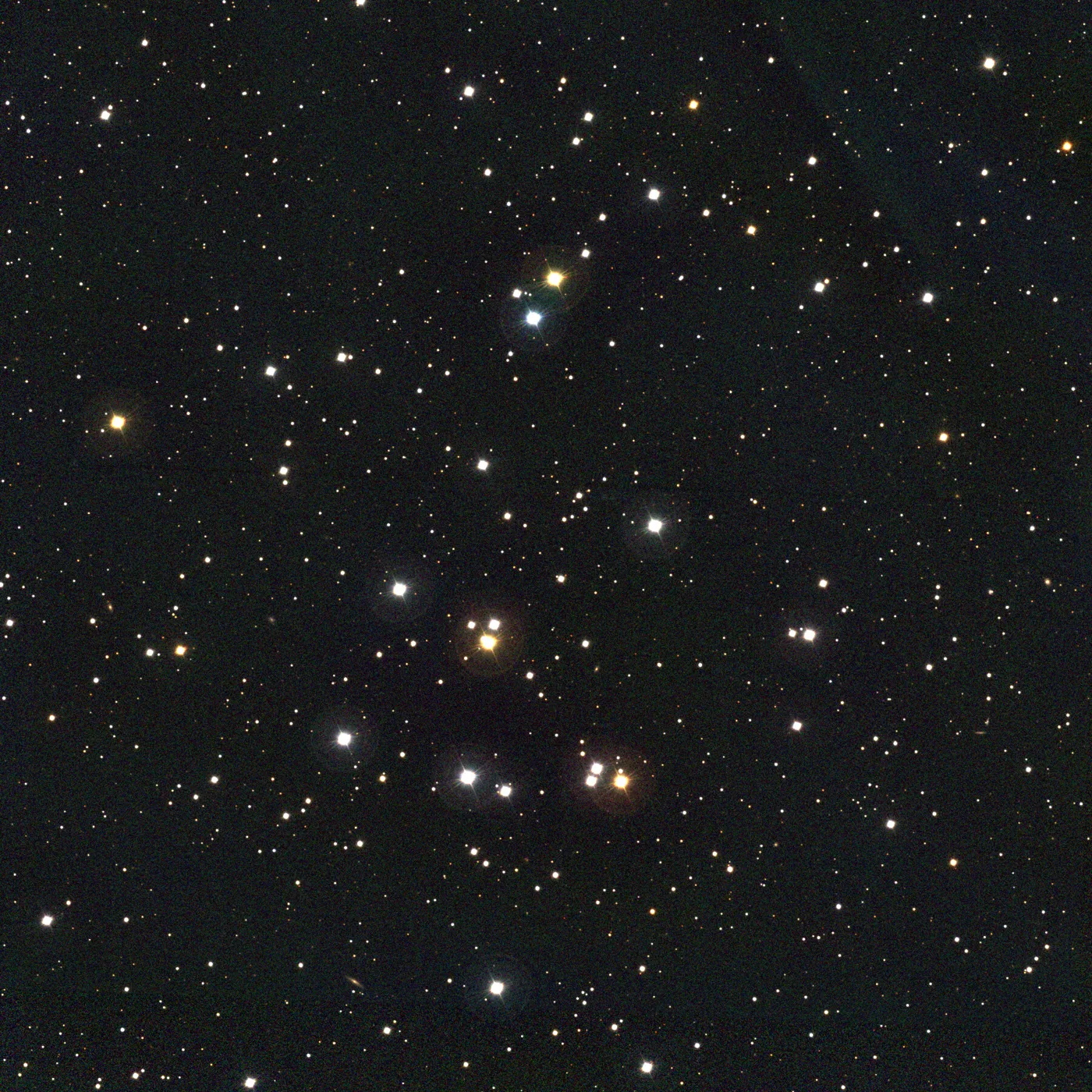
The Beehive Cluster, Messier 44, is one of the few deep-sky objects that looks better in a pair of binoculars than in most telescopes. It is a scatter of a few dozen bright stars, about three full Moons wide, in the faint constellation of Cancer between Gemini and Leo. From a dark site you can see it with the naked eye as a pale smudge; from a town you will need binoculars to find it at all. Either way it is easy once you know where to point.
Right now, in late October, it rises in the east-north-east around midnight and sits high in the south-east before dawn. The comfortable evening season is February to April, when it crosses the meridian between 10pm and 8pm.
What the Beehive actually is
M44 is an open cluster: a family of stars born from the same cloud, about 600 light years away and roughly 600 to 700 million years old. Astronomers count around 1,000 members, but only a few dozen are bright enough for binoculars. It covers about 1.5 degrees of sky, so its total brightness, around magnitude 3.7, is spread thin. That is why it vanishes under suburban light pollution even though the figure sounds bright.
Its older name is Praesepe, Latin for “manger”. The two stars either side of it, Asellus Borealis and Asellus Australis, are the “donkeys” feeding at it. Galileo turned his telescope on it in 1610 and resolved about 40 stars in what had always been a cloud. NASA’s Messier 44 page has a Hubble close-up of part of the cluster.
How to find it: the Pollux to Regulus hop
Cancer’s stars are faint, so do not start with Cancer. Start with the two bright stars either side of it.
- Find Pollux and Castor in Gemini. In winter and spring evenings they are the bright pair high in the south or south-west. Pollux is the slightly brighter, orange one.
- Find Regulus in Leo. It sits at the bottom of the backwards question mark that forms Leo’s head, to the east (left) of Gemini.
- Go a little over a third of the way from Pollux to Regulus. M44 lies just south of the line joining them. In a dark sky, look for a faint misty patch there; in a town, sweep that area with binoculars.
- Use the donkeys to confirm it. Two faint stars, Asellus Borealis above and Asellus Australis below, frame the cluster on its east side. If you see a loose spray of stars just west of that pair, you are on it.
If you are new to star-hopping, our guide to reading a star chart explains how to measure distances on the sky with your hand. A planetarium app makes the first find quicker; we compare them in best stargazing apps.
When to look from the UK
The Beehive is highest, and darkest-skied, when it crosses the meridian due south. From London it reaches 58 degrees up, from Edinburgh about 54 and from the north of Scotland about 51: comfortably high from anywhere in Britain. These are the times it is due south from London, worked out from its position; add a few minutes in the west of the country.
| Date | Due south (London) | What that means |
|---|---|---|
| 1 November 2026 | about 06:00 GMT | Pre-dawn only; rises around 22:15 |
| 1 December 2026 | about 04:00 GMT | Late-night and early morning object |
| 1 January 2027 | about 02:00 GMT | High after midnight |
| 1 February 2027 | about 23:50 GMT | Best of the year: up all night |
| 1 March 2027 | about 22:00 GMT | The easiest evening month |
| 15 March 2027 | about 21:10 GMT | Still well placed after dark |
| 1 April 2027 | about 21:00 BST | High in the south-west at nightfall |
| 1 May 2027 | about 19:00 BST | Low in the west in late twilight; season over |
The Moon matters more than the date. A Moon anywhere near first quarter or fuller washes out the fainter cluster stars and can hide M44 from the naked eye completely. The darkest windows in the evening season are the week either side of the new Moons on about 6 February, 8 March and 6 April 2027. The first of those coincides with an annular solar eclipse elsewhere in the world, which does not affect the night sky here.
Binoculars are the best instrument
Most binoculars show 5 to 7 degrees of sky, so the whole cluster sits in the middle of the view with dark sky around it, which is what makes it look like a swarm. In 10x50s expect 30 or more stars, several of them in obvious pairs and triangles, and a few with a faint orange tint. Brace your elbows on a wall or use a tripod and the count goes up noticeably. Our binoculars for stargazing page covers which sizes work, and 10x50 vs 15x70 compares the two classic astronomy sizes on objects like this one.
In a telescope: use your lowest power
A telescope’s narrow view is the problem here. A typical beginner’s reflector with a 25mm eyepiece shows only about 1 degree, so you see the middle of the Beehive and lose the shape that gives it its name. To get the best view:
- Use the longest focal length eyepiece you own. On a 650mm focal length scope, a 25mm eyepiece gives 26x and around 2 degrees with a wide-field design, which frames the cluster well. On a 1200mm Dobsonian you will only fit part of it.
- Short refractors do it best. A small, short-focus refractor at 15 to 25x frames M44 nicely.
- Then zoom in on details. Once you have seen the whole thing, higher power shows tight pairs and colour contrasts within it, and the faint background galaxies beyond it are a challenge for 8-inch scopes and up in very dark skies.
Our page on telescope eyepieces shows how to work out the true field of each eyepiece you own.
Seeing it with the naked eye
The Beehive is a classic test of sky darkness. From a properly dark site it shows as a soft, slightly grainy glow, larger than you expect. From most towns it is invisible. If you can see the four faint stars of Cancer’s main shape without effort, you should see M44 between them. The ancient Greeks treated it as a weather sign: when Praesepe disappeared in a clear-looking sky, high haze and rain were on the way.
Check how dark your own sky is on our UK light pollution map, or pick a site from our dark sky sites list.
Next targets on the same night
If the Beehive is your first cluster, the Pleiades is the obvious next one, higher in the west on winter evenings: our guide on how to see the Pleiades shows what binoculars add there. The Double Cluster in Perseus is another binocular showpiece in the same season. For a fuller list, see what you can see with binoculars.
Frequently asked questions
Where is the Beehive Cluster in the sky? In Cancer, between Gemini and Leo, a little over a third of the way from Pollux to Regulus and just south of the line between them. The two faint stars Asellus Borealis and Asellus Australis sit just east of it.
Can you see the Beehive Cluster with the naked eye? Yes, from a dark site, as a pale fuzzy patch about three full Moons wide. Under suburban or town skies it is usually invisible without binoculars.
When is the best time to see the Beehive Cluster from the UK? February to April evenings, when it is high in the south after dark, away from a bright Moon. In late October and November it is visible in the hours before dawn.
Why is M44 called the Beehive? Through binoculars or a small telescope, its stars look like a swarm of bees. Its older name, Praesepe, means “manger”.
Are binoculars or a telescope better for M44? Binoculars, for most people. The cluster is about 1.5 degrees across, wider than the view in many telescopes. In a telescope, use the lowest magnification you have.
How far away is the Beehive Cluster? About 600 light years. It is one of the nearest open clusters to the Sun, which is why its stars are spread across such a large patch of sky.
Sources
- NASA, Messier 44: distance, magnitude, Galileo’s observation.
- Deep Sky Corner, Praesepe (Messier 44): angular size, member count and age.
- Transit times and altitudes: calculated by Starvest from the cluster’s position (RA 8h 40m, Dec +19.7 degrees) for London.
Clear skies forecast? Get a nudge.
Our weekly email flags the next good UK observing window and one easy target to find.
Join the listMore from Starvest
Keep reading
Best Telescopes for Beginners in the UK (Tested by Price Bracket)
The best beginner telescopes in the UK by budget, from sub-£150 tabletop scopes to app-guided and smart telescopes, with real 2026 prices.
What Can You See with Binoculars at Night? A Realistic Astronomy List
A realistic list of what you can see with binoculars in astronomy, from the Moon and Jupiter's moons to Andromeda, with tips for spotting each from the UK.

How to Set Up and Use Your First Telescope (Step by Step)
How to use a telescope as a beginner: assemble the mount, align the finder, focus, and find your first targets. A clear step-by-step UK guide.