See the Space Station UK: Pass Times, and Why It Vanishes
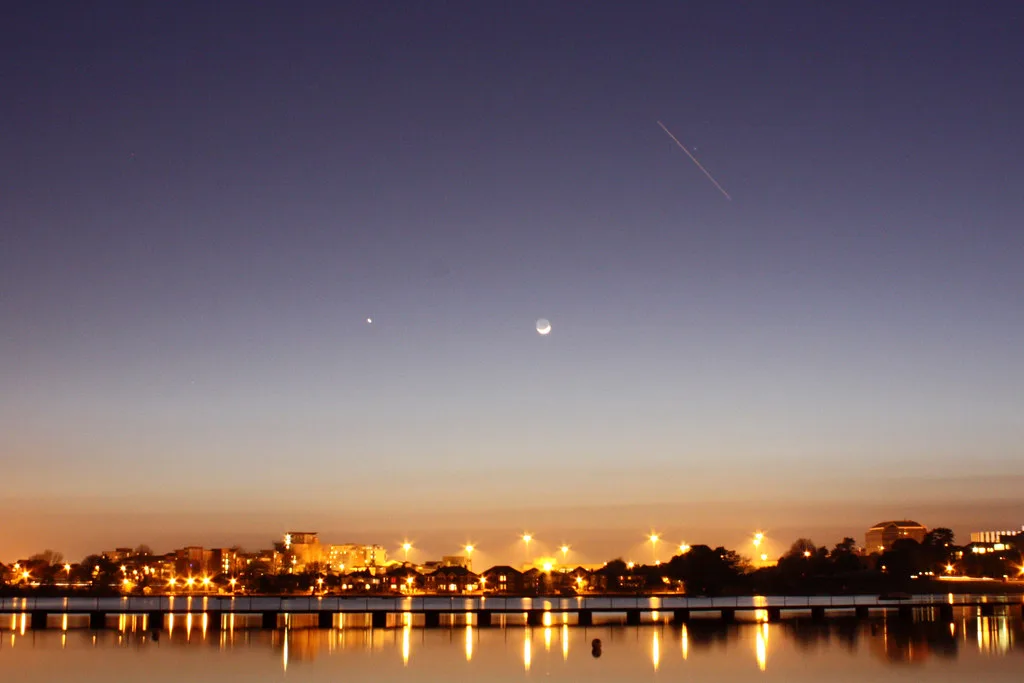
If you want to see the space station from the UK tonight, Friday 4 September 2026, the honest answer from London is no. The only two passes today were at 04:23 and 05:56 this morning, and the evening run does not start again until Tuesday 8 September. That is how this works: the International Space Station is not up there for you on demand, it arrives in clusters of a few days, then disappears for a week or more.
The good news is that when it does come back, it is the easiest object in this entire site to see. No telescope, no dark sky, no star chart. It is brighter than every star in the sky, it works from a city centre, and it takes about three minutes of your evening.
The next evening passes over London
These are the visible passes from central London for the coming fortnight, in British Summer Time, generated on 4 September 2026. Times shift by a minute or two after each reboost of the station’s orbit, so check on the day if you are timing it finely.
| Date | Starts | Direction it appears | Highest point | Brightness |
|---|---|---|---|---|
| Tue 8 Sep | 22:43 | SW, low | 12°, SSW | mag -1.2 |
| Wed 9 Sep | 21:56 | SSW, low | 23°, SSE | mag -2.5 |
| Thu 10 Sep | 21:09 | S, low | 17°, SE | mag -2.0 |
| Thu 10 Sep | 22:44 | WSW, low | 32°, SW | mag -2.5 |
| Fri 11 Sep | 21:57 | SW, low | 44°, SSE | mag -3.4 |
| Sat 12 Sep | 21:10 | SW, low | 33°, SSE | mag -2.9 |
| Sat 12 Sep | 22:46 | WSW, low | 48°, WSW | mag -3.0 |
| Sun 13 Sep | 21:58 | WSW, low | 73°, SSE | mag -3.9 |
The one to set an alarm for is Sunday 13 September at 21:58. It climbs to 73 degrees, which is close enough to straight up that you will have to lean back, and at magnitude -3.9 it will be brighter than anything else in the sky except the Moon.
How to read a pass list without getting confused
Every prediction service gives you the same four things, and each one answers a different question.
Brightness (magnitude). Lower and more negative is brighter. Anything at -3 or better is unmistakable. A -1 pass is still easy, but it will look like a bright aircraft rather than something startling. For comparison, the brightest star in the night sky, Sirius, sits at about -1.4.
Start direction. Where on the horizon it appears. It will almost always be somewhere between west and south for UK observers, and it always travels west to east, because that is the direction the station orbits.
Maximum altitude. How high above the horizon it gets, in degrees, where 0 is the horizon and 90 is directly overhead. Your fist at arm’s length covers about 10 degrees. A 12-degree pass barely clears the rooftops. A 70-degree pass goes over your head.
End direction. Where it disappears. And this is where most people get caught out.
Why it vanishes at its brightest
Look again at the table above. On 8 September the pass reaches its highest point at 22:43:31 and ends at 22:43:31. Same second. On 9, 10, 11 and 12 September, the same thing happens: the pass simply stops at the moment it is highest and brightest.
That is not a glitch in the data. The station is flying into Earth’s shadow. It shines only because it is reflecting sunlight, so the instant it crosses the terminator line into the planet’s own shadow it goes out, over about ten or fifteen seconds, like a dimmer being turned down. It does not set. It does not fly behind a cloud. It is still there, still moving, just no longer lit.
This is the single most common question people ask after their first sighting, and it is worth knowing in advance so you do not spend two minutes squinting at an empty patch of sky. In the evening, the station usually vanishes partway across. In the pre-dawn passes the reverse happens: it appears out of nowhere in the middle of the sky, already high up, as it emerges into sunlight.
It also explains why sightings only happen near dawn and dusk. NASA puts it simply: the station is visible because it reflects sunlight, but it is not bright enough to see during the day. So you need the sky above you to be dark while the station, 400 kilometres up, is still in sunlight. That overlap lasts a couple of hours after sunset and a couple of hours before sunrise.
Where you stand in Britain changes the show
The ISS orbits at an inclination of 51.6 degrees to the equator, which means it can pass directly overhead anywhere between 51.6 degrees north and 51.6 degrees south. Astronomy Now sets out what that means here: the station can reach the zenith for anywhere south of a line drawn roughly between Swansea and London, and appears lower in the sky for everywhere north of it.
That is not a small effect. Take the same two nights and run the numbers for three places in Britain:
| Pass | Penzance | London | Edinburgh |
|---|---|---|---|
| Sat 12 Sep, ~22:46 | 85°, mag -3.9 | 48°, mag -3.0 | 31°, mag -2.7 |
| Sun 13 Sep, ~22:00 | 78°, mag -3.8 | 73°, mag -3.9 | 29°, mag -2.7 |
On the Saturday night, Cornwall gets a pass that goes almost exactly overhead while Edinburgh gets one a third of the way up the southern sky, at less than half the apparent brightness. Nobody in Scotland is being cheated, it is just geometry: the further north you are, the further south the station’s track sits, and the more air you are looking through.
If you are in the north of Scotland, the practical consequence is that you want an unobstructed southern horizon, and a low pass over the sea or open ground beats a high one behind a terrace of houses.
The seasonal pattern, including the week it goes mad
Passes are not evenly spread through the year. Around midsummer, at UK latitudes, something unusual happens. The Northern Hemisphere is tilted towards the Sun, which tips the station’s orbital plane nearly face-on to the sunlight, and for a stretch of days the ISS never enters Earth’s shadow at all. Sky & Telescope describes the result: observers between about 40 and 60 degrees north can catch four, five or six passes in a single night, roughly every 90 minutes from dusk until dawn, with none of them cut short.
The whole of Britain sits inside that band. If you have ever wondered why some June evenings seem to produce a space station every hour and half the year produces none at all, that is the reason. Mid-May to mid-July is the season to plan around.
In midwinter the opposite is true: the passes cluster tightly into the short twilight windows, and there are long stretches with nothing visible at all. Those are the weeks to point at other things worth seeing in the night sky instead.
Getting times for your own postcode
Do not start with NASA. The Spot the Station website stopped providing sighting information and stopped sending its email and text alerts on 12 June 2025, and the page now only points you at the mobile app. The app works and is free, but its notifications give you a couple of hours’ warning at most, which is fine for a spontaneous look and useless for planning an evening.
For planning, use Heavens-Above. Set your location once and it gives you a table for the next ten days with exactly the four columns described above, for your coordinates rather than for the nearest big city. It is also the only free tool that will show you the same data for Tiangong and for Starlink trains. A good general stargazing app will do the job on your phone as well, and most of the decent ones include ISS alerts.
One thing that makes this object unusual: light pollution is irrelevant. At magnitude -3 the station cuts through the worst orange sky in the country. You do not need a dark sky site or dark adaptation. A back garden in a city works exactly as well as a hilltop in Northumberland, which is not something we get to say often on this site.
Is that it, or is it a plane?
Four things at once tell you it is the station rather than something else.
It does not blink. Aircraft carry flashing strobes and coloured navigation lights. The ISS is one steady, unblinking white point. This is the giveaway that settles most sightings within five seconds.
It is silent. Anything at 400 kilometres makes no sound. If you can hear it, it is a plane.
It moves at a particular speed. The station covers 28,000 kilometres an hour and crosses the whole sky in about six minutes at most, which reads as a determined, purposeful glide, faster than a high aircraft and far slower than a meteor. Meteors last a second or two; see our guide to meteor showers over the UK for the difference in practice.
It is far too bright to be a satellite. Hundreds of satellites are visible from a dark site, but almost all are faint. Only a handful get anywhere near the station.
Two lookalikes are worth knowing. Starlink trains are a line of a dozen or more evenly spaced faint dots following each other, seen shortly after a launch. Nothing like a single bright point. Tiangong, the Chinese space station, is genuinely similar but fainter, and its orbit is inclined at 41.5 degrees rather than 51.6, so it can never pass overhead in Britain. From the UK it is always a low southern-horizon object, and from northern Scotland it is often not visible at all.
Binoculars, telescopes, and why you should not bother
People ask whether a telescope shows the solar panels. Under very good conditions with a large aperture and a tracking mount, an experienced observer can pick out the shape of the station at high magnification, and photographers do capture the modules. For everyone else, the answer is no.
The problem is angular speed. The station crosses the sky faster than you can push a telescope, and at any useful magnification your field of view is a fraction of a degree. You will spend the entire pass failing to find it, and miss the pass. Even with binoculars, the honest gain is that it looks slightly brighter and you can sometimes see it is not perfectly point-like.
Watch it with your eyes. That is the correct instrument for this object, and one of the few times we will say that.
See it while it is there
NASA has selected SpaceX to build the United States Deorbit Vehicle, a heavily modified Dragon that will steer the station down into a remote stretch of ocean after operations end in 2030, with the final re-entry currently planned for 2031. The ISS has been continuously crewed since November 2000. Whatever replaces it, whether commercial stations or something else, there is no guarantee it will be as big or as bright.
A structure 109 metres end to end, with people living in it, crossing your sky at five miles a second. It is worth three minutes.
Frequently asked questions
Can I see the space station from the UK tonight? Only if a pass is scheduled, and only within a couple of hours of sunset or sunrise. Over London the next evening passes are 8 to 13 September 2026, with the best on Sunday 13 September at 21:58. Check Heavens-Above for your own location, because pass times and altitudes vary noticeably across Britain.
Which direction do I look? West to east, always. It will appear low in the western or southwestern sky, climb, then head off towards the east or southeast. A pass list will give you the exact compass points for your location.
Why did it disappear halfway across the sky? It flew into Earth’s shadow. The station is only visible because it reflects sunlight, so when it crosses into the shadow it fades out over ten or fifteen seconds and stays invisible for the rest of the pass. This is normal and happens on most evening passes.
How bright is the space station? At its best it is the brightest thing in the night sky after the Moon, comparable to Venus. Good passes over Britain run around magnitude -3 to -3.9. Low passes near the horizon are much fainter, closer to magnitude -1.
Do I need a dark sky or a telescope? Neither. It is bright enough to see from any town or city centre, and it moves too fast to track through a telescope. Naked eye is genuinely the best way to watch it.
Why are there sometimes several passes in one night and sometimes none for a fortnight? The station orbits every 90 minutes, but you only see it when your sky is dark and the station is still sunlit. Around midsummer those conditions can hold all night at UK latitudes, giving four to six passes; in winter and during unfavourable stretches of the orbit’s drift, there may be nothing visible for a week or more.
Is the Chinese space station visible from the UK too? Tiangong is visible but fainter, and its lower 41.5 degree orbital inclination means it never rises high in British skies. Expect a modest object low in the south from England, and very little from Scotland.
Clear skies forecast? Get a nudge.
Our weekly email flags the next good UK observing window and one easy target to find.
Join the listMore from Starvest
Keep reading
Best Telescopes for Beginners in the UK (Tested by Price Bracket)
The best beginner telescopes in the UK by budget, from sub-£150 tabletop scopes to app-guided and smart telescopes, with real 2026 prices.
What Can You See with Binoculars at Night? A Realistic Astronomy List
A realistic list of what you can see with binoculars in astronomy, from the Moon and Jupiter's moons to Andromeda, with tips for spotting each from the UK.
How to Set Up and Use Your First Telescope (Step by Step)
How to use a telescope as a beginner: assemble the mount, align the finder, focus, and find your first targets. A clear step-by-step UK guide.