How to See Uranus: Find It Near the Pleiades, Nov 2026
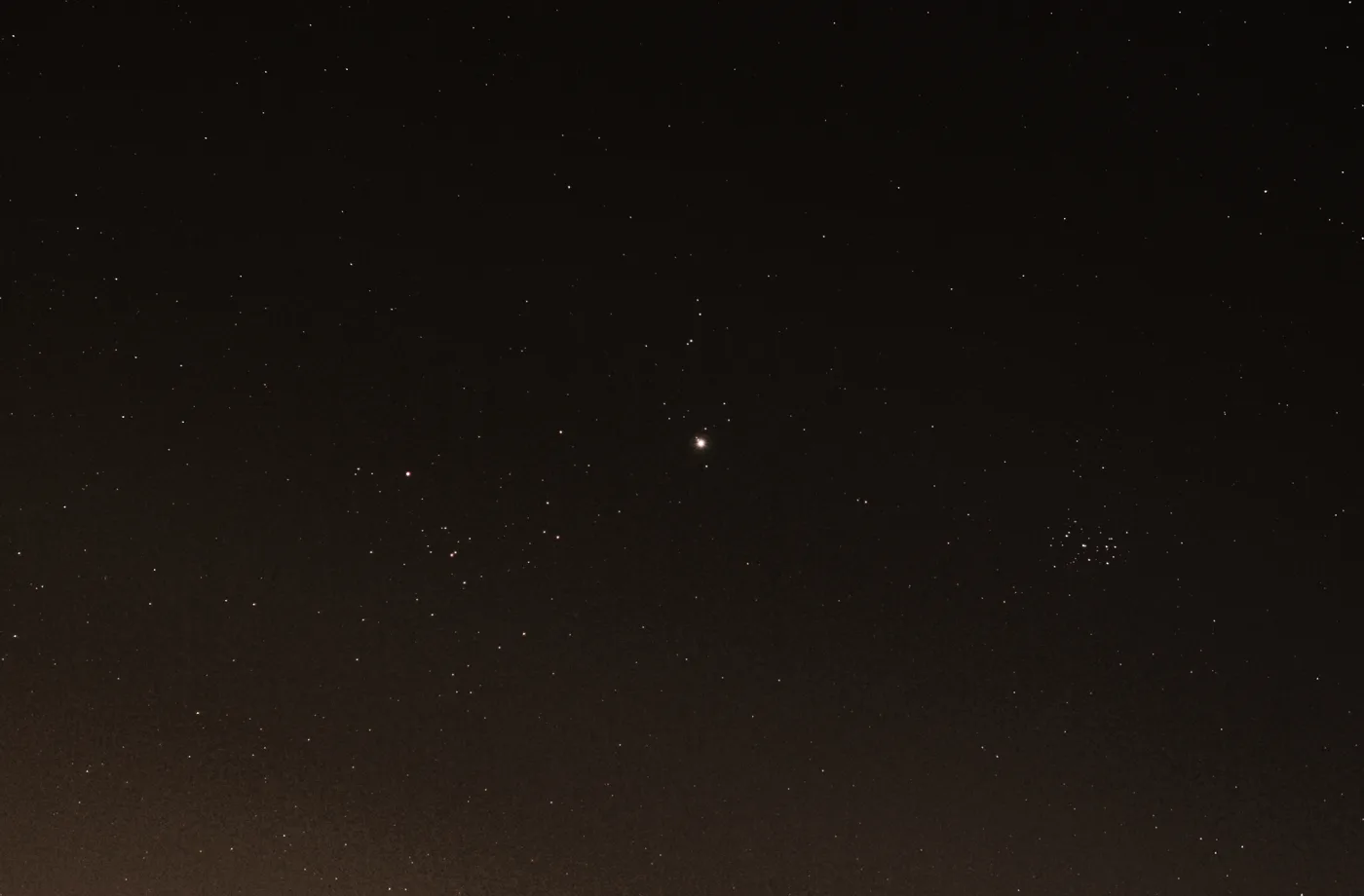
Knowing how to see Uranus comes down to one fact: this winter it sits just a few degrees from the Pleiades, the easiest star cluster in the sky to find. At magnitude 5.6 it is bright enough for any pair of binoculars, and on a truly dark night it is right at the edge of naked-eye visibility. Uranus reaches opposition on 25 November 2026, when it is opposite the Sun in the sky, up all night and at its closest to us for the year. Here is how to find it from the UK, how to be sure you have it, and what it looks like in a small telescope.
Uranus in 2026-27: the numbers that matter
| Uranus around opposition | |
|---|---|
| Opposition | 25 November 2026, 23:41 GMT |
| Brightness | magnitude about 5.6 |
| Constellation | Taurus, between the Pleiades and Aldebaran |
| Apparent size | 3.8 arcseconds |
| Distance | about 18.4 times the Earth-Sun distance, roughly 2.76 billion km |
| Highest in the sky (London) | about 59 degrees, due south just before midnight |
We computed the positions and times on this page with a standard planetary ephemeris for London; the opposition time and 3.8 arcsecond size match published predictions. Edinburgh sees it slightly lower, at about 55 degrees, which is still excellent.
Uranus does not change much in brightness through the season. It stays around magnitude 5.6 from October to January, so you do not need to wait for opposition night. Anything from mid-October to February works.
When to look
- Now (October): Uranus rises in the east-north-east around 8pm BST in early October and is highest at about 4am. Late evening is fine once it has climbed above rooftops, from about 11pm.
- Around opposition (late November): it rises before sunset, is well placed all evening, and is highest just before midnight GMT.
- January: it is highest by about 8.20pm GMT on 15 January, which makes it an easy early-evening target.
Pick a night without a bright Moon near Taurus. Uranus is faint enough that moonlight makes the star-hop harder, although binoculars will still show it.
How to find Uranus: the star-hop from the Pleiades
- Find the Pleiades. Look east in the late evening in autumn, or south in the evening in winter, for the tight little group of stars that looks like a tiny dipper. Our guide on how to see the Pleiades has more help if you have never picked it out.
- Find Aldebaran. Below and to the left of the Pleiades as they rise, look for a bright orange star at the end of a V of stars. That is Aldebaran and the Hyades cluster.
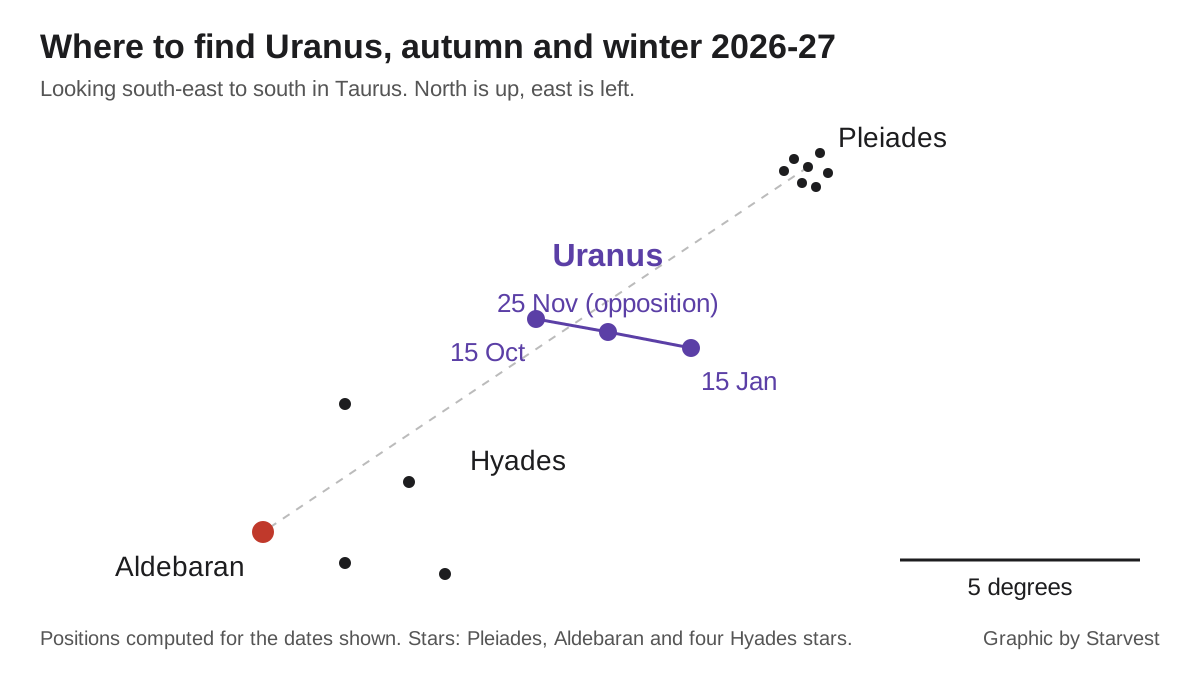
- Run a line between them. Uranus sits close to the straight line from the Pleiades to Aldebaran, a little south of it, roughly 40% of the way from the Pleiades.
- Put the Pleiades at one edge of your binoculars. Uranus is about 5 degrees from the Pleiades in late November, so with the cluster at the edge of a 10x50 field (usually around six degrees wide) Uranus will be near the opposite edge, towards Aldebaran.
Uranus is moving slowly west, towards the Pleiades, until about 9 February 2027, when it turns and heads back east. In mid-October it is about 6.4 degrees from the Pleiades; by mid-January it has closed to about 4.5 degrees. The chart shows its path.
How to be sure it is Uranus and not a star
In binoculars Uranus looks exactly like a faint star. There are three ways to confirm it:
- Use an app. A planetarium app such as Stellarium or SkySafari, set to your location, shows Uranus against the real star pattern. Hold the binoculars on the patch and match the shape of the nearby stars. Our round-up of the best stargazing apps covers the free options.
- Sketch and come back. Draw the half-dozen stars around your suspect and look again a week later. Uranus will have moved slightly against them; the stars will not.
- Look at the colour. Through a telescope, and with some imagination in binoculars, Uranus has a distinct pale blue-green tint that the white stars around it lack.
If you are new to matching the sky to a chart, our guide on how to read a star chart makes this step much easier.
Can you see Uranus with the naked eye?
Only just, and only from a properly dark site. Magnitude 5.6 is close to the limit of what the eye can see under good rural skies, and well beyond what you will see from a town. If you want to try, find it in binoculars first, then lower them and look at the exact spot with averted vision (looking slightly to one side). The UK’s dark sky places give you the best chance.
Seeing Uranus with binoculars
Any decent pair will do. 10x50s or 8x42s show Uranus easily as a steady point of light once you know where to look. Bracing them on a wall or mounting them on a tripod helps you hold the field still while you compare it with the chart. Binoculars will not show a disc; for that you need a telescope. See what you can see with binoculars for other targets in the same part of the sky.
What Uranus looks like through a small telescope
At low power Uranus looks like a star with a faint blue-green colour. Push the magnification to 100x to 150x on a steady night and it becomes a tiny, flat disc that holds its shape while the stars around it stay as points. At 150x its 3.8 arcsecond disc appears roughly as large as a third of the full Moon looks to the naked eye. You will see no detail on it, and that is normal: even large amateur telescopes show only the colour and the disc.
A 70mm refractor will show the disc on a good night; a 130mm or 150mm reflector shows it more clearly. Our guides on the best magnification for planets and astronomical seeing explain why a steady night matters more than extra power. If you are buying, the best telescope for planets has the models we would choose.
Uranus’s brightest moons, Titania and Oberon, are around magnitude 14. They need a large telescope, usually 250mm or more, a dark sky and a detailed finder chart, so treat them as a challenge for later.
Uranus and the planets you can see this winter
Uranus is the faintest planet you can see without a telescope, and the only one most people never knowingly look at. Neptune, at about magnitude 7.8, needs binoculars and a careful chart. For the bright planets on view this season, see our guide on how to see the planets. NASA’s Uranus facts page is a good companion if you want to know what you are looking at: an ice giant tipped on its side, with a year lasting 84 of ours.
Frequently asked questions
When is the best time to see Uranus in 2026? From mid-October 2026 to February 2027, with opposition on 25 November 2026. Around then it rises before sunset and is highest in the south just before midnight.
Where is Uranus in the sky right now? In Taurus, close to the line between the Pleiades and the orange star Aldebaran, a little south of it and about 40% of the way from the Pleiades. In late November it is about 5 degrees from the Pleiades.
Can you see Uranus without a telescope? Yes, with binoculars it is easy once you know where to look. With the naked eye it is just possible from a very dark rural site, because its magnitude of 5.6 is close to the limit of human vision.
What does Uranus look like through a telescope? A small, pale blue-green disc with no visible detail. You need around 100x to 150x and a steady night to see it as a disc rather than a star.
How do I know I am looking at Uranus? Match the stars around it to a planetarium app, look for its blue-green tint, or note its position against nearby stars and check again a week later. Uranus moves; the stars do not.
Can I see Uranus’s moons? Not with a small telescope. The brightest, Titania and Oberon, are around magnitude 14 and need roughly a 250mm telescope and a dark sky.
Clear skies forecast? Get a nudge.
Our weekly email flags the next good UK observing window and one easy target to find.
Join the listMore from Starvest
Keep reading
Best Telescopes for Beginners in the UK (Tested by Price Bracket)
The best beginner telescopes in the UK by budget, from sub-£150 tabletop scopes to app-guided and smart telescopes, with real 2026 prices.
What Can You See with Binoculars at Night? A Realistic Astronomy List
A realistic list of what you can see with binoculars in astronomy, from the Moon and Jupiter's moons to Andromeda, with tips for spotting each from the UK.
How to Set Up and Use Your First Telescope (Step by Step)
How to use a telescope as a beginner: assemble the mount, align the finder, focus, and find your first targets. A clear step-by-step UK guide.