Saturn at Opposition 4 October, Plus Mars in the Beehive
October is the month the planets come back for British observers: Saturn in the evening, Mars and Jupiter before dawn, and the Moon calling on all three. Out in space, Europe’s Jupiter probe used Earth as a slingshot on Monday, and the Royal Observatory has named the year’s best astronomy photograph. Here is what is worth your attention.
Saturn reaches opposition on Sunday 4 October
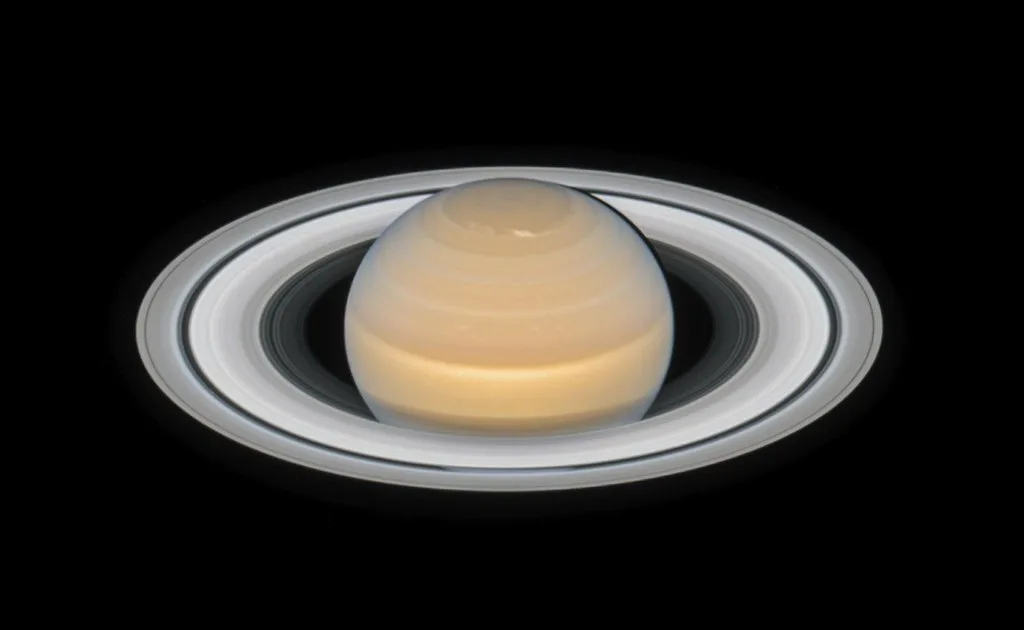
The Royal Observatory Greenwich’s October sky guide, published on 29 September, puts Saturn at opposition on 4 October. Opposition means the planet sits opposite the Sun in our sky, so it rises around sunset, is up all night and is at its brightest for the year. Look for the brightest star-like point in the southern sky, steady and slightly golden, drifting from southeast to southwest through the evening. The Observatory also flags the Moon passing close to Saturn (and Neptune, for telescope users) from about 9pm to 3am on the night of 24 to 25 October.
The catch this year is the rings. They passed edge-on in March 2025 and are only reopening slowly: at this opposition they are tilted just 7.5 degrees towards us, so a small telescope shows a thin bar through the planet rather than the wide hoop in every famous photograph. You will still see them in a 60mm to 80mm scope, plus Titan as an obvious point of light alongside. What you will not see easily is Cassini’s division. Our guide to seeing Saturn’s rings through a telescope works through the aperture and magnification that actually show structure in an awkward year like this one. Source: Royal Observatory Greenwich, night sky highlights October 2026.
Mars meets the Moon on 5 October, then walks through the Beehive
If you are up before dawn, the two bright “stars” in the east are Mars and Jupiter. Sky at Night Magazine’s planet notes, published on 1 October, set out the sequence. In the early hours of 5 October the waning crescent Moon, 32% lit, sits 1.4 degrees from Mars at about 03:30 BST, closing to 41 arcminutes by around 05:50 BST as dawn brightens. The next morning, 6 October, the Moon is 2.4 degrees from Jupiter at 06:00 BST.
The better target for anyone with a camera is Mars and the Beehive Cluster, M44. Between 10 and 12 October Mars runs in front of the cluster and appears embedded in it on the mornings of 11 and 12 October. Binoculars frame it perfectly, and a run of shots across three mornings shows the planet moving against the stars, which is about as direct a demonstration of orbital motion as you can photograph from a back garden. Our list of what you can see with binoculars covers the rest of the morning sky. Mars and Jupiter keep closing through the month, ending 1.2 degrees apart on 16 November. Source: Sky at Night Magazine.
The same Royal Observatory guide has the Hunter’s Moon full at 4.12am on 26 October, the night after the clocks go back, and the Orionids peaking on the night of 21 to 22 October at up to 15 an hour once the Moon sets after 2am. Our UK meteor shower calendar has the timings, including the Draconids, which work in the evening of 8 October rather than after midnight.
Juice used Earth to bend its path to Jupiter
On Monday 28 September the European Space Agency’s Jupiter Icy Moons Explorer flew 8,640 km above the Indian Ocean, with closest approach at 11:45 UTC. ESA says the flyby turned the spacecraft through 20 degrees and added 3.5 km/s to its speed, and that operators needed only one small correction burn, out of six slots set aside, in the four weeks beforehand. Saving propellant here leaves more for the moons: Juice has 35 flybys of Ganymede, Europa and Callisto ahead of it.
Its monitoring camera caught Earth on the way out, Africa and Madagascar clearly visible with the Moon as a small grey dot nearby. There is one more Earth flyby to come, in January 2029, before arrival at Jupiter in July 2031. You cannot see Juice from the ground, but Jupiter itself is the brightest point in the dawn sky this month. Source: ESA.
A shark nebula wins Astronomy Photographer of the Year
The ZWO Astronomy Photographer of the Year 2026 winners were announced at an online ceremony on Thursday 17 September. The overall winner, and winner of Stars and Nebulae, is “The Quiet Predator” by Ali Alobaidly, a deep image of the Shark Nebula in which judge Steve Marsh notes you can see distant galaxies through the dust. Other category winners include Stefano Pellegrini’s star trail over Botswana in Skyscapes, Petr Horalek’s daytime occultation of Venus by the Moon in Our Moon, and Nikolaos Strimpoulis’s “Mineral Moon” in the young category.
The winning images are on show at the National Maritime Museum in Greenwich. If they have got you thinking about a first imaging setup, start with our best telescopes for astrophotography beginners. Source: Royal Museums Greenwich.
Clear skies forecast? Get a nudge.
Our weekly email flags the next good UK observing window and one easy target to find.
Join the listMore from Starvest
Keep reading
Best Telescopes for Beginners in the UK (Tested by Price Bracket)
The best beginner telescopes in the UK by budget, from sub-£150 tabletop scopes to app-guided and smart telescopes, with real 2026 prices.
What Can You See with Binoculars at Night? A Realistic Astronomy List
A realistic list of what you can see with binoculars in astronomy, from the Moon and Jupiter's moons to Andromeda, with tips for spotting each from the UK.
How to Set Up and Use Your First Telescope (Step by Step)
How to use a telescope as a beginner: assemble the mount, align the finder, focus, and find your first targets. A clear step-by-step UK guide.