Quadrantids 2027 UK: Peak 3.25am Mon 4 Jan, No Moon
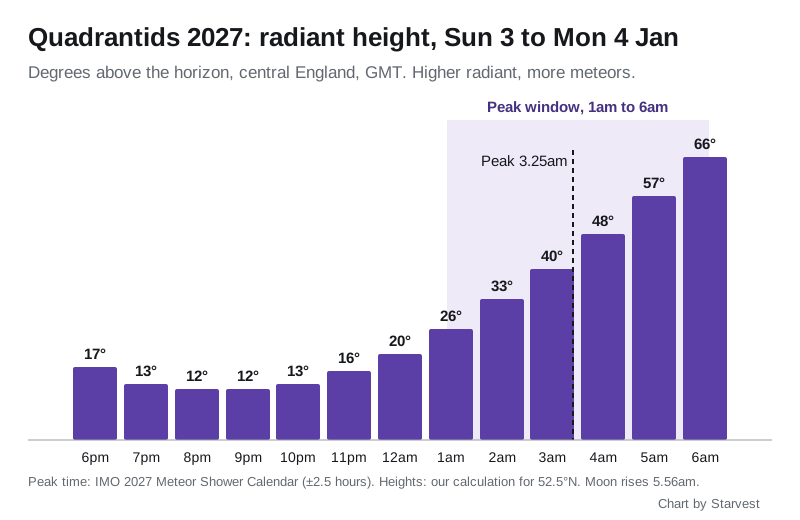
The Quadrantids 2027 peak at 3.25am GMT on Monday 4 January, according to the International Meteor Organization’s 2027 calendar. That is the middle of a British winter night, with the radiant climbing in the north east and no Moon in the sky until a thin crescent rises just before 6am. The IMO calls this year’s moonlight conditions perfect. The night to go out is Sunday 3 into Monday 4 January, and the hours that matter are 1am to 6am.
The catch is the Quadrantids’ famously short peak. Their best rates last only a few hours, so a cloudy 3am can cost you the whole shower. Here is exactly when to look, where, and what you will really count.
Quadrantids 2027 at a glance
| Sunday 3 to Monday 4 January 2027 | |
|---|---|
| Peak | 3.25am GMT Monday, give or take about 2.5 hours |
| Quoted ZHR | 80, varying between about 60 and 200 |
| Moon | 12% lit waning crescent, rises about 5.55am |
| Fully dark | about 6.10pm Sunday to 6.10am Monday |
| Radiant 20 degrees up | from about midnight |
| Radiant at the peak | 44 degrees up, in the north east |
| Active period | 28 December to 12 January |
Peak time, ZHR and active period come from the IMO 2027 Meteor Shower Calendar. Moon, darkness and radiant heights are our own calculation for central England (52.5 degrees north). In Edinburgh the Moon rises about 35 minutes later and dawn twilight starts about 10 minutes later; in Plymouth full darkness arrives about 15 minutes later in the evening, which makes no difference to the peak hours.
Why some sites give a different time
Search for the Quadrantids 2027 and you will find peak times anywhere from midnight on 3 January to nearly 6am on 4 January. The IMO is the source to trust: its calendar puts the maximum at solar longitude 283.15 degrees, which falls at 3.25am GMT on 4 January, and it adds that gaps in past observations leave an uncertainty of about 2.5 hours either way. Some countdown sites simply quote a date at midnight UTC, which is not a prediction at all.
The useful part is that every credible estimate lands inside British darkness this year. Whether the true peak comes at 1am or 5.30am, you can be outside for it. That is rare: in many years the Quadrantid maximum falls in daylight over the UK.
Where to look
The radiant sits in the far north of Boötes, close to the handle of the Plough, in an area once marked as the constellation Quadrans Muralis. It never sets from Britain, but in the evening it sits low in the north, only 12 degrees up at 8pm and 9pm. It then climbs into the north east: 20 degrees at midnight, 33 degrees at 2am, 44 degrees at the peak, 48 degrees at 4am and 57 degrees at 5am.
You do not need to stare at the radiant. Meteors can appear anywhere in the sky; their trails just point back to it. Face roughly north east or east, look about halfway up, and take in as much sky as you can. If you cannot find the Plough, our star chart guide explains how.
Hour by hour
| Time (GMT) | Radiant height | What to expect |
|---|---|---|
| 6pm to midnight | 12 to 20 degrees | Low radiant, very few meteors; occasional long grazers skimming the horizon |
| 1am | 26 degrees | Rates start to build |
| 2am | 33 degrees | Worth being settled in by now |
| 3am to 4am | 40 to 48 degrees | The predicted peak at 3.25am; best chance of the highest rates |
| 5am | 57 degrees | Radiant high; rates depend on how early or late the true peak came |
| 5.55am | 66 degrees | Thin Moon rises, dawn twilight begins about 6.10am |
If you can only manage one block, make it 2.30am to 4.30am. If you are an early riser rather than a late one, 4am to 6am has the radiant higher and is still well inside the predicted window.
What you will really count
The ZHR of 80 is a standardised figure: what one observer would see under a perfect sky with the radiant overhead. Neither is true in Britain, so real counts are lower. At 3.25am, with the radiant 44 degrees up, these are the rough hourly counts for a single observer with a clear view:
| Your sky | If ZHR is 80 | If ZHR is 60 | If ZHR reaches 200 |
|---|---|---|---|
| Very dark rural (faintest stars magnitude 6.5) | about 55 | about 40 | about 140 |
| Dark village (5.5) | about 25 | about 20 | about 65 |
| Suburb (5.0) | about 18 | about 14 | about 45 |
| Town edge (4.5) | about 13 | about 9 | about 30 |
We worked these from the IMO’s population index for the Quadrantids, 2.1 at maximum. Plug your own sky into our meteor shower rate calculator, or check your sky’s limiting magnitude with the Bortle scale calculator.
The IMO notes that recent returns have varied: 2022, 2023 and 2025 came in at the low end, while 2024 and 2026 were close to average. It also mentions a modelling suggestion that the stream is slightly shifted towards the Sun in 2027, which could boost activity. Treat any outburst as a bonus, not a promise.
How to give yourself the best chance
- Check the forecast on Sunday afternoon. January cloud is the real enemy. If your area is clouded over, a drive of 30 to 60 miles towards a clear patch can save the night. Our dark sky sites list helps you choose.
- Get away from lights. Each step of light pollution roughly halves what you see, so a village beats a suburb by more than you would expect.
- Dress for minus temperatures. Early January nights in Britain often drop below freezing. Wear more layers than seems sensible, and lie on a reclining chair or camping mat with a sleeping bag.
- Let your eyes adapt. Give it 20 minutes without looking at a phone. A red torch keeps your night vision.
- No telescope or binoculars. Meteors are fast and spread across the whole sky; your eyes are the right instrument.
What if Sunday night is cloudy?
Because the Quadrantid peak is so narrow, the following night (Monday 4 into Tuesday 5 January) will show only a fraction of the activity, and the night before (Saturday 2 into Sunday 3) is too early. Both are still dark and Moon-free in the small hours, so a few Quadrantids are possible, along with the odd bright fireball the IMO says can turn up for days after the maximum. But there is no proper second chance. If the peak night is clear, take it.
For the rest of the year’s showers and their Moon conditions, see our UK meteor showers calendar, and the Society for Popular Astronomy’s meteor section for observing advice.
Frequently asked questions
When do the Quadrantids peak in 2027? The IMO predicts the peak at 3.25am GMT on Monday 4 January 2027, with an uncertainty of about 2.5 hours. From the UK, that means the night of Sunday 3 into Monday 4 January, between about 1am and 6am.
Will the Moon spoil the Quadrantids in 2027? No. The Moon is a 12% lit waning crescent that does not rise until about 5.55am, just before dawn, so the whole peak window is Moon-free. The next New Moon is on 7 January.
Which direction should I look for the Quadrantids? Face north east or east and look about halfway up. The radiant is near the handle of the Plough in northern Boötes, but meteors appear all over the sky.
How many Quadrantids will I see per hour? From a dark rural site near the peak, around 55 an hour if the shower reaches its usual ZHR of 80. From a suburb, expect closer to 15 to 20. Rates can be much higher if 2027 brings a strong return.
Why is the Quadrantid peak so short? The stream of debris the Earth passes through is narrow, so the best rates last only a few hours rather than the day or two of the Perseids or Geminids. That is why the exact peak time matters so much for this shower.
Can I see the Quadrantids on 3 January in the evening? Only a few. The radiant is just 12 to 20 degrees up in the north from 8pm to midnight, so most meteors are below the horizon. The good hours start after 1am.
Clear skies forecast? Get a nudge.
Our weekly email flags the next good UK observing window and one easy target to find.
Join the listMore from Starvest
Keep reading
Best Telescopes for Beginners in the UK (Tested by Price Bracket)
The best beginner telescopes in the UK by budget, from sub-£150 tabletop scopes to app-guided and smart telescopes, with real 2026 prices.
What Can You See with Binoculars at Night? A Realistic Astronomy List
A realistic list of what you can see with binoculars in astronomy, from the Moon and Jupiter's moons to Andromeda, with tips for spotting each from the UK.
How to Set Up and Use Your First Telescope (Step by Step)
How to use a telescope as a beginner: assemble the mount, align the finder, focus, and find your first targets. A clear step-by-step UK guide.