Solar Eclipse 2027 UK: 42% in London, Times for 26 Places
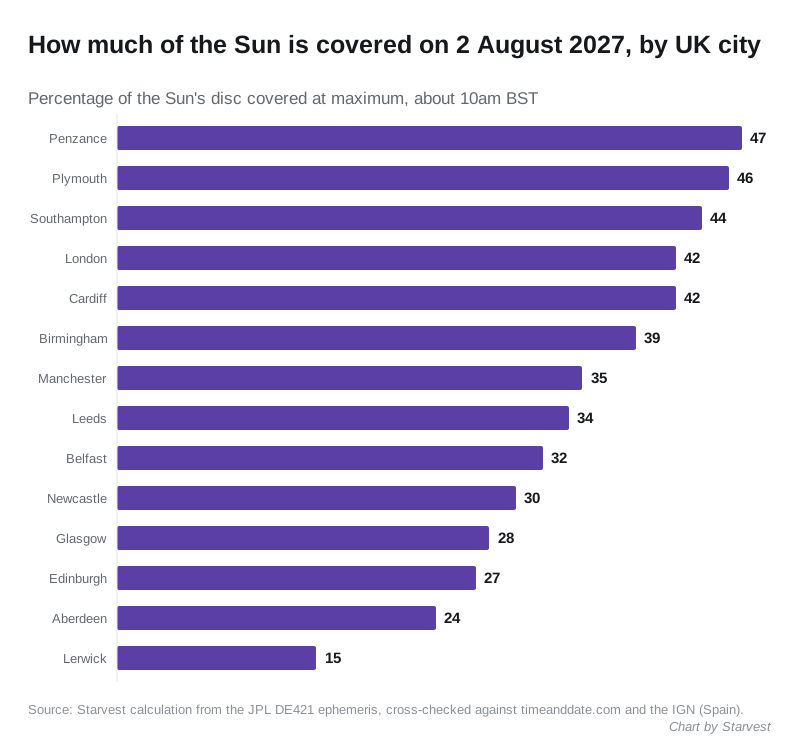
The solar eclipse of 2027 in the UK happens on the morning of Monday 2 August. Across the country the Moon starts to cover the Sun shortly before or after 9am BST, the eclipse peaks at about 10am, and it is over by 11am. From London about 42% of the Sun is hidden at maximum. The further south-west you are, the more you see: 47% from Penzance, 27% from Edinburgh and 15% from Lerwick.
It is a partial eclipse everywhere in Britain and Ireland. The total eclipse, with up to 6 minutes 23 seconds of darkness, is a few hundred miles south, across the Strait of Gibraltar and North Africa. Below are the times for 26 UK places, how to watch safely, and what you need to know if you are thinking of travelling to the path of totality.
Eclipse times by UK city
Times are British Summer Time. “Sun’s height” is how many degrees above the horizon the Sun is at maximum: at around 40 degrees it clears most rooftops and trees, so you do not need a special viewpoint.
| Place | Starts | Maximum | Ends | Sun covered | Sun’s height |
|---|---|---|---|---|---|
| Penzance | 8.57am | 9.54am | 10.54am | 47% | 37° |
| Plymouth | 8.59am | 9.56am | 10.56am | 46% | 38° |
| Southampton | 9.01am | 9.58am | 10.58am | 44% | 40° |
| Brighton | 9.02am | 9.59am | 11.00am | 44% | 40° |
| Canterbury | 9.04am | 10.01am | 11.01am | 43% | 41° |
| Bristol | 9.02am | 9.58am | 10.56am | 42% | 39° |
| Cardiff | 9.01am | 9.57am | 10.56am | 42% | 38° |
| London | 9.03am | 10.00am | 10.59am | 42% | 40° |
| Oxford | 9.03am | 9.59am | 10.58am | 41% | 39° |
| Cambridge | 9.05am | 10.00am | 10.59am | 39% | 40° |
| Birmingham | 9.04am | 9.59am | 10.56am | 39% | 39° |
| Norwich | 9.06am | 10.02am | 10.59am | 38% | 41° |
| Nottingham | 9.05am | 10.00am | 10.56am | 37% | 39° |
| Liverpool | 9.05am | 9.58am | 10.54am | 36% | 38° |
| Sheffield | 9.06am | 10.00am | 10.56am | 36% | 39° |
| Manchester | 9.06am | 9.59am | 10.55am | 35% | 38° |
| Leeds | 9.07am | 10.00am | 10.55am | 34% | 38° |
| York | 9.08am | 10.00am | 10.55am | 34% | 39° |
| Hull | 9.08am | 10.01am | 10.56am | 34% | 39° |
| Belfast | 9.06am | 9.57am | 10.50am | 32% | 35° |
| Newcastle | 9.09am | 10.01am | 10.54am | 30% | 38° |
| Glasgow | 9.10am | 9.59am | 10.50am | 28% | 36° |
| Edinburgh | 9.11am | 10.00am | 10.51am | 27% | 37° |
| Aberdeen | 9.14am | 10.02am | 10.51am | 24% | 37° |
| Inverness | 9.14am | 10.00am | 10.49am | 23% | 36° |
| Lerwick | 9.23am | 10.04am | 10.47am | 15% | 36° |
We worked these out from NASA JPL’s DE421 ephemeris for each city centre and checked them against timeanddate.com, which gives the same London and Glasgow times to the minute. Other calculators may differ by a minute because of rounding and the exact edge of the Moon they use. If you live between two places on the list, your figures will sit between theirs.
The pattern is simple: coverage falls steadily from the south-west to the north-east, while the time of maximum barely changes. Almost everyone in the UK gets their best view between 9.54am and 10.04am.
Where to look, and what you will notice
At maximum the Sun is in the east-south-east, about 40 degrees up from London. That is a little under halfway from the horizon to overhead, so a garden, a park or an office car park works. You do not need a hill.
At 42% the Moon takes a clear bite out of the Sun, but the daylight barely changes. Most people would not notice anything without looking through eclipse glasses. The easiest sign without glasses is under a tree: the gaps between leaves act as pinhole cameras, and the dappled light on the ground turns into hundreds of small crescents.
This is a smaller eclipse than the one on 12 August 2026, which covered about 91% of the Sun from London. But that one came at about 7.15pm with the Sun only 10 degrees up, low enough that a row of houses could hide it. In 2027 the Sun is four times higher, in the middle of the morning, and in the school summer holidays across England, Wales and Northern Ireland. If the weather is kind, far more people will get a clear look.
How to watch it safely
Never look at the Sun directly, even when it is partly covered. At 42% the uncovered part is still bright enough to damage your eyes in seconds, and the damage is painless while it happens. Ordinary sunglasses, however dark, do not protect you. Our full guide to observing the Sun safely covers each method in detail.
- Eclipse glasses are the simplest option. Buy a pair marked as meeting the ISO 12312-2 standard, from an astronomy retailer or a seller that names the standard, well before August. Check them for scratches or holes before use, and supervise children.
- Pinhole projection costs nothing. Make a small hole in a piece of card, stand with your back to the Sun and let the light fall on a second piece of card or a wall. A colander does the same thing many times over.
- Binoculars and telescopes need a proper solar filter fitted securely over the front of the instrument, made for that purpose. Never look through optics without one, and never use the small screw-in filters that fit near the eyepiece.
- Phone photos are fine for a quick picture, but do not look at the Sun while lining up the shot. A sheet of solar filter film over the lens gives a much sharper crescent.
The Royal Observatory Greenwich gives the same advice in its guide to solar eclipses.
Why it is total in Spain and North Africa
A total eclipse happens only along a narrow track where the Moon’s shadow touches the Earth. On 2 August 2027 that track starts in the Atlantic, crosses the Strait of Gibraltar, runs along the North African coast to Egypt, crosses the Red Sea and ends in the Indian Ocean beyond Somalia. Britain sits well north of it, so from here the Moon only ever covers part of the Sun.
The longest totality is in Egypt, near Luxor, at 6 minutes 23 seconds. Spain’s national observatory, the Instituto Geográfico Nacional, puts almost all of the province of Cádiz, much of Málaga province and the southern edge of Granada and Almería inside the path. It gives these durations:
| Place | Totality starts (local time) | Length of totality |
|---|---|---|
| Ceuta | 10.45am | 4 min 48 sec |
| Melilla | 10.48am | 4 min 34 sec |
| Cádiz | 10.45am | 2 min 54 sec |
| Málaga | 10.48am | 1 min 48 sec |
Spanish local time is an hour ahead of the UK, so totality in Cádiz falls at about 9.45am BST. Gibraltar and Tarifa, both close to the centre of the track, get over four minutes by our calculation. Seville is just outside the path and sees a deep partial eclipse only.
Travelling for totality
If you have never seen a total eclipse, this is the most accessible one for UK travellers in decades: southern Spain and Gibraltar are around two and a half hours’ flight away, in August, with a high mid-morning Sun. A few things are worth knowing now:
- Book early. Coastal Andalusia is already busy in early August, and eclipse demand adds to it. Accommodation along the Costa de la Luz and around Gibraltar is likely to be the first to go.
- Position matters more than the town name. Durations fall quickly towards the edges of the track: Málaga gets under two minutes while Ceuta, across the water, gets nearly five. Aim for somewhere near the centre line.
- Have a plan for the morning. Roads to popular viewpoints may be slow, so be in place well before the partial phase begins, roughly an hour before totality.
- The same safety rules apply for the partial phases before and after totality. Glasses come off only during totality itself, and go back on at the first flash of sunlight.
The next total eclipse visible from the UK itself is not until 2090, and Spain’s observatory notes there will not be another total eclipse in Spain until 2053.
Will the weather be clear?
Nobody can tell you that until the week itself, and a single weather front could cover the whole country. The partial phase lasts about two hours, so a gap in the cloud at any point between 9am and 11am gives you a look. Check the forecast a few days ahead and be ready to move to a clearer spot if you can.
For the other eclipses visible from the UK between now and 2030, including the penumbral lunar eclipse on 20 February 2027 and the sunset eclipse of 26 January 2028, see our guide to the next eclipse in the UK. The astronomy calendar for 2027 has every eclipse, meteor shower and planet event of the year.
Frequently asked questions
What time is the solar eclipse on 2 August 2027 in the UK? It starts between about 8.57am and 9.23am BST depending on where you are, peaks between 9.54am and 10.04am, and ends between 10.47am and 11.01am. In London it runs from 9.03am to 10.59am, with maximum at 10am.
Will the 2027 eclipse be total in the UK? No. It is partial everywhere in the UK, from about 47% of the Sun covered in Cornwall to 15% in Shetland. Totality is visible from southern Spain, Gibraltar, North Africa, Egypt, Saudi Arabia and Yemen.
How much of the Sun will be covered in London? About 42% at 10.00am BST, with the Sun around 40 degrees above the east-south-eastern horizon.
Will it get dark during the eclipse in the UK? No. With less than half the Sun covered, the drop in daylight is too small for most people to notice. Shadows look slightly sharper, and light through tree leaves forms crescent shapes on the ground.
Can I look at the eclipse without glasses? No. Use eclipse glasses that meet ISO 12312-2, or project the Sun’s image through a pinhole onto card. Sunglasses do not protect your eyes, and you should never point binoculars or a telescope at the Sun without a proper front-mounted solar filter.
When is the next total solar eclipse visible from the UK? Not until 23 September 2090, when totality crosses southern England and Ireland. Until then, the closest totals for UK travellers are in Spain: 2 August 2027 is the last one there until 2053.
Clear skies forecast? Get a nudge.
Our weekly email flags the next good UK observing window and one easy target to find.
Join the listMore from Starvest
Keep readingBest Telescopes for Beginners in the UK (Tested by Price Bracket)
The best beginner telescopes in the UK by budget, from sub-£150 tabletop scopes to app-guided and smart telescopes, with real 2026 prices.
What Can You See with Binoculars at Night? A Realistic Astronomy List
A realistic list of what you can see with binoculars in astronomy, from the Moon and Jupiter's moons to Andromeda, with tips for spotting each from the UK.
How to Set Up and Use Your First Telescope (Step by Step)
How to use a telescope as a beginner: assemble the mount, align the finder, focus, and find your first targets. A clear step-by-step UK guide.