Venus Morning Star 2027 UK: Up by 4am, Gone by Late March
Venus is the morning star in 2027, and it is at its best for UK observers right now. It reaches its greatest distance from the Sun in the morning sky, about 47 degrees, on 3 January 2027, rising a little after 4am GMT from London, four hours before the Sun. If you are up before work in January and see a dazzling white “star” low in the south-south-east, that is Venus.
There is a twist the headline date hides. From Britain, Venus actually stands highest at dawn in mid December, not on 3 January, and by the end of March it is lost in the morning twilight. The tables below show when it rises and how high it gets, week by week, from London and Edinburgh.
Every time and height on this page was calculated by Starvest for central London (51.5 degrees north) and Edinburgh (56 degrees north) with the PyEphem astronomy library. The elongation date matches published almanacs: EarthSky gives 19:00 UT on 3 January at about 47 degrees. Times are GMT until the clocks go forward on 28 March 2027, then BST.
Venus morning star 2027 at a glance
| Venus before dawn | |
|---|---|
| Greatest western elongation | 3 January 2027, about 47 degrees from the Sun |
| Brightest | Late November 2026, magnitude minus 4.5 |
| Rises (London) | About 3.50am in mid December, 4.06am on 3 January, 4.53am on 31 January |
| Where to look | South-south-east, about 20 degrees up at first light in early January |
| Phase in a telescope | Half lit on 3 January, a crescent before that |
| Visible until | Roughly the end of March 2027 from the UK |
| Constellations | Libra in December and early January, Sagittarius by February |
When Venus rises, week by week
| Date | London rises | London sunrise | Edinburgh rises | Edinburgh sunrise |
|---|---|---|---|---|
| 29 Nov 2026 | 3.54am | 7.40am | 4.14am | 8.15am |
| 13 Dec 2026 | 3.46am | 7.57am | 4.08am | 8.35am |
| 3 Jan 2027 | 4.06am | 8.05am | 4.34am | 8.43am |
| 17 Jan 2027 | 4.30am | 7.57am | 5.01am | 8.31am |
| 31 Jan 2027 | 4.53am | 7.40am | 5.27am | 8.09am |
| 14 Feb 2027 | 5.09am | 7.16am | 5.43am | 7.40am |
| 28 Feb 2027 | 5.14am | 6.48am | 5.46am | 7.07am |
| 14 Mar 2027 | 5.07am | 6.17am | 5.35am | 6.31am |
In practice you will not see Venus the moment it rises. It needs to clear rooftops and trees, so allow an hour after the rise time, and it stays visible well into the brightening sky. On a clear January morning you can still pick it out a few minutes before sunrise if you know exactly where to look, but never sweep binoculars or a telescope near the Sun to find it.
Why it is highest in December, not on 3 January
Greatest elongation is the day Venus sits furthest from the Sun along the sky. How high that puts it above a British horizon depends on the angle the ecliptic (the Sun’s path) makes with the horizon at dawn. In winter mornings that angle is getting shallower from week to week, so Venus slides south and lower even while its distance from the Sun barely changes.
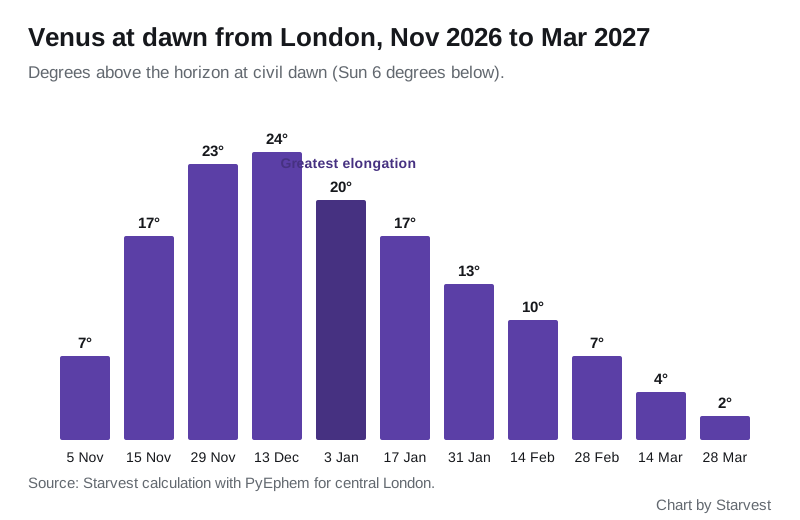
At civil dawn, when the Sun is 6 degrees below the horizon and the sky is starting to brighten, Venus stands:
- 24 degrees up from London on 13 December 2026 (21 degrees from Edinburgh), its best;
- 20 degrees on 3 January (17 degrees from Edinburgh), the elongation date;
- 13 degrees on 31 January (10 from Edinburgh);
- 7 degrees on 28 February (4 from Edinburgh);
- 2 degrees by 28 March, too low to see easily in the twilight.
Observers in Australia get the better deal. From Sydney, Venus is 29 degrees up at civil dawn on 3 January and is still climbing, to 34 degrees by the end of the month, because the morning ecliptic stands steeply there in their summer. That is why many overseas articles call this a superb apparition; from Britain it is a good one that fades quickly after January.
What to see in a small telescope
Venus shows no surface detail, but its phase changes visibly through the winter. In late November it is a fat crescent about 26% lit and large, around 41 arcseconds across. On 3 January it is close to half lit (astronomers call this dichotomy) and about 25 arcseconds across. By the end of January it is a gibbous 63% and noticeably smaller, because it is pulling away from Earth.
Any small telescope at 50 to 100 times shows the phase. The glare is the main problem: Venus is so bright it smears and shows false colour in a cheap refractor. Two tricks help. Observe in twilight rather than full darkness, when the sky behind it is less black, and if you can, look when Venus is at least 15 to 20 degrees up so you are not peering through thick, turbulent air. Our guide to seeing the planets covers magnification, and best telescope for planets covers the kit.
The Moon and Venus this winter
A thin crescent Moon passes Venus twice in the window:
- Saturday 5 December 2026: a 13% crescent about 7 degrees below Venus, in the south-south-east at 7am.
- Sunday 3 January 2027: an 18% crescent about 10 degrees below and to the right of Venus at 7.15am, on the morning of greatest elongation. By 4 January the Moon has slipped lower and further left, under Venus.
Both make a good phone photograph: frame the pair over a skyline, use a tripod or a wall, and tap to focus on the Moon. Our phone Moon photography guide has the camera settings.
Never look for Venus near the Sun
When Venus is low in a bright dawn sky, it is tempting to search for it with binoculars just before sunrise. Do not do this once the Sun is close to rising, and never after sunrise: a stray sweep across the Sun through binoculars or a telescope can blind you instantly. Put your optics away before the Sun is up. The solar observing safety page explains why. For accurate rise times at your own town, the free in-the-sky.org planner gives them for any UK location.
Frequently asked questions
When is Venus the morning star in 2027? From November 2026 to about the end of March 2027 from the UK. It reaches greatest western elongation, 47 degrees from the Sun, on 3 January 2027, and is easy to see before dawn throughout December and January.
What time does Venus rise in January 2027? From London it rises at about 4.06am GMT on 3 January, 4.30am on 17 January and 4.53am on 31 January. Edinburgh is roughly 30 minutes later.
Which direction should I look for Venus? South-south-east, about 20 degrees up at first light in early January. That is two outstretched fists at arm’s length above the horizon. It is the brightest point in the sky apart from the Moon.
When is Venus brightest this winter? In late November 2026, at magnitude minus 4.5. It stays above minus 4.0 through January, so it looks almost as bright at the elongation.
Why does Venus look like a half Moon in a telescope on 3 January? At greatest elongation the Sun lights Venus from the side as seen from Earth, so close to half the disc is lit. Before that it is a crescent; after it, gibbous.
Can you see Venus in daylight? Experienced observers can when they know its exact position, but it is risky near sunrise. Never use binoculars or a telescope to search for it when the Sun is up or about to rise.
Clear skies forecast? Get a nudge.
Our weekly email flags the next good UK observing window and one easy target to find.
Join the listMore from Starvest
Keep reading
Best Telescopes for Beginners in the UK (Tested by Price Bracket)
The best beginner telescopes in the UK by budget, from sub-£150 tabletop scopes to app-guided and smart telescopes, with real 2026 prices.
What Can You See with Binoculars at Night? A Realistic Astronomy List
A realistic list of what you can see with binoculars in astronomy, from the Moon and Jupiter's moons to Andromeda, with tips for spotting each from the UK.
How to Set Up and Use Your First Telescope (Step by Step)
How to use a telescope as a beginner: assemble the mount, align the finder, focus, and find your first targets. A clear step-by-step UK guide.