Are GoTo Telescopes Worth It? Why Tracking Is the Real Win
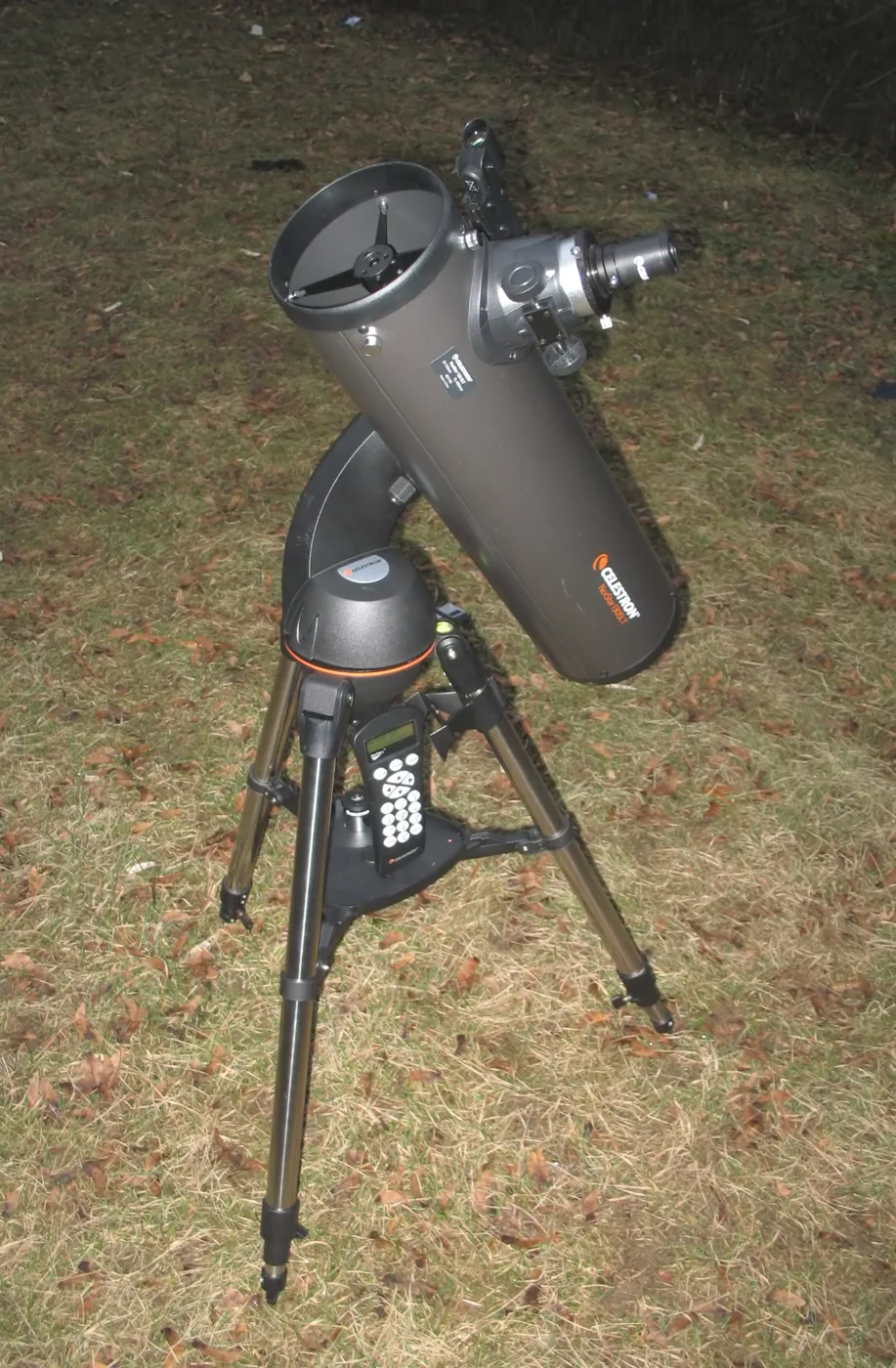
Are GoTo telescopes worth it? For some UK observers, clearly yes. For others they are the wrong place to spend the money. A GoTo telescope has motors on both axes and a small computer that knows where thousands of objects are. Once aligned, it slews to whatever you pick and then keeps tracking it as the sky turns. Both are useful, but most buyers think the “finding” part is the main benefit, when for many people the tracking is what makes the biggest difference.
This page sets out what the motor actually buys you, what it costs you in aperture, power and setup time, and who should buy a manual telescope instead. If you are still at the stage of choosing a first scope, read how to buy a telescope in the UK alongside it.
What GoTo does, and what it does not
A GoTo mount does three jobs:
- Alignment. You tell it the date, time and your location (or a phone app does it for you), then centre one, two or three bright stars. From those it builds a model of the sky.
- Slewing. Pick an object from the handset or app and the mount drives the telescope to it.
- Tracking. The motors keep turning slowly to hold the object in view as the Earth rotates.
What it does not do is make faint things bright. A 130mm GoTo telescope shows exactly what a 130mm manual telescope shows. If a galaxy is too faint to see in your sky with that mirror, GoTo will point you at the right patch of blank-looking sky. For beginners in light-polluted towns, that is a real source of disappointment, and it is worth knowing before you buy. Our light pollution map guide shows how to check your own sky.
Real UK GoTo telescopes, and how they work
These are established models from the two brands most UK astronomy shops stock. We checked the specifications against the manufacturer or a UK retailer.
Celestron NexStar 130SLT. A 130mm f/5 Newtonian reflector (650mm focal length) on a single-arm computerised mount with a handset. Celestron lists a database of over 40,000 objects and its SkyAlign method, where you centre any three bright objects without needing to know their names. It runs on 12 volts from 8 AA batteries, which are not included, or from a separately sold power tank or mains adapter.
Sky-Watcher Explorer-130P AZ-GO2. The same 130mm f/5 optical size on a Wi-Fi GoTo mount. There is no handset in the box: the mount creates its own Wi-Fi network and you control it from the free SynScan app on a phone or tablet, with a SynScan handset available separately. Power is 8 AA batteries or a 12V 1A supply. Alignment options include Brightest Star Alignment and North-Level Alignment.
Sky-Watcher AZ-GTi. A compact Wi-Fi GoTo mount sold on its own or with small telescopes such as the Skymax 102 and 127 Maksutovs and the Explorer-130PS. Its useful extra is FreedomFind: encoders on both axes let you push the telescope by hand without the mount losing track of where it is pointing. It also runs on 8 AA batteries or 12V.
Compare these with the Celestron StarSense Explorer range, which is “push-to”, not GoTo. The app shows you where to move the telescope, but there are no motors, so it neither slews nor tracks. Our StarSense Explorer DX 130AZ review covers how well that works in practice.
The case for GoTo
Tracking at high magnification. This is the strongest argument, and it is often overlooked. At 150x or more, Jupiter or Saturn drifts across the eyepiece in well under a minute on a manual alt-azimuth mount, so you spend the session nudging rather than looking. A tracking mount holds the planet steady while you wait for moments of good seeing, which is when fine detail appears. It also makes it easier to show the view to a child or friend, because the object is still there when they take their turn.
Light-polluted skies. From a town garden you may only see a dozen stars to hop between, which makes star hopping hard. GoTo needs just two or three bright stars to align, then it can find the brighter clusters, double stars and planetary nebulae that are still visible from town.
Limited time. On a weeknight with an hour of clear sky, a GoTo can work through a list of a dozen targets. Hunting manually, a beginner might find three.
Daytime and twilight objects. Once aligned, a GoTo can find Venus or Jupiter in a bright twilight sky, where finding them by eye through the finder is hard. Never point any telescope near the Sun; see our solar observing safety guide.
The case against
You pay for motors instead of aperture. For the money a GoTo 130mm costs, you can usually buy a larger manual telescope, such as a 150mm or 200mm Dobsonian. Aperture decides how much light you collect and how much fine detail you can resolve, and it does not go out of date. Our Skyliner 200P review shows what that extra mirror does, and telescope aperture explained has the theory.
Power. Eight AA batteries do not last long when the motors are slewing. They also lose capacity in the cold, which matters on a frosty UK winter night, when the sky is often at its best. Most owners end up buying a 12V power tank or a mains supply. A weak supply is also a common cause of a GoTo mount slewing to the wrong place, so put fresh batteries or a charged pack in before blaming your alignment.
Setup time and fiddliness. The mount needs to be level, the date, time and location need to be right, and the alignment stars need to be centred carefully. A sloppy alignment gives sloppy pointing. For a quick ten-minute look at the Moon, a manual scope is often faster from back door to eyepiece.
You learn the sky more slowly. Some observers find that GoTo means they never learn where anything is. Others find the reverse: seeing an object once makes it easier to find again without help. It depends on you, but if learning the constellations is part of why you want a telescope, a manual scope teaches you faster.
More to go wrong. Cables, handsets, Wi-Fi connections and phone app updates are all possible points of failure that a Dobsonian simply does not have.
Who should buy a GoTo, and who should not
| Your situation | Our suggestion |
|---|---|
| Town garden, mainly planets, Moon and bright clusters | GoTo is worth it, chiefly for tracking |
| Short sessions on weeknights | GoTo is worth it |
| You want the most detail on faint galaxies and nebulae | Buy a bigger manual Dobsonian |
| You want to learn the sky by star hopping | Manual scope, or push-to such as StarSense |
| You want to try deep-sky astrophotography | A smart telescope or an equatorial mount, not a basic alt-az GoTo; see below |
| Child’s first telescope | Keep it simple; see best telescope for kids |
GoTo and astrophotography
A basic alt-azimuth GoTo tracks well enough for phone shots and short video of the Moon and planets. It is not a good platform for long exposures of galaxies and nebulae, because an alt-azimuth mount rotates the field of view over time. For deep-sky photography, an equatorial mount that you polar align is the traditional route, while a smart telescope handles the whole process automatically. Our best telescope for astrophotography beginners compares the options.
Our verdict
A GoTo telescope is worth it if you observe from a bright sky, have limited time, or want to look at planets at high power without nudging the tube every few seconds. It is not worth it if your money would otherwise buy a substantially bigger mirror, or if you enjoy finding things yourself. A good middle ground is a mount like the AZ-GTi with FreedomFind, which lets you push the scope by hand when you want to and still tracks when you need it to.
Frequently asked questions
Are GoTo telescopes worth it for beginners? They are worth it for beginners in light-polluted areas or with little time, mainly because the mount tracks objects at high magnification. If you can observe from a dark sky and want to learn the constellations, a manual Dobsonian gives you more aperture for the money.
Do GoTo telescopes show more than manual ones? No. The optics decide what you can see. A 130mm GoTo telescope shows the same as a 130mm manual telescope; it just finds objects for you and keeps them in view.
How long do batteries last in a GoTo telescope? Not long. Models like the NexStar 130SLT and Sky-Watcher AZ-GO2 run on 8 AA batteries, and slewing drains them quickly, especially on cold nights. Most owners switch to a rechargeable 12V power tank or a mains adapter.
What is the difference between GoTo and push-to? A GoTo mount has motors that move the telescope to an object and track it. A push-to system, such as Celestron StarSense Explorer, tells you which way to move the telescope by hand and has no motors, so it does not track.
Why does my GoTo telescope point to the wrong place? The usual causes are a wrong date, time or location, a mount that is not level, alignment stars that were not centred carefully, or a weak power supply. Check the power first, then redo the alignment with a high-power eyepiece to centre the stars accurately.
Can I use a GoTo telescope for astrophotography? For the Moon and planets, yes. For long exposures of deep-sky objects, an alt-azimuth GoTo rotates the field, so an equatorial mount or a smart telescope is the better choice.
Sources
- Celestron, NexStar 130SLT product page: aperture, database size, SkyAlign, power.
- Sky-Watcher Explorer-130P AZ-GO2 and AZ-GTi specifications from UK retailer listings: SynScan app control, Wi-Fi, power, FreedomFind encoders.
Clear skies forecast? Get a nudge.
Our weekly email flags the next good UK observing window and one easy target to find.
Join the listMore from Starvest
Keep reading
Best Telescopes for Beginners in the UK (Tested by Price Bracket)
The best beginner telescopes in the UK by budget, from sub-£150 tabletop scopes to app-guided and smart telescopes, with real 2026 prices.

What Can You See with Binoculars at Night? A Realistic Astronomy List
A realistic list of what you can see with binoculars in astronomy, from the Moon and Jupiter's moons to Andromeda, with tips for spotting each from the UK.

How to Set Up and Use Your First Telescope (Step by Step)
How to use a telescope as a beginner: assemble the mount, align the finder, focus, and find your first targets. A clear step-by-step UK guide.