Astronomical Darkness UK Summer 2027: Lost Nights by City
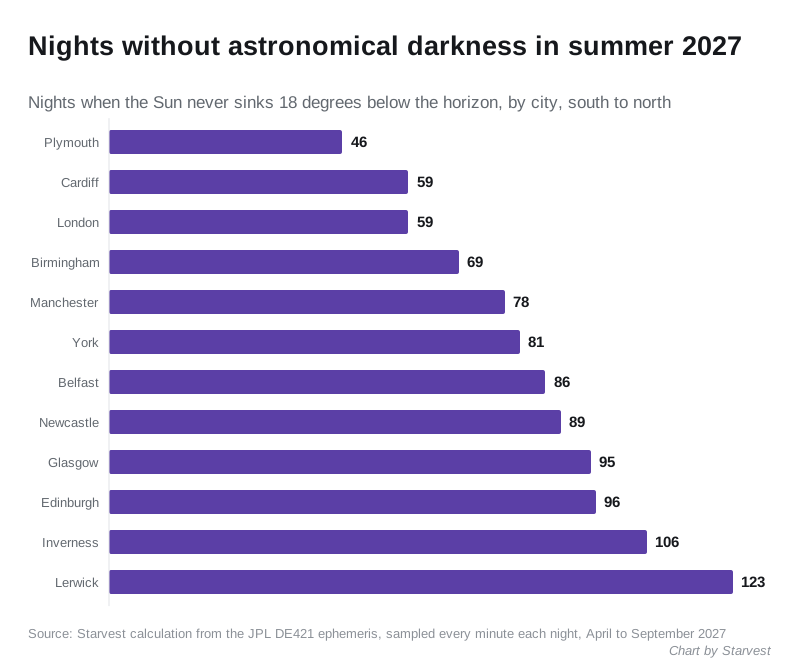
Astronomical darkness disappears from the UK in summer. In London, the Sun will not sink 18 degrees below the horizon on any night from 23 May to 20 July 2027, so for 59 nights the sky never gets fully dark. In Edinburgh the gap is 96 nights, and in Lerwick, Shetland, 123, from late April to late August.
Published figures for this disagree, often because they mix up the different kinds of twilight or round to “mid-May to early August” for the whole country. We worked out every night of summer 2027 for 12 places using NASA’s JPL DE421 ephemeris, checking the Sun’s position every minute through each night. The table below is the result.
When true darkness ends and returns in 2027
“Night of 23 May” means the night that starts on the evening of 23 May and runs into the morning of 24 May.
| Place | Latitude | First night without darkness | Last night without darkness | Nights lost |
|---|---|---|---|---|
| Plymouth | 50.4°N | 29 May | 13 July | 46 |
| Cardiff | 51.5°N | 23 May | 20 July | 59 |
| London | 51.5°N | 23 May | 20 July | 59 |
| Birmingham | 52.5°N | 18 May | 25 July | 69 |
| Manchester | 53.5°N | 13 May | 29 July | 78 |
| York | 54.0°N | 12 May | 31 July | 81 |
| Belfast | 54.6°N | 9 May | 2 August | 86 |
| Newcastle | 55.0°N | 8 May | 4 August | 89 |
| Glasgow | 55.9°N | 5 May | 7 August | 95 |
| Edinburgh | 56.0°N | 4 May | 7 August | 96 |
| Inverness | 57.5°N | 29 April | 12 August | 106 |
| Lerwick | 60.2°N | 21 April | 21 August | 123 |
The pattern is almost entirely about latitude. Cardiff and London sit on nearly the same line of latitude and get the same dates, even though they are 210 kilometres apart east to west. Every degree further north adds roughly ten nights to the gap.
The dates move by a day at most from year to year, so the table works as a planning guide for any summer. For a single place not listed, or any other night of the year, use our astronomical darkness calculator.
What astronomical darkness means
Twilight is measured by how far the Sun is below the horizon, not by the clock:
| Sun below horizon | Stage | What it looks like |
|---|---|---|
| 0 to 6 degrees | Civil twilight | Bright enough to read outdoors; only the brightest planets and stars show |
| 6 to 12 degrees | Nautical twilight | The horizon fades; most naked-eye stars are out |
| 12 to 18 degrees | Astronomical twilight | Looks dark to most people, but a faint glow remains low in the north |
| More than 18 degrees | Astronomical darkness | The Sun adds no light at all to the sky |
So a night “without astronomical darkness” is not a light night in London. On the darkest point of the shortest night, 21 to 22 June 2027, the Sun still gets 15 degrees below London’s horizon. What you lose is the last bit of sky darkness that faint galaxies, nebulae and the dimmer Milky Way need. Light pollution in a city does far more damage than that twilight glow, which is why a dark sky site still beats a back garden in June.
Further north it is a different story. In Belfast and Newcastle the Sun does not even reach 12 degrees below the horizon for part of June, so nautical twilight runs all night:
| Place | Nights with no nautical darkness either (2027) | Lowest the Sun gets on 21 to 22 June |
|---|---|---|
| London | None | 15.1 degrees below |
| Manchester | None | 13.1 degrees below |
| York | None | 12.6 degrees below |
| Belfast | 18 to 23 June (6 nights) | 12.0 degrees below |
| Newcastle | 10 June to 1 July (22 nights) | 11.6 degrees below |
| Edinburgh | 1 June to 10 July (40 nights) | 10.6 degrees below |
| Inverness | 23 May to 20 July (59 nights) | 9.1 degrees below |
| Lerwick | 11 May to 1 August (83 nights) | 6.4 degrees below |
In Lerwick the midsummer sky never gets much darker than the end of civil twilight. Shetlanders call it the simmer dim.
The darkest moment of a summer night
On these nights the sky is darkest at local solar midnight, not at midnight on the clock. With British Summer Time and the UK sitting west of Greenwich, that falls at about 1am BST in London and nearer 1.15am in Plymouth and Glasgow. If you want the best of a June sky, plan around the hour either side of that time.
What you can still observe in the light weeks
The summer gap is a poor time for faint galaxies and the dimmest Milky Way, but plenty still works:
- The Moon. It needs no darkness at all. In 2027 the Moon is full on 19 June and 18 July, and new on 4 June and 4 July. Summer full moons ride low in the south from the UK, which suits shooting them over a landscape. Our guide to observing the Moon has the features to look for at each phase.
- Bright double stars. Albireo in Cygnus, Mizar and Alcor in the Plough, and Epsilon Lyrae (the Double Double) near Vega are all high on summer nights and cut through twilight easily. See our list of double stars for small telescopes.
- Bright star clusters. The Hercules globular cluster, M13, is high overhead in June and July and shows well in a small telescope even in twilight.
- Planets in 2027. From London, Mars and Jupiter sit in the west after sunset in early June, but both sink lower through the month: by 21 June Jupiter is only about 9 degrees up at 11pm BST. Saturn takes over in the mornings, rising in the east and standing about 20 degrees up by 3am BST in mid-July ahead of its autumn opposition. Venus is too close to the Sun to see in midsummer 2027. Our planet viewing guide explains what each shows.
- Noctilucent clouds. The brightest “night-shining” clouds appear low in the northern sky one to two hours after sunset or before dawn, mostly from late May to early August, exactly the weeks when the sky never fully darkens. The twilight is what lights them.
- The International Space Station. Summer brings runs of visible passes through the night because the station stays sunlit. Our ISS guide explains how to find them.
When the dark nights come back
Astronomical darkness returns slowly. The first nights back give only a few minutes of it around solar midnight, and it takes a couple of weeks before there is a worthwhile dark window. In London, darkness returns on the night of 21 to 22 July 2027, three weeks before the Perseids peak on 12 to 13 August. In Edinburgh it comes back on 8 to 9 August, only just in time. The full list of 2027 showers is in our meteor showers guide, and the astronomy calendar for 2027 has the year’s other key dates.
The twilight stages used here are the standard definitions set out by the US Naval Observatory’s Astronomical Applications Department, which publishes the almanac data behind most sunrise and twilight tables.
Frequently asked questions
When is there no astronomical darkness in the UK? It depends on where you are. In 2027 London has none from the night of 23 May to the night of 20 July, Manchester from 13 May to 29 July, Edinburgh from 4 May to 7 August, and Lerwick from 21 April to 21 August. Plymouth has the shortest gap of any place we checked, from 29 May to 13 July.
Does anywhere in the UK keep astronomical darkness all summer? No. Even the far south of Cornwall and the Channel coast lose it for several weeks around midsummer. You need to be south of about 48.5 degrees north, roughly the latitude of Brittany, for the Sun to reach 18 degrees below the horizon every night of the year.
Can I still see the Milky Way in June? From a dark site in southern England, yes, faintly, around solar midnight, which is about 1am BST. The brightest parts low in the south hold up better than the faint outer regions. In Scotland the twilight is too strong in June to see much of it.
What time is darkest on a summer night in the UK? Local solar midnight, which falls at about 1am BST in London and a little later further west: roughly 1.15am in Plymouth and Glasgow.
Do the dates change every year? Only slightly. They shift by about a day from year to year because of the leap year cycle, so this table is a reliable guide for any summer.
What is the difference between nautical and astronomical twilight? Nautical twilight ends when the Sun is 12 degrees below the horizon, when the horizon line fades from view. Astronomical twilight ends at 18 degrees, when the Sun stops adding any light to the sky at all.
Clear skies forecast? Get a nudge.
Our weekly email flags the next good UK observing window and one easy target to find.
Join the listMore from Starvest
Keep readingBest Telescopes for Beginners in the UK (Tested by Price Bracket)
The best beginner telescopes in the UK by budget, from sub-£150 tabletop scopes to app-guided and smart telescopes, with real 2026 prices.
What Can You See with Binoculars at Night? A Realistic Astronomy List
A realistic list of what you can see with binoculars in astronomy, from the Moon and Jupiter's moons to Andromeda, with tips for spotting each from the UK.
How to Set Up and Use Your First Telescope (Step by Step)
How to use a telescope as a beginner: assemble the mount, align the finder, focus, and find your first targets. A clear step-by-step UK guide.