Lyrids 2027 UK: Peak 2.40am BST Fri 23 April, 95% Moon
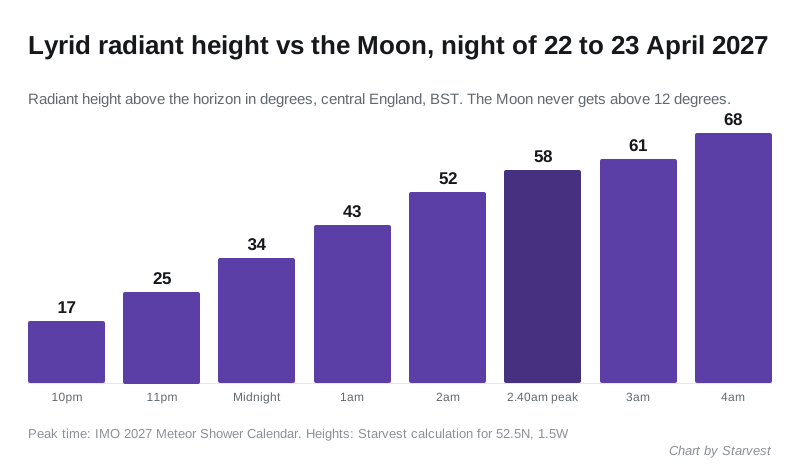
The Lyrids 2027 peak at 2.40am BST on Friday 23 April, according to the International Meteor Organization’s 2027 calendar. The night to go out is Thursday 22 into Friday 23 April. The bad news is the Moon: it was full on 20 April and is still 95% lit on peak night, and the IMO calls the Lyrids the worst-placed major shower of the year.
The good news, which most previews miss, is where that Moon sits. From Britain it stays very low in the south all night, never more than about 12 degrees up from central England, while the Lyrid radiant climbs high in the east. Put a house, a hedge or a hill between you and the Moon and you can still catch the brighter Lyrids. Here is how to do it, and what you will honestly see.
Lyrids 2027 at a glance
| Thursday 22 to Friday 23 April 2027 | |
|---|---|
| Peak | 2.40am BST Friday (01.40 UT) |
| Quoted ZHR | 18 |
| Moon | 95% lit, waning, rises about 11pm, sets about 6.15am, never above 12 degrees |
| Fully dark | about 10.40pm to 3.30am (central England) |
| Radiant at the peak | 58 degrees up, in the east |
| Speed | 49 km per second, medium fast |
| Active period | 14 to 30 April |
Peak time, ZHR, speed and active period come from the IMO 2027 Meteor Shower Calendar. The Moon, darkness and radiant heights are our own calculation for central England (52.5 degrees north). From London the Moon rises about 10.50pm; from Edinburgh about 11.35pm, and it peaks lower there, at under 9 degrees. Edinburgh also gets only about 3.5 hours of full darkness at this time of year, from about 11.20pm to 3am.
Why you may see 2am, or the wrong day, elsewhere
Some 2027 previews give 01.11 UT or 01.40 UT and forget that British Summer Time has started, so they read as 1am or 2am. The IMO time of 01.40 UT is 2.40am BST. Others recycle the 2026 article, which had the peak on a Wednesday. In 2027 it is Thursday night into Friday morning.
Either way, the exact minute matters less than with the Quadrantids. The Lyrid peak is fairly short but the shower produces some meteors from about 14 April to 30 April, and the nights of 21 to 22 and 23 to 24 April are worth a look if Thursday is cloudy.
How to hide the Moon
This is the whole game in 2027. The Moon rises in the south east around 11pm, crosses due south at about 3am and sets in the south west soon after 6am. At its highest it is only 12 degrees up from the Midlands, 13 degrees from London, 14 degrees from Plymouth and under 9 degrees from Edinburgh. That is about the height of a two-storey house seen from across a street.
- Face north east, east or overhead. The radiant is in the east, the Moon is in the south. Turn your back to the Moon and you lose very little.
- Use a building as a Moon shade. Stand or lie on the north side of a house, barn or wall so the Moon is hidden behind it. Its light still brightens the whole sky, but keeping the disc itself out of your eyes lets them adapt properly.
- Go somewhere dark anyway. A bright Moon lifts the sky glow most where there is already light pollution. A dark rural site still gives you a usable sky; a town gives you almost nothing. Our dark sky sites list helps you choose.
Where to look
The Lyrid radiant sits near the border of Lyra and Hercules, a short distance from Vega, the brilliant blue-white star that rises in the north east on spring evenings. Find Vega and you have found the right part of the sky. You do not need to stare at it: Lyrids can appear anywhere, and their trails point back towards Vega’s corner of the sky.
The radiant is only 4 degrees up at 8pm, so evening watches are nearly worthless. It reaches 25 degrees at 11pm, 43 degrees at 1am, 58 degrees at the 2.40am peak and 68 degrees at 4am.
Hour by hour
| Time (BST) | Radiant height | Moon | What to expect |
|---|---|---|---|
| 10pm | 17 degrees | Not risen | Dark sky but a low radiant; a few long, slow-looking Lyrids skimming low |
| 11pm | 25 degrees | Rising in the south east | Best moonless window, short |
| Midnight | 34 degrees | 5 degrees, south east | Rates building |
| 1am | 43 degrees | 9 degrees | Settle in, Moon behind you |
| 2am to 3am | 52 to 61 degrees | 12 degrees, due south | The predicted peak at 2.40am |
| 3.30am | 64 degrees | 11 degrees | Astronomical twilight begins |
| 4am | 68 degrees | 10 degrees | Sky brightening; only bright meteors now |
If you can only manage one block, make it 1.30am to 3.30am. If you would rather go out early, 11pm to midnight gives you a sky with no Moon at all, at the cost of a lower radiant.
What you will really count
A ZHR of 18 is what one observer would see under a perfect black sky with the radiant overhead. In 2027 the Moon takes the sky well away from perfect. These are rough hourly counts at 2.40am, with the radiant 58 degrees up, worked from the IMO’s population index of 2.1:
| Your sky on the night | Faintest stars you can see | Lyrids an hour |
|---|---|---|
| Perfect, moonless (not possible this year) | magnitude 6.5 | about 15 |
| Dark rural site, Moon hidden | magnitude 6.0 | about 10 |
| Dark rural site, Moon in view | magnitude 5.5 | about 7 |
| Village or suburb | magnitude 5.0 | about 5 |
| Town edge | magnitude 4.5 | about 3 to 4 |
Most readers will land between 5 and 10 an hour. That is the honest number. Our meteor shower rate calculator runs the sum for your own sky; the Bortle scale calculator helps you estimate how dark it is.
Could there be a surprise?
The Lyrids have a history of occasional bursts. Observers in the United States counted rates near 90 an hour in 1982, and older accounts describe much bigger displays. Nobody has predicted one for 2027, and the IMO notes nothing unusual for this return. Lyrids also produce a fair share of bright meteors and fireballs, which cut through moonlight far better than faint ones. That is the real reason to go out.
How to give yourself the best chance
- Check the forecast on Thursday afternoon. Late April cloud often clears overnight behind a front. A drive of 30 to 60 miles to a clear patch can make the night.
- Dress for a cold night. Clear April nights still drop close to freezing in rural Britain. Lie on a reclining chair or mat with a sleeping bag.
- Give your eyes 20 minutes. Keep your phone away and use a red torch.
- No telescope or binoculars. Meteors cross the whole sky in a second; your eyes are the right tool. If you want something to look at between meteors, the Moon itself rewards a small telescope before you turn your back on it.
If Thursday is cloudy
Try Wednesday 21 to Thursday 22 April or Friday 23 to Saturday 24 April. Rates will be noticeably lower, because the Lyrid peak is short, and on the 21st the Moon is fuller and up longer. A fortnight later the Eta Aquariids peak on 6 May with far better moonlight, though from Britain their radiant only clears the horizon shortly before dawn. Our meteor showers in the UK hub and astronomy calendar 2027 list every shower and Moon phase for the year.
Frequently asked questions
When do the Lyrids peak in 2027? The IMO predicts the peak at 01.40 UT on Friday 23 April 2027, which is 2.40am BST. Go out on the night of Thursday 22 April.
Will the Moon ruin the Lyrids in 2027? It will cut the numbers, because it is 95% lit. From Britain it stays below about 12 degrees in the south, though, so if you face east and keep it behind a building you can still see the brighter meteors.
How many Lyrids will I see an hour? From a dark rural site with the Moon hidden, about 10 at the peak. From a village or suburb, about 5. The quoted ZHR of 18 assumes a perfect moonless sky.
Which direction should I look for the Lyrids? North east, east or high overhead, near the bright star Vega. That keeps the low Moon in the south behind you.
What time is best to watch the Lyrids in the UK? 1.30am to 3.30am BST on Friday 23 April. Before 11pm the radiant is too low, and after about 3.30am the sky starts to brighten.
What causes the Lyrids? Dust from Comet Thatcher (C/1861 G1), which takes about 415 years to orbit the Sun. Earth passes through its debris every April.
Clear skies forecast? Get a nudge.
Our weekly email flags the next good UK observing window and one easy target to find.
Join the listMore from Starvest
Keep readingBest Telescopes for Beginners in the UK (Tested by Price Bracket)
The best beginner telescopes in the UK by budget, from sub-£150 tabletop scopes to app-guided and smart telescopes, with real 2026 prices.
What Can You See with Binoculars at Night? A Realistic Astronomy List
A realistic list of what you can see with binoculars in astronomy, from the Moon and Jupiter's moons to Andromeda, with tips for spotting each from the UK.
How to Set Up and Use Your First Telescope (Step by Step)
How to use a telescope as a beginner: assemble the mount, align the finder, focus, and find your first targets. A clear step-by-step UK guide.