New Moon Dates 2027 UK: All 13, and the Darkest Weekends
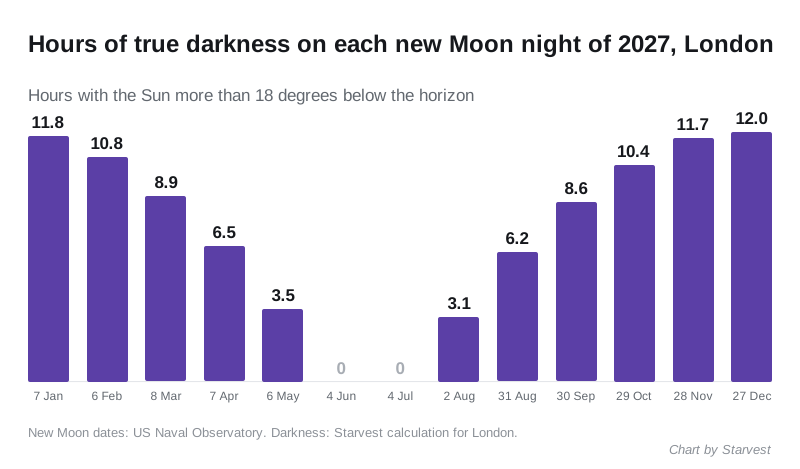
These are the new moon dates for 2027 in UK clock time: thirteen new Moons, starting at 8.24pm on Thursday 7 January and ending at 8.12pm on Monday 27 December. August has two, on the 2nd and the 31st, which is why 2027 has thirteen rather than the usual twelve. Two of them, in June and July, are almost useless for deep-sky observing, because the Sun never gets far enough below the horizon anywhere in the UK for the sky to go fully dark.
A new Moon is the darkest point of the lunar month: the Moon sits between the Earth and the Sun, its lit side faces away from us, and it is up during the day, not at night. For faint targets such as the Milky Way, galaxies and nebulae, the few nights either side of each date are the ones to plan around.
Every time below comes from the US Naval Observatory’s Moon phases data, which is published in Universal Time. We have converted each one to UK clock time: GMT until 28 March 2027, BST (one hour ahead) from 28 March to 31 October, then GMT again. That moves the April new Moon from 6 April in UTC to the early hours of 7 April on a British clock.
New moon dates 2027 at a glance
| New Moon | UK time | Best weekend nights | Astronomical darkness, London |
|---|---|---|---|
| Thu 7 January | 8.24pm GMT | Fri 8 and Sat 9 Jan | about 12 hours |
| Sat 6 February | 3.56pm GMT | Fri 5 and Sat 6 Feb | about 11 hours |
| Mon 8 March | 9.29am GMT | Fri 5 and Sat 6 Mar | about 9 hours |
| Wed 7 April | 12.51am BST | Fri 9 and Sat 10 Apr | about 6.5 hours |
| Thu 6 May | 11.58am BST | Fri 7 and Sat 8 May | about 3.5 hours |
| Fri 4 June | 8.40pm BST | Fri 4 and Sat 5 Jun | none |
| Sun 4 July | 4.02am BST | Fri 2 and Sat 3 Jul | none |
| Mon 2 August | 11.05am BST | Fri 30 and Sat 31 Jul | about 3 hours |
| Tue 31 August | 6.41pm BST | Sat 28 Aug or Fri 3 Sep | about 6 hours |
| Thu 30 September | 3.36am BST | Fri 1 and Sat 2 Oct | about 8.5 hours |
| Fri 29 October | 2.36pm BST | Fri 29 and Sat 30 Oct | about 10.5 hours |
| Sun 28 November | 3.24am GMT | Fri 26 and Sat 27 Nov | about 11.5 hours |
| Mon 27 December | 8.12pm GMT | Fri 24 and Sat 25 Dec | about 12 hours |
“Best weekend nights” means the Friday and Saturday nights closest to the new Moon, within four days either side. The darkness column is our own calculation of how long the Sun stays more than 18 degrees below the horizon in London on the night of the new Moon. Our astronomical darkness calculator gives the exact start and end times for your own town on any date.
How many nights either side of a new Moon are dark enough?
You do not need the exact night. A thin crescent a few days before new Moon only rises in the hour or two before dawn, and a thin crescent a few days after sets in the west not long after the Sun. So from about three days before a new Moon to about four days after, you get most or all of the night free of moonlight.
That is why a midweek new Moon is not a lost cause. In March, for example, the new Moon is on Monday morning, but the Friday and Saturday before it are only two and three days earlier, and the crescent then rises at around dawn. In April the new Moon falls in the early hours of Wednesday, so the following weekend, two and three days later, is the better choice: the crescent sets in the evening twilight and leaves the rest of the night dark.
Beyond about five days after new Moon, the crescent grows towards first quarter and stays up until around midnight, which is fine for planets and the Moon itself but washes out faint galaxies. Our moon phase calculator shows the phase and illumination for any night you are considering.
The summer gap: June and July new Moons
Astronomical darkness means the Sun is more than 18 degrees below the horizon. Until it gets that low, a faint glow of twilight stays in the northern sky, and it is enough to hide the faintest objects even with no Moon at all.
In 2027, by our calculation, true darkness disappears for roughly these periods, give or take a day:
| Place | No astronomical darkness |
|---|---|
| London | about 23 May to 20 July |
| Manchester | about 13 May to 29 July |
| Edinburgh | about 4 May to 7 August |
| Lerwick, Shetland | about 21 April to 21 August |
So the new Moons of 4 June and 4 July give no true darkness anywhere in Britain. The 6 May new Moon gives London about three and a half hours, but Edinburgh has already lost its astronomical darkness by then. The 2 August new Moon brings it back for the south of England, with about three hours in London, while Scotland waits another week or more.
Summer nights are still worth going out on. Planets, double stars, bright star clusters and the Moon are unaffected, and the northern twilight is when noctilucent clouds appear. But if you are travelling to a dark site for the Milky Way or galaxies, plan around the new Moons from August to April.
Five new Moon weekends worth planning a trip around
Fri 8 and Sat 9 January. About 12 hours of darkness and a crescent just one or two days old that sets in the early evening. Cold, but the winter sky around Orion is at its best. Earlier in the week, the Quadrantid meteor shower peaks on the night of 3 to 4 January with almost no moonlight; see our Quadrantids 2027 page.
Fri 5 and Sat 6 February. The new Moon falls at 3.56pm on the Saturday, so both nights are as dark as the month gets. Orion and the winter Milky Way are high in the south in the evening.
Sat 28 August or Fri 3 September. The second new Moon of August, on the 31st, comes as true darkness returns across the whole UK. The summer Milky Way through Cygnus is high in the evening and the band runs down into Sagittarius low in the south. This is the best Milky Way new Moon of the year for most of Britain. Our Milky Way guide covers where to look and how to photograph it.
Fri 1 and Sat 2 October. The new Moon is in the early hours of Thursday 30 September, so the weekend after is only one and two days later. Nights are long again, the Andromeda Galaxy is well up in the east by mid evening, and BST still gives you a later start to the darkness.
Fri 29 and Sat 30 October. The new Moon falls on the Friday afternoon, and the clocks go back in the early hours of Sunday 31 October, so on the Sunday evening darkness arrives an hour earlier by the clock. If you have only one autumn weekend free, this is it.
The two August new Moons
When a calendar month has two new Moons, the second is sometimes called a black Moon. It is a naming quirk, not an astronomical event: the Moon looks the same as at any new Moon, which is to say you cannot see it.
The first August new Moon, on 2 August, does produce something you can see. It lines up with the Sun closely enough to cause a solar eclipse, total along a track across southern Spain and North Africa, with a partial phase visible from the UK. Never look at the Sun without proper solar filters; our solar observing safety page explains what is safe.
Where to go on a new Moon night
A new Moon only helps if your sky is dark in the first place. From a town centre, the glow of streetlights does more harm than any Moon. Our list of dark sky sites in the UK covers the International Dark Sky Places and other easy spots, and what to see in the night sky has the month’s targets. If you want the full Moon dates too, for planning the opposite way, they are on our full moon dates 2027 page.
For a second source on any date, HM Nautical Almanac Office, the UK’s official almanac publisher, issues the same lunar phases.
Frequently asked questions
How many new Moons are there in 2027? Thirteen. The lunar cycle is about 29.5 days, so a calendar year usually holds twelve new Moons with about eleven days left over, and every two or three years a thirteenth fits in. In 2027 the extra one falls on 31 August, the second new Moon of that month.
When is the first new Moon of 2027 in the UK? At 8.24pm GMT on Thursday 7 January 2027. The following Friday and Saturday nights, 8 and 9 January, have about 12 hours of astronomical darkness in London and only a thin evening crescent.
Is the night of a new Moon the darkest night of the month? It is the darkest for moonlight, but the nights two or three days either side are almost as good, because a thin crescent is only up near sunrise or sunset. Your local light pollution and the time of year matter more than the exact night.
Why are June and July new Moons bad for stargazing in the UK? Because the Sun never gets 18 degrees below the horizon in midsummer at British latitudes, so a faint twilight glow lasts all night. In 2027 London has no astronomical darkness from about 23 May to 20 July, and Edinburgh from about 4 May to 7 August.
Are new Moon times the same everywhere in the UK? Yes. A new Moon is a single moment for the whole Earth, so the time is identical in Cornwall and Shetland. Only the clock conversion changes: UK times are one hour ahead of UTC while BST is in force, from 28 March to 31 October 2027.
What is a black Moon? An informal name for the second new Moon in one calendar month. In 2027 that is the new Moon at 6.41pm BST on 31 August. It looks no different from any other new Moon.
Clear skies forecast? Get a nudge.
Our weekly email flags the next good UK observing window and one easy target to find.
Join the listMore from Starvest
Keep reading
Best Telescopes for Beginners in the UK (Tested by Price Bracket)
The best beginner telescopes in the UK by budget, from sub-£150 tabletop scopes to app-guided and smart telescopes, with real 2026 prices.
What Can You See with Binoculars at Night? A Realistic Astronomy List
A realistic list of what you can see with binoculars in astronomy, from the Moon and Jupiter's moons to Andromeda, with tips for spotting each from the UK.
How to Set Up and Use Your First Telescope (Step by Step)
How to use a telescope as a beginner: assemble the mount, align the finder, focus, and find your first targets. A clear step-by-step UK guide.